SpongeBob SquarePants Seasons 1-3
Stephen Hillenburg / Nickelodeon · 1999
The creative golden age - 'Band Geeks', 'Chocolate with Nuts', 'Pizza Delivery' - cel animation at peak
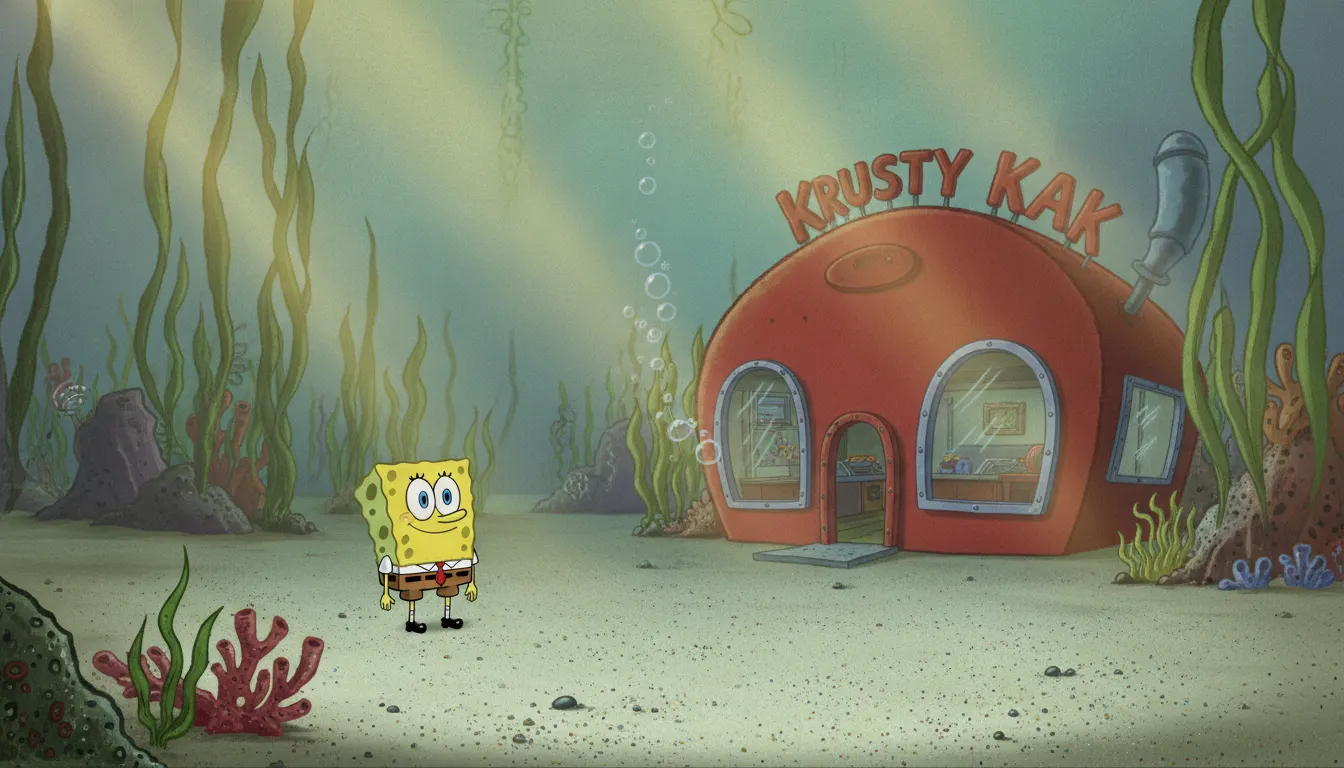
Stephen Hillenburg marine-biologist Nickelodeon underwater comedy. Bikini Bottom kelp forests, Krusty Krab interior, candy underwater palette with painted bubbles.
The moves a human crew would use to get here. Cue applies them for you, and knowing their names is how you ask for a change.
Characters that are accurate to their species (sponge, sea star, octopus, crab) rendered in simplified cartoon form, grounding fantasy in real animal morphology
Buildings and environments constructed from lobster traps, coral formations, and nautical debris - Bikini Bottom has ecological consistency within its cartoon logic
Deep ocean blues and greens in backgrounds with bright primary character colors (SpongeBob yellow, Patrick pink, Squidward teal) for maximum pop contrast
SpongeBob's rectangular sponge body with round holes, big blue eyes, buck teeth, and brown pants - a silhouette recognizable at 10 pixels
Characters' mouths stretch to extreme dimensions for comedic effect - wide open screaming, tiny puckered disgust, full-face smile
Scene transitions using rising bubble formations, matching the underwater setting and providing a consistent visual transition grammar
Wide environmental shots establishing Bikini Bottom's scale using accurate ocean topography - kelp forests, sandy seafloor, distant coral formations
SpongeBob SquarePants premiered on Nickelodeon on May 1, 1999, created by marine science educator and animator Stephen Hillenburg. Hillenburg developed the concept from his unpublished educational comic The Intertidal Zone (1989), which he created while working as a marine science instructor at the Ocean Institute in Dana Point, California. The show has run continuously through 14 seasons as of 2024, with Hillenburg passing away in November 2018 from ALS.
Unlike most animation creators, Hillenburg was a trained marine biologist before becoming an animator (attending CalArts film program in the early 1990s). This background fundamentally shaped the show's visual identity: the settings of Bikini Bottom are grounded in actual ocean floor environments - sea anemones, coral structures, kelp forests - rendered in bright, cheerful cartoon form. The characters are accurate to their species: SpongeBob is a literal sea sponge (not a kitchen sponge, though his rectangular form resembles one), Patrick is a sea star, Squidward is an octopus despite his name, Sandy is a squirrel in an air dome, Mr. Krabs is a crab.
Bikini Bottom's architecture is built from ocean debris and marine structures: the Krusty Krab is a lobster trap, houses are coral formations, the Jellyfish Fields are accurately imagined open-ocean zones. Background designer Kenny Pittenger and art director Nick Jennings developed this visual world across the early seasons.
Hillenburg's design sensibility draws from 1950s-60s UPA animation and mid-century cartoon design. Characters use simple curved shapes with expressive anatomy: SpongeBob's square sponge body with round eyes, Squidward's elongated cylindrical head and four tentacle-legs, Mr. Krabs' compact crab body. The color palette is vivid and saturated - ocean greens and blues in backgrounds, bright character colors standing out clearly.
The show uses traditional cel animation through Season 3 (2001-2004), considered the creative peak by much of the fanbase. Season 4 onward shifted to digital production following Hillenburg's departure (he left after the SpongeBob SquarePants Movie in 2004, returning as showrunner in 2015). The digital era maintained the visual design but altered the line quality slightly.
SpongeBob's cultural reach is extraordinary - frame captures from specific scenes have become among the internet's most-used meme formats: 'Mocking SpongeBob' (Season 2 'Little Yellow Book'), 'Tired SpongeBob', 'Imagination SpongeBob'. The show's visual grammar is embedded in internet communication at a level matching only The Simpsons and possibly Shrek.
Stephen Hillenburg / Nickelodeon · 1999
The creative golden age - 'Band Geeks', 'Chocolate with Nuts', 'Pizza Delivery' - cel animation at peak
Stephen Hillenburg (director) / Paramount · 2004
Theatrical film intended as series finale, with cel animation of exceptional quality
Stephen Hillenburg · 1989
Unpublished educational comic that directly preceded SpongeBob's development
Paul Tibbitt / Paramount · 2015
Second theatrical film mixing 2D animation with live-action sequences
Nickelodeon Animation Studio · 2021
Spinoff applying the Hillenburg aesthetic to a CG-animated preschool prequel
Nickelodeon Animation Studio · 2021
SpongeBob spinoff expanding the Bikini Bottom visual world to Patrick's family TV show conceit
Klasky-Csupo / Nickelodeon · 1991
Nickelodeon contemporary using the children's animation flat-color approach SpongeBob joins
A Look is not a filter. It is a set of stored decisions the pipeline reads before it makes a single frame, so two videos in the same Look actually match.