Hey Arnold!
Craig Bartlett · 1996
Nickelodeon series; urban pastel animation with emotional realism
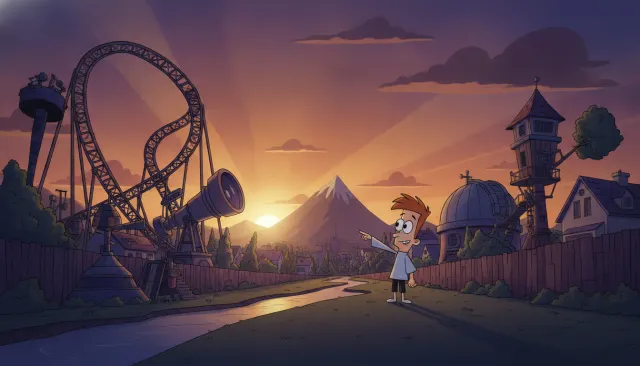
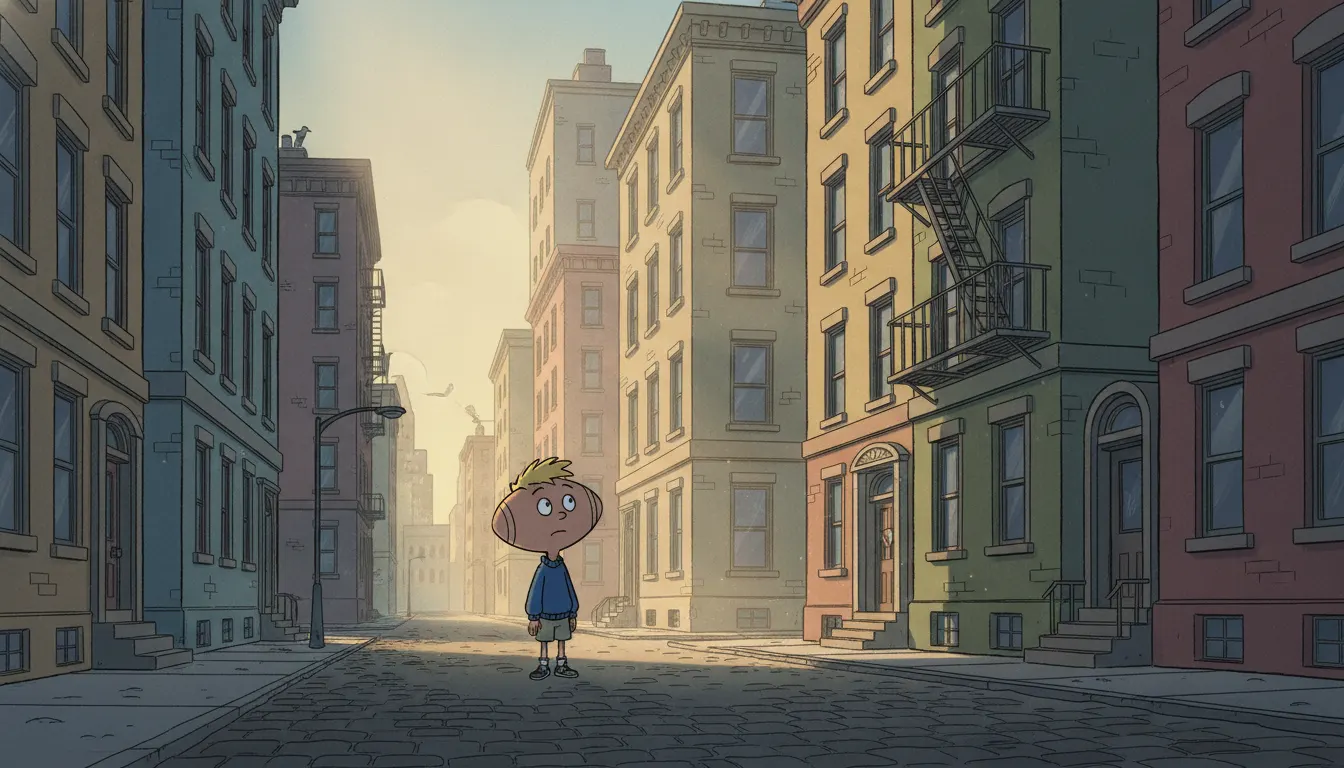
Craig Bartlett Hey Arnold urban-warmth city. Brownstone neighborhood, jazz-tinged 90s palette, football-head character design, boarding-house warmth.
The moves a human crew would use to get here. Cue applies them for you, and knowing their names is how you ask for a change.
Character heads shaped as unusual three-dimensional geometric forms (football heads, oversized rounds, elongated ovals) suggesting volume rather than flat illustration.
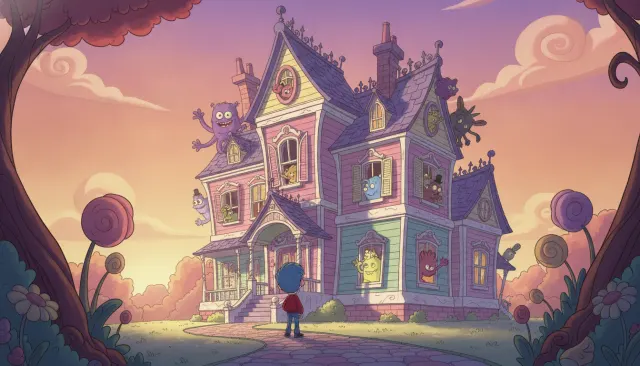
Dusty brick reds, sage greens, dirty whites, and pale blues replacing the high-saturation norm of 1990s Nickelodeon - palette serves emotional realism.
City environments with architectural specificity: Victorian brownstones, corner stores, graffiti murals, fire escapes, and topographically consistent city blocks.
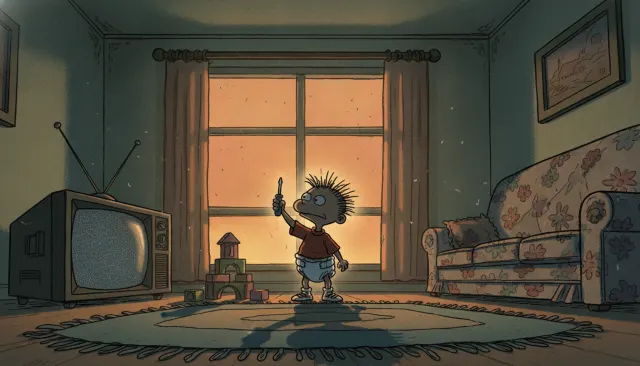
Frequent use of golden-hour, dusk, and nighttime lighting for emotional scenes - unusual for children's TV animation of the era.
Character faces designed for subtle emotional gradations - worry, longing, resignation - rather than broad comic exaggeration.
Background characters and supporting cast reflect urban ethnic and cultural diversity, with environmental design (signs, architecture, dress) to match.
Heavy use of medium close-up and close-up compositions for emotional beats, creating visual intimacy consistent with the show's tonal ambitions.
Hey Arnold! is an animated television series created by Craig Bartlett that aired on Nickelodeon from October 7, 1996 to June 8, 2004 (with the theatrical film Hey Arnold!: The Movie in 2002 and the television film Hey Arnold!: The Jungle Movie in 2017). The show is set in a fictional composite American city loosely based on Seattle, Brooklyn, and other urban environments, and its visual style represents one of the most distinctive urban aesthetics in American animated television.
Craig Bartlett developed Hey Arnold! from characters he created while working as a clay animator on Pee-wee's Playhouse. The show's visual language was shaped by his background in sculpture and three-dimensional art - characters have heads shaped like unusual geometric forms (Arnold's football-shaped head, Harold's round face, Nadine's elongated form) that reference sculptural volume more than flat illustration. This gives the show a sense of physical presence unusual in 1990s TV animation.
The show's city is its most distinctive visual element. The production team, working with art director Dima Malanitchev, developed a detailed urban environment combining brownstone apartment architecture, basketball courts, corner bodegas, and city parks. The city is ethnically and culturally diverse in a way rare for 1990s animation, and the environments reflect this: shops have signs in multiple languages, graffiti appears on walls, and the architectural density of the city is rendered with unusual care.
Key environment features: Arnold's boarding house is a Victorian brownstone with multiple floors and hidden rooftop access; Sunset Arms Boarding House becomes an anchor point around which the city's geography organizes. The city maintains topographic consistency across episodes, creating a sense of real place.
The color palette is notably muted for a Nickelodeon production of the era - the network's other flagship shows (Rugrats, Ren & Stimpy, Rocko's Modern Life) favored high-saturation, almost garish colors. Hey Arnold! uses dusty pastels and urban tones: faded brick reds, sage greens, dirty whites, warm grays, and pale sky blues. This palette reflects the show's tonal ambition - it aimed for emotional realism, and a more restrained color vocabulary served that goal.
The show dealt with adult themes - parental abandonment, grief, poverty, bullying, loneliness - with unusual directness for children's television. The visual tone matched: character expressions were designed for nuance rather than broad comic effect, and staging favored mid-shots and close-ups that created emotional intimacy. Late-evening and nighttime lighting was used frequently, giving episodes a moody, atmospheric quality rare in 1990s children's animation.
Hey Arnold! influenced the wave of 2000s and 2010s animation that took urban American settings and emotional realism seriously. Its visual model of muted pastels, diverse urban environments, and three-dimensional character forms anticipated shows like Over the Garden Wall, Hilda, and the broader 'empathy animation' tradition that emerged from Cartoon Network and Netflix in the 2010s.
Craig Bartlett · 1996
Nickelodeon series; urban pastel animation with emotional realism
Tuck Tucker · 2002
Theatrical film expanding the show's urban world to citywide stakes
Raymie Muzquiz · 2017
TV film closure; resolves Arnold's parental mystery with expanded world
Arlene Klasky, Gábor Csupó, Paul Germain · 1991
Nickelodeon contemporary using similarly muted but more chaotic palette
Emily Kapnek · 2000
Nickelodeon series following Hey Arnold's emotional realism for slightly older viewers
Luke Pearson · 2018
Netflix successor in the emotional-realism urban-suburban animation tradition
A Look is not a filter. It is a set of stored decisions the pipeline reads before it makes a single frame, so two videos in the same Look actually match.