Phineas and Ferb
Dan Povenmire & Jeff 'Swampy' Marsh · 2007
Disney Channel series; definitive geometric-suburban children's animation
Dan Povenmire and Jeff Marsh Disney Channel summer-vacation invention comedy. Highly stylized triangle / rectangle character geometry, Tri-State suburb palette.
The moves a human crew would use to get here. Cue applies them for you, and knowing their names is how you ask for a change.
Character heads designed as pure geometric forms - Phineas's right-triangle profile, Ferb's thin rectangle - pushed further than any contemporary children's animated series.
Entire main cast built from a consistent geometric vocabulary, creating visual coherence across hundreds of episodes and instantly readable character differentiation.
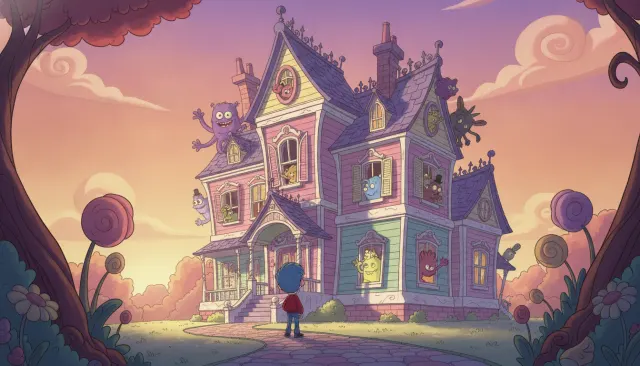
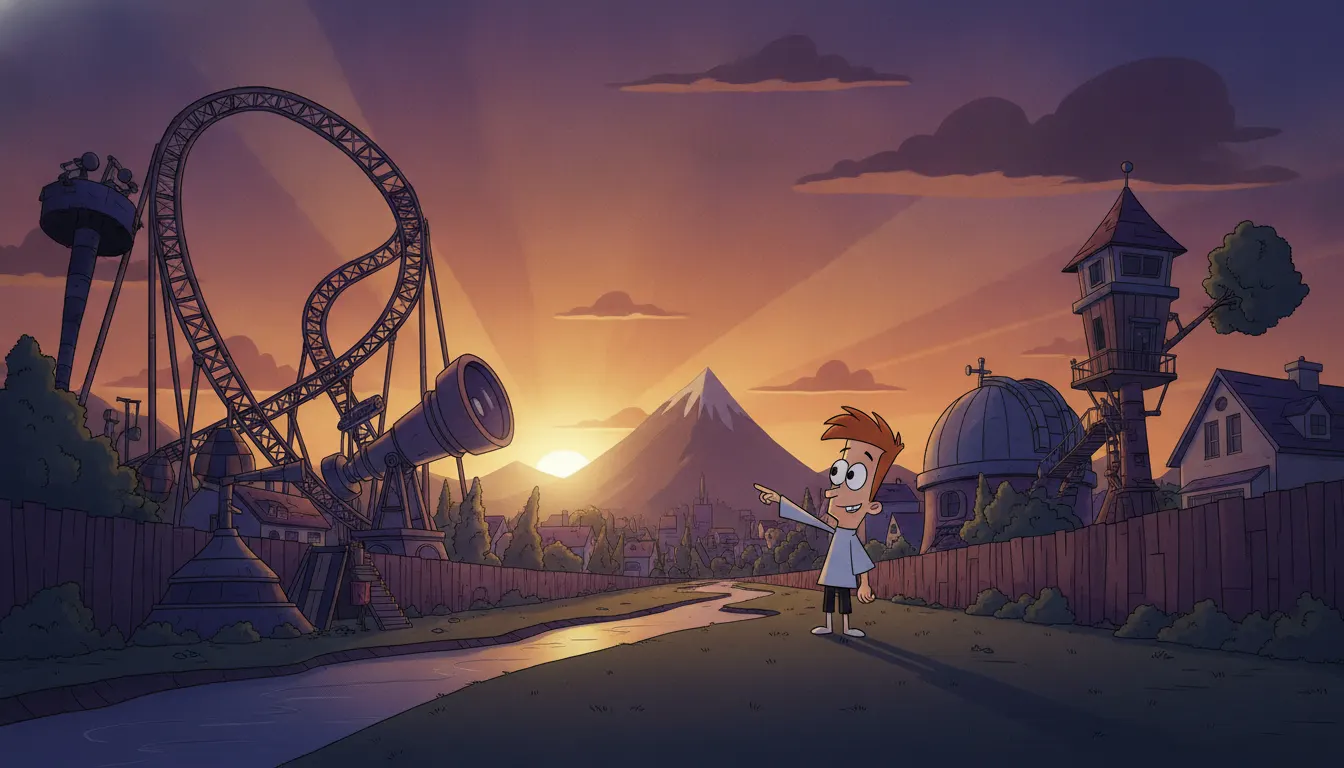
The Flynn-Fletcher backyard and Danville rendered as pure graphic shorthand - simplified rectangles, ellipses, and color fields standing in for suburban architecture and landscape.
Each original song maintains the show's design language while employing distinct visual staging, palette, and animation approach - 200+ self-contained visual music units.
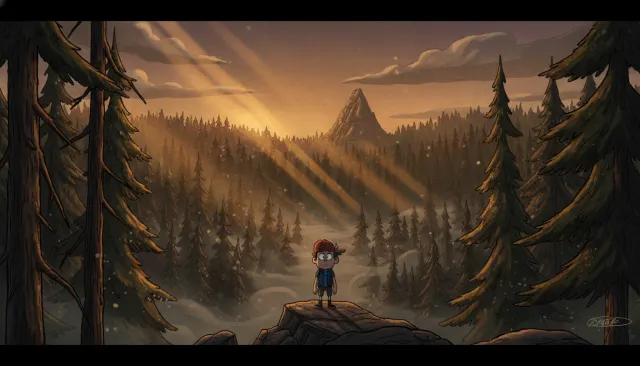
Bright greens, sky blues, warm amber skin tones, and saturated accents against clean backgrounds - a palette signaling optimism and summer energy.
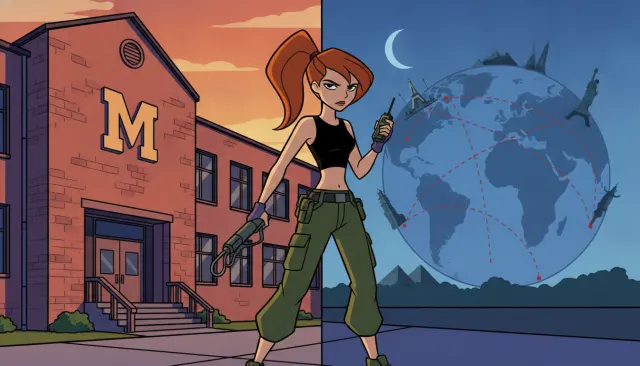
The show's twin-narrative structure (backyard invention / Perry vs. Doofenshmirtz) uses consistent environmental color coding to make parallel editing immediately clear.
Maximum emotional expressiveness achieved with minimum design complexity - characters with triangle heads convey as much nuance as more detailed animated characters.
Phineas and Ferb is an animated musical comedy series created by Dan Povenmire and Jeff 'Swampy' Marsh that aired on Disney Channel from August 17, 2007 to June 12, 2015, with a feature film (Phineas and Ferb the Movie: Candace Against the Universe) released on Disney+ in 2020. The series follows stepbrothers Phineas Flynn and Ferb Fletcher, who spend their summer building impossibly ambitious inventions, while their pet platypus Perry moonlights as a secret agent fighting the inept Dr. Doofenshmirtz. Its visual style is one of the most deliberately and inventively geometric in American children's television animation.
Dan Povenmire's background as an animator and storyboard artist on The Simpsons, Family Guy, and Rocko's Modern Life gave him extensive experience in flat, graphic 2D animation aesthetics. The visual philosophy of Phineas and Ferb takes this flat graphic sensibility to an intentional extreme: character designs built from pure geometric forms, simplified to the point of abstraction, while maintaining complete expressiveness.
Phineas's triangular head (literally a right triangle in profile) is the series' most discussed design choice. It was a deliberate statement: if the character is likable and expressive enough, audiences will accept any geometric form as a character. This proved correct.
The entire main cast uses a consistent geometric design language: Phineas is a triangle, Ferb is a rectangle (tall and thin), Candace is an elongated oval, and secondary characters follow similar systems. This geometric consistency creates a visual coherence across the show's 222 episodes that makes the character ensemble immediately readable regardless of context.
This approach draws on the UPA studio's 1950s modernist design philosophy while pushing it further into pure abstraction. The designs are more extreme than Foster's Home or The Powerpuff Girls - closer to corporate logo design than character illustration.
The Flynn-Fletcher backyard is the show's primary stage, designed as an idealized American suburban space: flat lawn, wooden fence, swimming pool, neighboring houses. The environment is stylized with the same geometric reductiveness as the characters - fences as pure rectangles, trees as simple ellipses, the suburban infrastructure as a graphic shorthand.
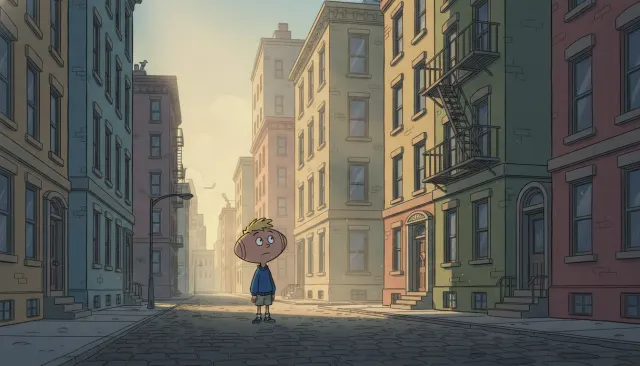
Danville, the fictional city, occasionally appears in larger establishing shots using the same graphic-background treatment. The color palette is warm and saturated: bright greens, sky blues, warm skin tones, and the rich navy of Dr. Doofenshmirtz's OWCA nemesis uniform.
The show features an original song in nearly every episode - one of the highest densities of original music in children's television history. Each song employs a different visual aesthetic while maintaining the show's overall design language, and the musical sequences are designed as self-contained visual units. Povenmire and Marsh's songwriting produced over 200 original songs across the run.
The show won multiple Emmy Awards and is one of the highest-rated Disney Channel series of all time. Its geometric design approach influenced subsequent Disney and Nickelodeon animation and remains a reference for design-forward children's animation.
Dan Povenmire & Jeff 'Swampy' Marsh · 2007
Disney Channel series; definitive geometric-suburban children's animation
Bob Bowen · 2020
Disney+ feature film; expanded scope in the same visual language
Dan Povenmire & Jeff 'Swampy' Marsh · 2016
Povenmire/Marsh successor series using evolved geometric design approach
Joe Murray · 1993
Povenmire storyboard credit; shared flat-graphic sensibility from which the style evolved
Craig McCracken · 2004
Contemporary Cartoon Network series sharing geometric character design philosophy
A Look is not a filter. It is a set of stored decisions the pipeline reads before it makes a single frame, so two videos in the same Look actually match.