Over the Garden Wall
Patrick McHale · 2014
Cartoon Network miniseries; definitive American folk-horror animation in autumn New England setting
Pat McHale Over the Garden Wall autumnal storybook. New England fall-forest folklore, gas-lamp warm palette, vintage-illustration character design.
The moves a human crew would use to get here. Cue applies them for you, and knowing their names is how you ask for a change.
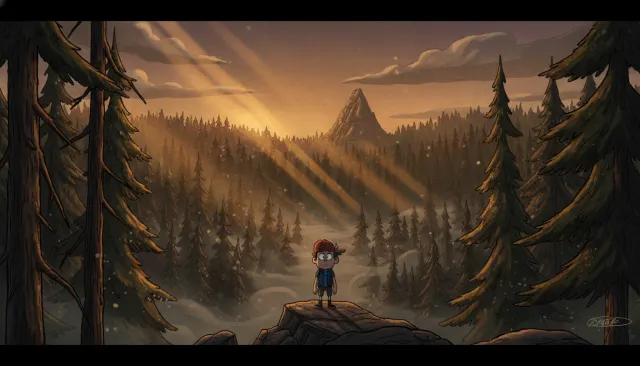
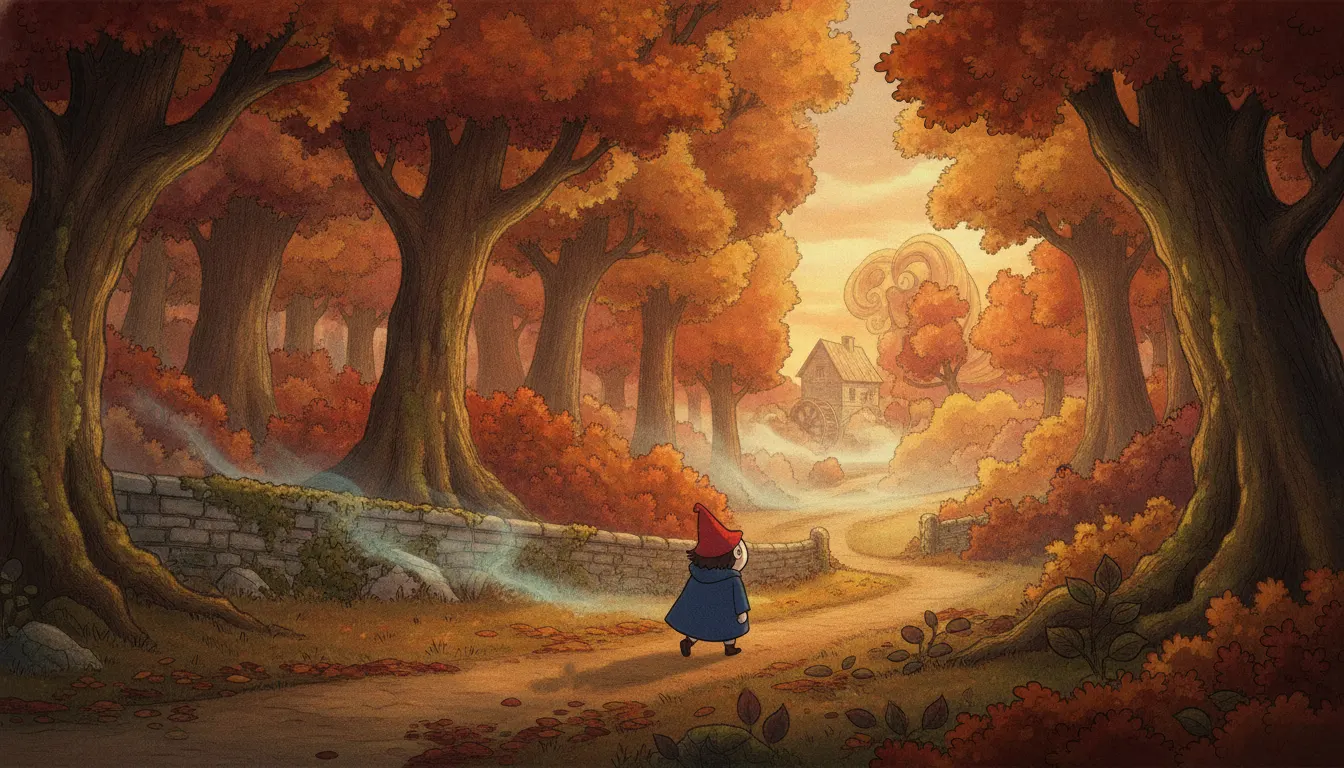
Deep autumnal colors rendered with the slightly muted, aged quality of 19th-century chromolithography - as if filtered through antique printing.
Forest environments with unusual botanical specificity - foliage patterns more detailed and varied than standard animated backgrounds, creating genuine forest depth.
Character proportions and costumes referencing turn-of-the-century American figure drawing - conical hats, folk costume, archaic accessories as instantly iconic forms.
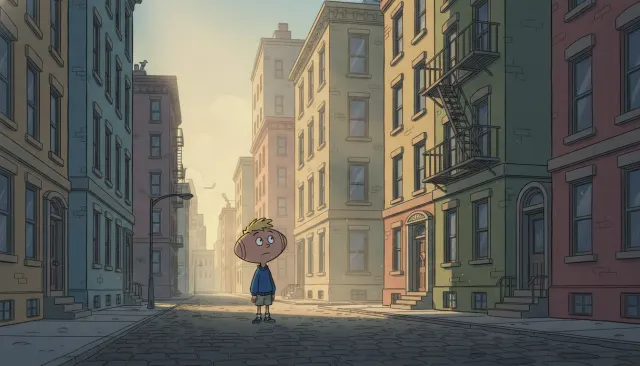
Mill towns, covered bridges, saltbox farmhouses, and village churches rendered with architectural authenticity to late-19th-century New England vernacular.
The Beast visualized as a darkness-form drawing on 19th-century illustrated shadow-monster tradition - presence and implication over explicit horror.
Jed Kaplan and Christopher Thines' score uses period-appropriate folk instrumentation as environmental sound as much as narrative underscore.
Every environment, regardless of scene requirements, maintains the deep autumn palette and seasonal emotional register - warmth and decay inseparable.
Over the Garden Wall is a 10-part animated miniseries created by Patrick McHale that aired on Cartoon Network in November 2014. Despite its short length, the series has become one of the most critically acclaimed and culturally influential American animated works of the 2010s. Set in a mythical autumn woodland realm called 'The Unknown,' it follows two stepbrothers - Wirt and Greg - attempting to find their way home, encountering folk tale characters and supernatural menace along the way.
Patrick McHale worked as a writer and creative director on Adventure Time before developing Over the Garden Wall from his short film Tome of the Unknown (2013). The visual development drew primarily on three sources: 19th-century American folk art and illustration (particularly the work of Maxfield Parrish and Arthur Rackham), New England autumn landscape painting, and early 20th-century American newspaper comic strips and children's book illustration.
Production designer Nick Cross and the art department created a visual world governed by these references. The result is unlike anything else in American television animation: a visual language simultaneously nostalgic and strange, warm and menacing, recognizably American and somehow outside specific time.
The series' most immediately distinctive quality is its color palette: deep, saturated autumn colors rendered with unusual richness for an animated TV production. Burnt oranges, deep crimsons, chocolate browns, forest greens darkening to near-black, and the specific muted gold of late-October light. The Unknown is perpetually autumn, and every environment is saturated with the season's emotional register - beauty, decay, nostalgia, and unease.
The color work references the specific quality of 19th and early 20th-century chromolithography and book illustration: rich but slightly muted, as if filtered through the slight discoloration of antique printing. This aged quality gives the series its most haunting quality - it feels genuinely old.
Character designs blend the clean, readable silhouettes of classic American comic strip illustration with the slightly archaic proportions and costume of turn-of-the-century American figure drawing. Wirt's conical red hat, Greg's teapot costume, and the woodsman's lantern are all designed as immediately iconic forms.
Environment design features dense, painterly forest interiors with complex foliage patterns - more botanically detailed than most animated backgrounds - alongside period-specific New England architecture: covered bridges, mill towns, saltbox farmhouses, and village churches.
The series draws explicitly on the visual grammar of folk horror: the forest as an inherently threatening space, the monster hidden within familiar pastoral settings, the encounter with supernatural forces that observe older rules than contemporary ones. The Beast, whose visual design references the shadow-form tradition of 19th-century illustrated children's literature, is among the most genuinely frightening characters in American children's animation.
The series won four Emmy Awards and is regularly cited by animation creators as a formative influence. Its autumn-forest aesthetic directly influenced subsequent American animation's willingness to embrace genuine menace and folk-horror tonality within a children's register.
Patrick McHale · 2014
Cartoon Network miniseries; definitive American folk-horror animation in autumn New England setting
Patrick McHale · 2013
Short film prototype that led directly to the miniseries
Pendleton Ward · 2010
McHale's formative show; shares visual sensibility from a different tonal angle
Luke Pearson · 2018
Netflix animated series in the same atmospheric folk-illustration tradition
Alex Hirsch · 2012
Disney Channel contemporary sharing woodland mystery and genuine menace aesthetic
Walt Disney · 1940
Disney's 'Night on Bald Mountain' segment shares the dark folk-supernatural visual tradition
A Look is not a filter. It is a set of stored decisions the pipeline reads before it makes a single frame, so two videos in the same Look actually match.