Billy's Balloon
Don Hertzfeldt · 1998
Early short establishing stick figure aesthetic; children tormented by sentient balloons
Don Hertzfeldt minimalist stick-figure indie animation. World of Tomorrow, Rejected, Its Such a Beautiful Day. Cosmic-existential humor, paper background.
The moves a human crew would use to get here. Cue applies them for you, and knowing their names is how you ask for a change.
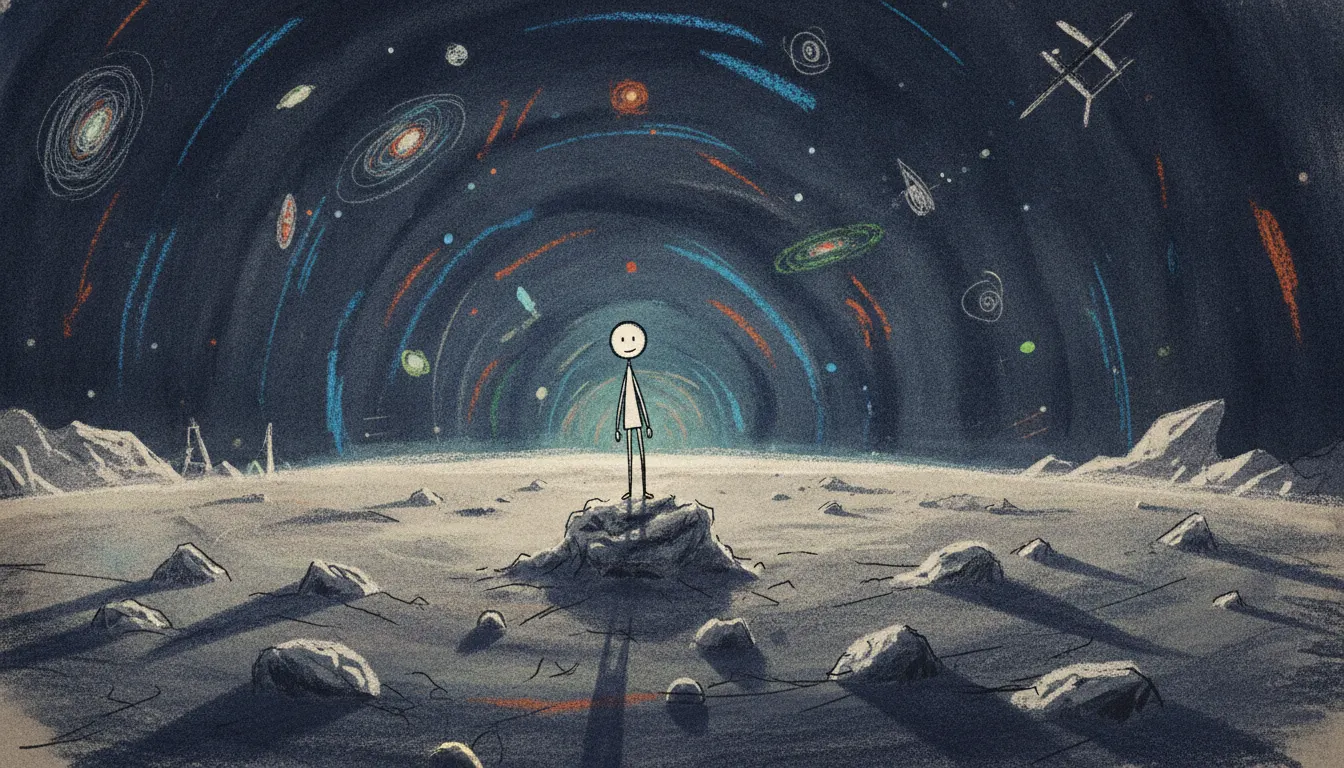
Round-headed figures with single-line limbs and dot eyes - no detail beyond what is strictly necessary for emotional expression, forcing audience projection.
Stick figure animation layered over real-world footage of landscapes and architecture, creating emotional dissonance between the crude and the photographic.
Narration and internal monologue delivered as hand-written text appearing on screen, often simultaneously with or replacing spoken dialogue.
Shooting on physical film preserves subtle paper texture, pencil weight variation, and gate weave that digital-only production cannot replicate.
Narratives begin with simple, almost childlike premises and methodically escalate to psychological or meta-textual collapse.
Palette restricted to near-white backgrounds, black line work, and occasional flat color fields - negative space is used as an emotional tool.
In later works, the physical film itself appears to burn, warp, or tear as a narrative device - the medium becomes the metaphor.
Don Hertzfeldt is an American independent animator whose hand-drawn stick figure aesthetic has become one of the most recognizable and emotionally powerful visual languages in animation. Working almost entirely alone, Hertzfeldt has spent his career from the mid-1990s to the present producing shorts and features that oscillate between absurdist comedy and profound existential melancholy - all rendered with deliberately crude, minimal character designs.
Hertzfeldt began making films as a teenager in Santa Barbara, California, shooting on 35mm film using a vintage Bolex camera. His early shorts like Billy's Balloon (1998) established his aesthetic: stick figures with round heads, single-line limbs, and no facial features beyond dot eyes and a curved mouth. The crudeness is deliberate. Hertzfeldt has spoken about the power of simplicity - the less visual information a character carries, the more the audience projects their own emotions onto it. This is the foundational principle of the style.
Rejected (2000) brought international attention. Framed as a collection of rejected commercial pitches, it escalates from absurdist non-sequiturs ('My spoon is too big!') to a meta-breakdown of the film itself. The short was nominated for the Academy Award for Best Animated Short Film and became a defining artifact of early internet animation culture. The contrast between childlike visuals and adult psychological distress became Hertzfeldt's signature.
Beginning with Everything Will Be OK (2006), Hertzfeldt developed a longer-form narrative style with his 'Bill trilogy' (completed as It's Such a Beautiful Day in 2012). These films retain the stick figure characters but layer them over experimental live-action footage of fields, highways, and suburban landscapes. The dissonance between crude drawing and beautiful photography creates an intense emotional texture. The protagonist Bill navigates memory loss, illness, and mortality with a deadpan precision that became among the most affecting work in any animation genre.
World of Tomorrow (2015) and its sequels pushed the aesthetic into science fiction. Emily Prime, a toddler, engages with her future cloned self in a universe of simple geometric shapes, pastel color fields, and Hertzfeldt's hand-lettered on-screen text. The sequels World of Tomorrow Episode Two: The Burden of Other People's Thoughts (2017) and Episode Three: The Absent Destinations of David Prime (2022) expanded into increasingly abstract visual territory while preserving the foundational stick figure vocabulary.
All Hertzfeldt films are hand-drawn on physical paper and scanned, preserving subtle paper texture and pencil weight variation. The style is widely influential in web animation, indie zine culture, and DIY creative contexts where labor-intensive production is impossible. Creators borrow it for its paradox: maximum emotional resonance with minimum visual investment.
Don Hertzfeldt · 1998
Early short establishing stick figure aesthetic; children tormented by sentient balloons
Don Hertzfeldt · 2000
Academy Award-nominated breakthrough; absurdist fake commercials escalating to meta-collapse
Don Hertzfeldt · 2006
First Bill trilogy installment; live-action compositing and existential illness narrative
Don Hertzfeldt · 2012
Compiled Bill trilogy feature; memory, mortality, and transcendence
Don Hertzfeldt · 2015
Academy Award-nominated sci-fi short; Emily Prime and the cloned future self
Don Hertzfeldt · 2017
Sequel expanding into pastel geometry and fragmented memory
Don Hertzfeldt · 2022
Most visually abstract entry; time travel and recursive identity
A Look is not a filter. It is a set of stored decisions the pipeline reads before it makes a single frame, so two videos in the same Look actually match.