Flickr smoke photography group / Graham Jeffrey tutorials
Graham Jeffrey · 2006-2010
Foundational technical guides that established the canonical smoke photography setup and sparked a global community practice
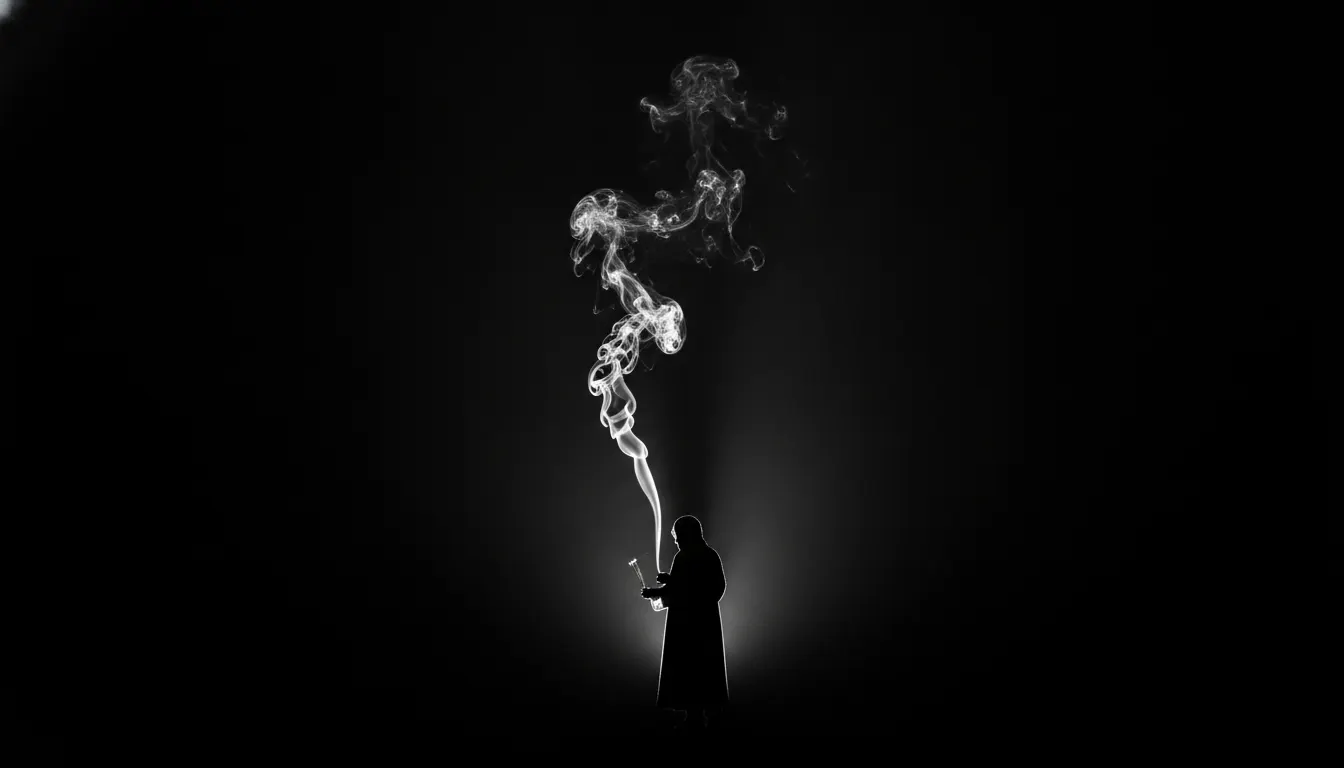
Isolated smoke tendril against black. Backlit incense or cigarette curl, organic ribbon shape, high-contrast white-on-black, abstract form study.
The moves a human crew would use to get here. Cue applies them for you, and knowing their names is how you ask for a change.
Black background sufficiently distanced from strobe lights to receive zero exposure, producing the jet-black field that makes tendril forms read as pure form.
Two speedlights positioned perpendicular to the optical axis, illuminating the smoke's profile to maximize edge contrast and reveal internal tendril structure.
Focusing and timing the capture to catch the zone where smooth laminar flow breaks into complex turbulent structure - the most visually rich region.
Post-capture hue assignment to the neutral gray smoke - blue, orange, purple, or gradient - using selective color or hue-shift tools in Lightroom or Photoshop.
Inverting the black-background negative to produce a white-background version with dark gray smoke, or white smoke on white for a soft-light variant.
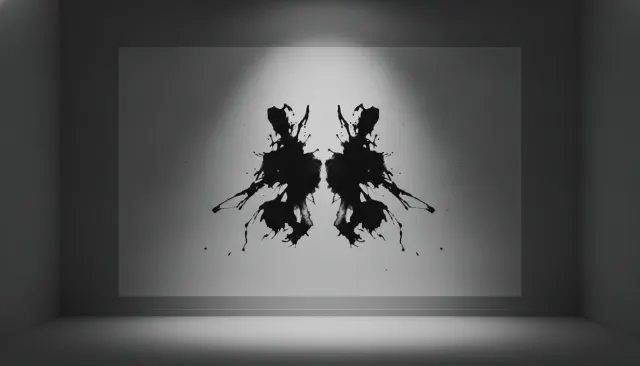
Horizontally mirroring the tendril form and blending it with the original, producing bilateral symmetric patterns that reference Rorschach forms.
Stacking two or three smoke captures in screen blend mode, producing complex overlapping tendril networks.
Smoke photography isolates the ephemeral forms of rising smoke against a pure black background, revealing structures of extraordinary complexity - turbulent columns, laminar tendrils, vortex rings, and chaotic transitions from laminar to turbulent flow - that are invisible to the naked eye but legible in the freeze-frame of a high-speed strobe photograph.
The specific technique for isolated tendril smoke photography was popularized and systematized by UK photographer Graham Jeffrey (active 2006-2010) and Turkish photographer Mehmet Ozgur (active 2007-2012), both of whom published extensive technical guides and Flickr galleries that became the reference for the community. The canonical setup is: a joss stick or incense cone as the smoke source, a pure black background approximately 60-90cm behind the subject, two speedlights positioned at 90-degree angles to the optical axis (so they illuminate the smoke from the sides without hitting the background), a black background on the lens hood to prevent flare, and a manual focus point at the smoke column.
The lateral strobe placement is the key to the look: side-lighting creates maximum edge contrast in the translucent smoke column, revealing fine tendril structure invisible with front or back lighting. The pure black background requires no post-processing exposure reduction - if the background is far enough from the side lights and the room is dark, the background falls naturally to zero exposure.
The forms revealed by smoke photography are expressions of laminar-to-turbulent flow transition in fluid dynamics. The initial smoke column from a joss stick rises in laminar flow - smooth, parallel streamlines - for approximately 3-7 centimeters before breaking into the Kelvin-Helmholtz instability that initiates turbulence. The transition zone produces the most photographically complex forms: vortex rings, mushroom shapes, folded sheets, and helical tendrils.
The tendril forms are not random but mathematically determined by initial conditions, convection currents, and the Navier-Stokes equations governing fluid motion. Slow-motion video of smoke columns reveals that many apparently frozen tendril forms are in rapid rotational motion, making the still photograph a temporal snapshot of continuous dynamic behavior.
The standard post-processing workflow for smoke photography involves: adjusting contrast to push the background to absolute black, applying selective color or hue/saturation adjustments to shift the neutral gray smoke into color (blue, orange, purple) for visual interest, and occasionally inverting the image to produce white smoke on white background or black smoke on white. The colorization step is entirely digital and not visible in the original capture.
Graham Jeffrey · 2006-2010
Foundational technical guides that established the canonical smoke photography setup and sparked a global community practice
Mehmet Ozgur · 2007-2012
Large body of technically refined smoke photography that defined the color-shifted tendril aesthetic widely referenced by subsequent practitioners
various / 500px and Flickr communities · various 2008-2015
Thousands of practitioners applying the Jeffrey-Ozgur method, producing the body of work that made the look recognizable as a photographic genre
various physics visualization labs · 2010s
High-speed camera documentation of smoke column behavior revealing the temporal dynamics beneath the still-photograph aesthetic
various commercial photographers · 2010s-present
Adoption of the isolated tendril look in perfume and incense commercial photography for editorial and product imagery
various / Processing and Unity communities · 2015-present
Digital fluid simulation producing smoke-analogous tendril forms without physical combustion, extending the aesthetic to video and interactive contexts
A Look is not a filter. It is a set of stored decisions the pipeline reads before it makes a single frame, so two videos in the same Look actually match.