BBC Blue Planet II
2017
deep-sea bioluminescence sequences using experimental low-light rigs
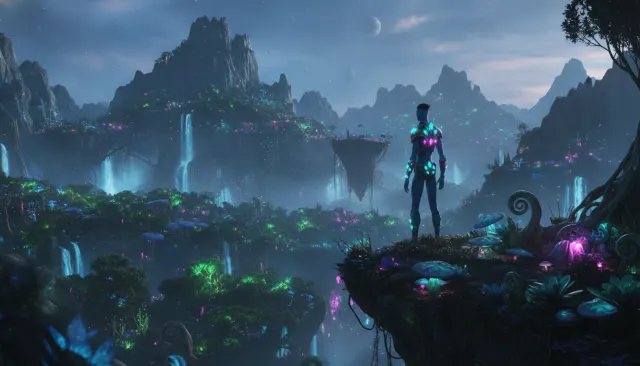
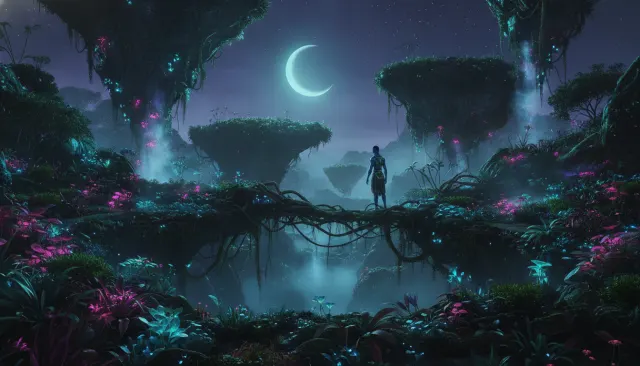
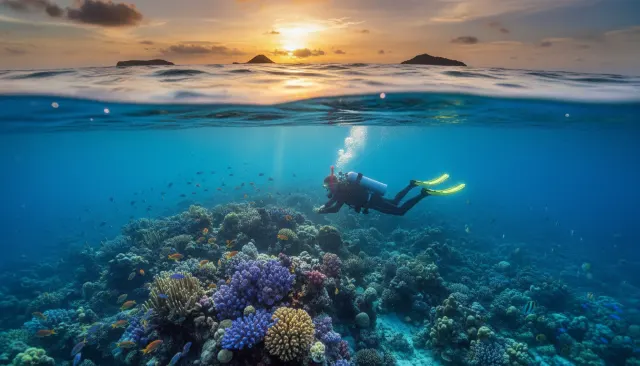
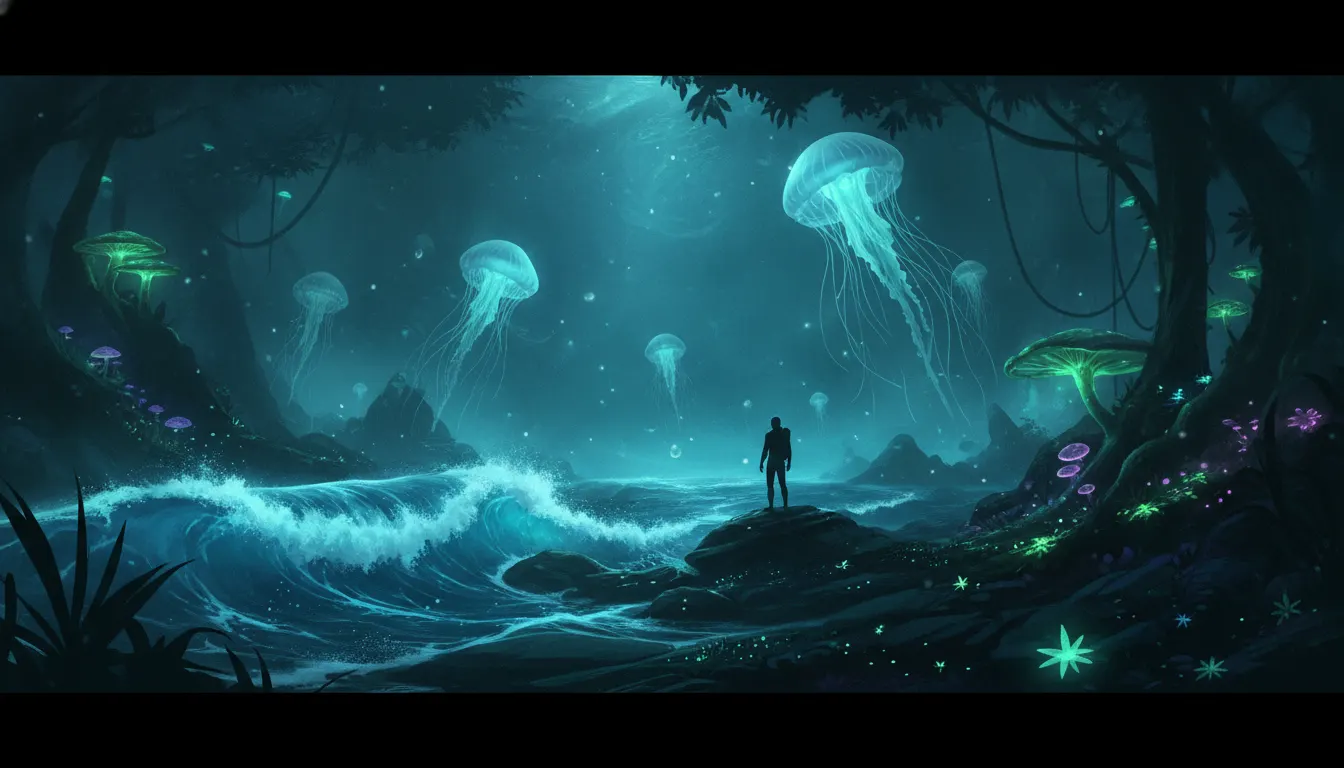
Bioluminescent glow low-light aesthetic. Deep-ocean or jungle scene illuminated only by glowing organisms, plankton wave, fungus, jellyfish, cool blue-green ambient.
The moves a human crew would use to get here. Cue applies them for you, and knowing their names is how you ask for a change.
absolute black base exposure: underexpose background by 4-6 stops, leaving only emissive light sources visible
based color in 470-530 nm blue-green range for marine organisms; 550-600 nm yellow-green for fireflies
emissive layer + wide Gaussian blur pass on Screen blend mode for bloom spread
slow sine-wave opacity modulation at 0.3-1.5 Hz simulates biological rhythm
Bioluminescence is the production and emission of cold light by living organisms through a chemical reaction typically involving a luciferin substrate oxidized by the enzyme luciferase. It evolved independently in at least 94 distinct lineages - including deep-sea fish (anglerfish lures, viperfish photophores), ctenophores, dinoflagellates such as Noctiluca scintillans (responsible for the 'blue tide' phenomenon in coastal waters), Aequorea victoria jellyfish (source of the GFP gene used throughout biomedical research), and terrestrial organisms including fireflies (Lampyridae, using benzothiazole luciferin) and bioluminescent fungi in Panellus stipticus and Mycena chlorophos.
The biological light is emission-based: it emanates from within an organism rather than reflecting external illumination. Colors cluster around 470–530 nm (blue-green) in marine organisms, constrained by the light-transmission properties of seawater; terrestrial examples like fireflies emit yellow-green at 550–600 nm. The background is always near-absolute darkness - deep ocean (200+ metres), cave environments, or nocturnal open fields - which creates a profound contrast ratio impossible with reflected light. The glow is soft and diffuse when produced by surface bioluminescence (dinoflagellate waves), or point-source and directional when coming from individual photophores.
Documentary cinematographers pioneering this aesthetic include Doug Allan and Alastair Fothergill for BBC's 'Blue Planet' (2001) and 'Blue Planet II' (2017), which used ultra-low-light cameras (Nikon Z9, specialized deep-sea housings) to capture bioluminescence in situ. Louie Schwartzberg's 'Fantastic Fungi' (2019) brought bioluminescent mushroom footage to theatrical audiences. The James Cameron-supervised underwater photography for 'Avatar: The Way of Water' (2022) - and Pandora's bioluminescent biome design established by the original 'Avatar' (2009) with the Lightstorm/Weta Digital team - brought the aesthetic into mainstream cinematic design.
The discovery of GFP (green fluorescent protein) from Aequorea victoria jellyfish by Osamu Shimomura (Nobel Chemistry, 2008) has made bioluminescence central to modern biomedical research imaging: GFP tagging allows scientists to track protein expression and cellular processes in living organisms under fluorescence microscopes. This research application has given bioluminescent imagery a secondary connotation of scientific precision and biological intelligence - distinct from the purely aesthetic deep-sea context. BRET (bioluminescence resonance energy transfer) assays and luciferase reporter gene constructs appear in pharmaceutical research documentation, adding another institutional visual tradition to the form.
In post-production, bioluminescence is recreated using luminosity-masked glow compositing: a base emissive layer at near-black, with multiple softened bloom passes in cyan-teal (#00E5D0) or blue (#0077FF) applied with Screen or Add blend modes. Particle systems simulate dinoflagellate drift; animated noise maps control pulsing rhythms. Practical photography uses UV-reactive pigments and LED gels in a darkened studio environment. Software tools including Trapcode Particular (for particle drift), After Effects Optical Flares (for point-source bloom), and DaVinci Resolve's node-based color grading (luminosity keys isolating emissive areas) are the standard production toolkit.
2017
deep-sea bioluminescence sequences using experimental low-light rigs
2022
CGI bioluminescent ocean ecosystem, Cameron/Weta Digital
time-lapse bioluminescent mushroom sequences
2001
pioneering documentary bioluminescence footage, Doug Allan photography
2009
Pandora biome design with bioluminescent ground cover, James Cameron / Weta Digital
2007
ethereal blue glow aesthetic widely referenced in music video design
2013
widely circulated as aesthetic reference
2016
establishing still photography benchmark
A Look is not a filter. It is a set of stored decisions the pipeline reads before it makes a single frame, so two videos in the same Look actually match.