Avatar
2009
dir. James Cameron, Weta Digital, VFX sup. Joe Letteri, prod. design Rick Carter
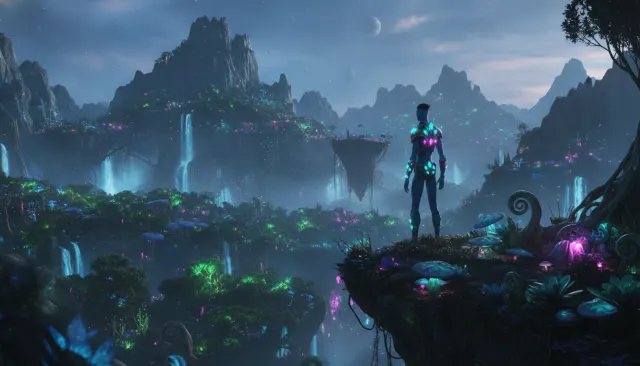
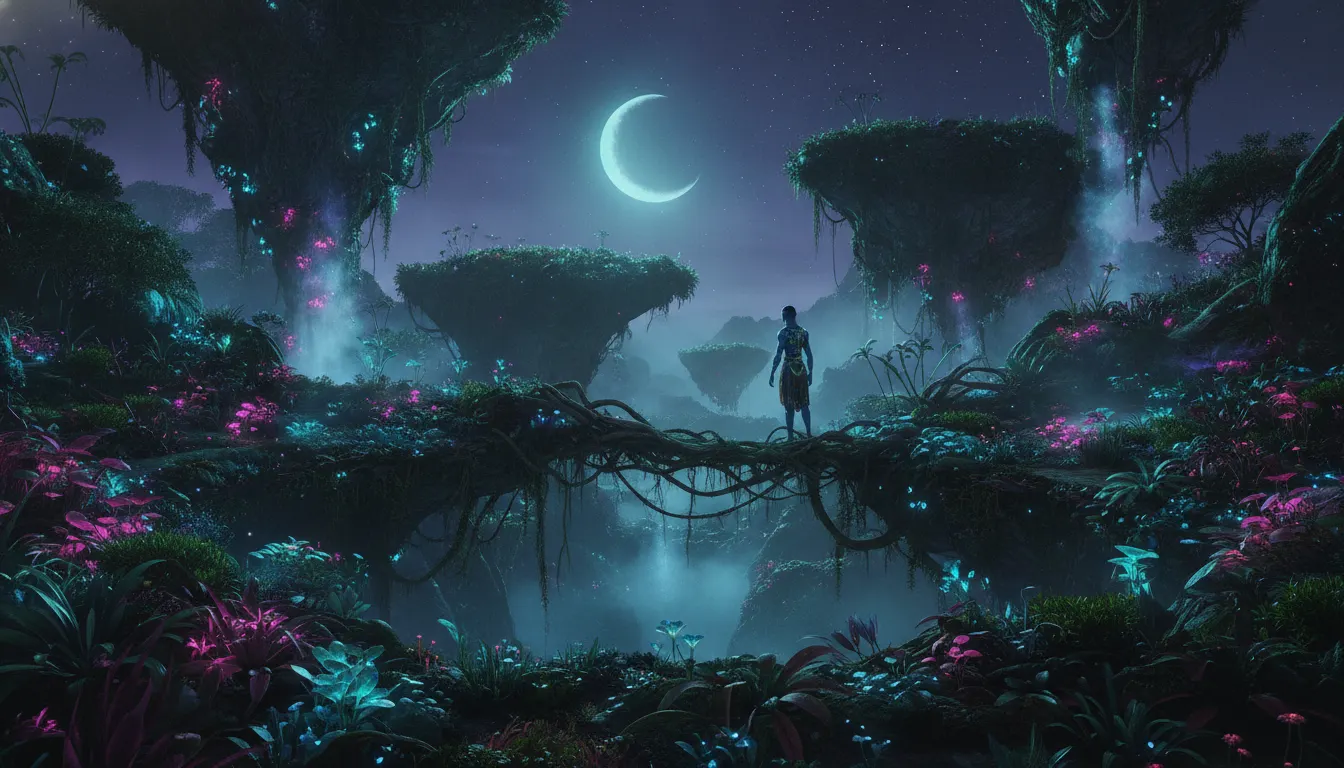
Avatar Pandora photoreal VFX. Bioluminescent jungle, Navi photoreal facial mocap, Weta water simulation showcase.
The moves a human crew would use to get here. Cue applies them for you, and knowing their names is how you ask for a change.
scale characters (Tulkun ocean sequences)
time virtual production compositing (Simulcam) ensuring CGI environment holds under photographic scrutiny
frame-rate reference capture (48-60fps) for underwater sequences to inform physics simulation
layer depth compositing with practical camera artifacts (lens flare, depth-of-field) baked into render passes
The daytime world of Pandora as realized in Avatar (2009) and expanded in Avatar: The Way of Water (2022) represents the high-water mark of synthetic environment photorealism at theatrical scale. James Cameron's production began pre-production in 1996 and waited for rendering technology to mature before beginning principal photography in 2007. The result, delivered by Weta Digital under visual effects supervisor Joe Letteri, established techniques that defined cinematic CGI for a decade.
Pandora's daytime jungles are not stylized-every leaf, vine, root, and atmospheric haze is rendered to the photorealistic standard of a National Geographic macro photograph transposed onto alien biology. The production developed a proprietary system called 'iMocap' (an extension of Cameron's 'Simulcam' virtual production tool) that allowed directors to view CGI environments in real time through a camera viewfinder during live-action shooting. This integration forced the CGI team to produce environments that held up under direct photographic scrutiny.
Production designer Rick Carter and concept art director Yuri Bartoli worked with botanist Jodie Holt (UC Riverside) and zoologist William Wexler to design Pandoran organisms that follow alien evolutionary logic-six-limbed animals, bioluminescent-ready plant anatomy, tree root networks that act as neural connections. The Hometree (a 300-meter-tall Na'vi sacred structure) required Weta to develop new procedural geometry tools to populate and render at scale.
For the sequel, Cameron and his team (DP Russell Carpenter) shot underwater reference using 48fps and 60fps high-frame-rate cameras in specially designed performance-capture tanks. Weta FX then built a fluid dynamics simulation system for Pandoran ocean water that accounts for light refraction at multiple depth layers, caustic patterns on coral analogues, and the behavior of Na'vi hair under water. The Tulkun (whale-analogues) required procedural simulation of water interaction across surfaces exceeding 25 million polygons per frame.
2009
dir. James Cameron, Weta Digital, VFX sup. Joe Letteri, prod. design Rick Carter
2022
dir. James Cameron, Weta FX, VFX sup. Eric Saindon
spatial environment design
2016
Jon Favreau / MPC - photoreal jungle successor technique
2019
Jon Favreau / MPC - photoreal photogrammetry successor
A Look is not a filter. It is a set of stored decisions the pipeline reads before it makes a single frame, so two videos in the same Look actually match.