Avatar
2009
dir. James Cameron, Weta Digital, VFX sup. Joe Letteri
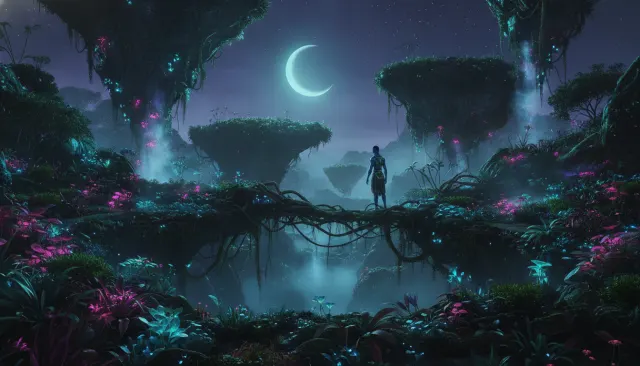
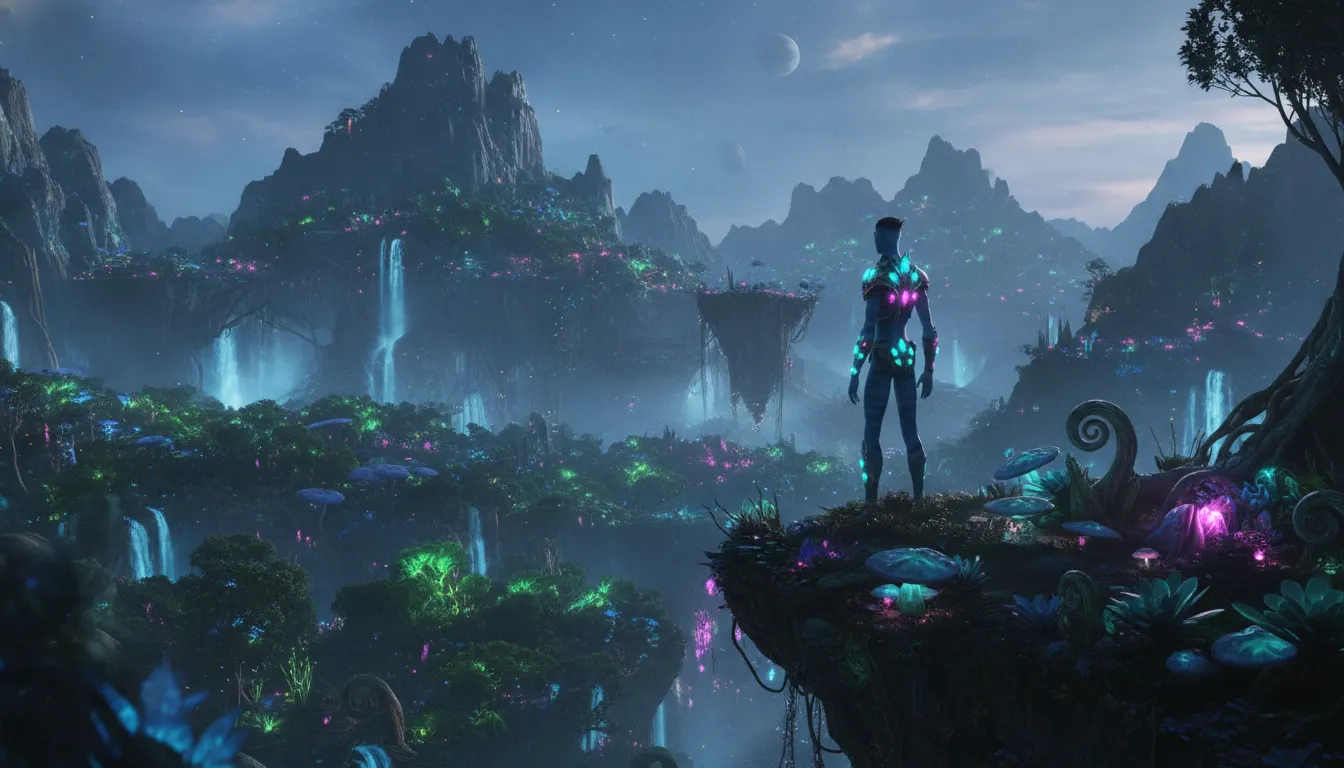
James Cameron Avatar Pandora bioluminescent VFX. Naavi performance capture, glowing forest flora, floating Hallelujah Mountains, Weta full-CG world build.
The moves a human crew would use to get here. Cue applies them for you, and knowing their names is how you ask for a change.
organism emission maps with wavelength-specific color (blue-cyan for most flora, violet for spores, acid-green for deep canopy)
processing with physically-based lens flare at emission source edges
organic rhythm, not mechanical flash
James Cameron's Avatar (2009) and Avatar: The Way of Water (2022) introduced one of the most distinctive and widely imitated CGI environments in cinema history: the bioluminescent night world of Pandora. Where the film's daytime sequences are defined by saturated primary colors and photorealistic foliage, the night sequences shift to a phosphorescent palette of electric blues, cyans, violets, and acid greens-an entire ecosystem that generates its own cold light in darkness.
Cameron briefed the Weta Digital team (visual effects supervisor Joe Letteri, production designer Rick Carter) using real-world bioluminescence research-deep-sea organisms, fireflies, fungi-as the starting point. The design principle is that every organism on Pandora evolved bioluminescence for signaling and defense, creating an ecosystem where the entire food web glows. This gave every design element (tree roots, animal skin, Na'vi body paint, atmospheric spores) a glowing counterpart activated under low light.
Producing Pandora night scenes required a dedicated bioluminescent lighting pass in Weta's rendering pipeline. Each organism had a separate emission map specifying the wavelength, intensity, and pulse frequency of its glow. The compositing pipeline then layered these emission maps over the base-lit environment renders, with atmospheric scatter creating the characteristic 'bloom' halos around each light source. The result is a scene lit almost entirely by emission rather than external light sources-a fundamentally different radiosity problem from conventional CG scene lighting.
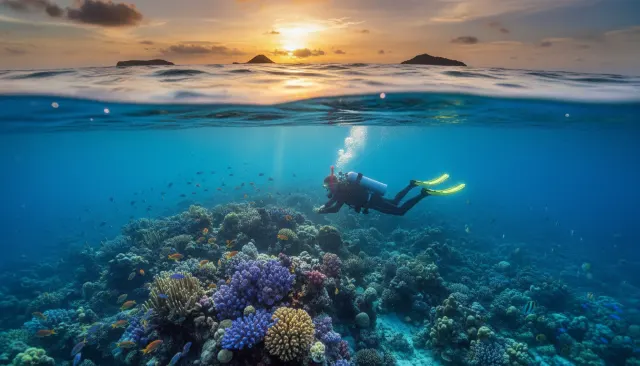
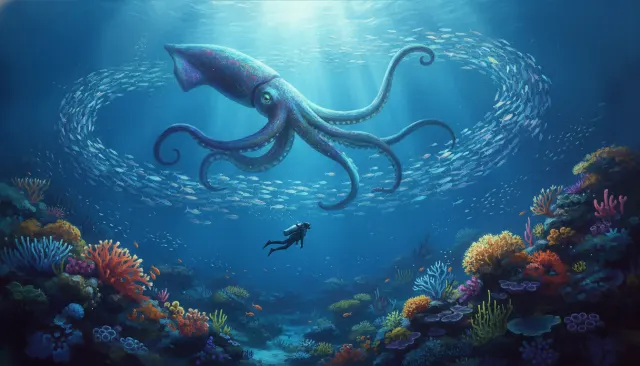
The sequel, directed by Cameron and released in December 2022, expanded the bioluminescent vocabulary to underwater environments. Pandora's ocean life (Ilu, Tulkun, reef ecosystems) was designed with deep-sea bioluminescence as reference-anglerfish lures, comb jellyfish cilia, dinoflagellate blooms. DP Russell Carpenter and Weta VFX supervisor Eric Saindon developed an underwater light-scatter model that refracts the bioluminescent emission through volumetric water.
2009
dir. James Cameron, Weta Digital, VFX sup. Joe Letteri
2022
dir. James Cameron, Weta FX, VFX sup. Eric Saindon
themed environment
2003
BBC Natural History inspiration reference
2009
Jacques Cluzaud, marine bioluminescence documentary reference
A Look is not a filter. It is a set of stored decisions the pipeline reads before it makes a single frame, so two videos in the same Look actually match.