David Doubilet
1999
*Water Light Time* , career survey photobook of underwater work
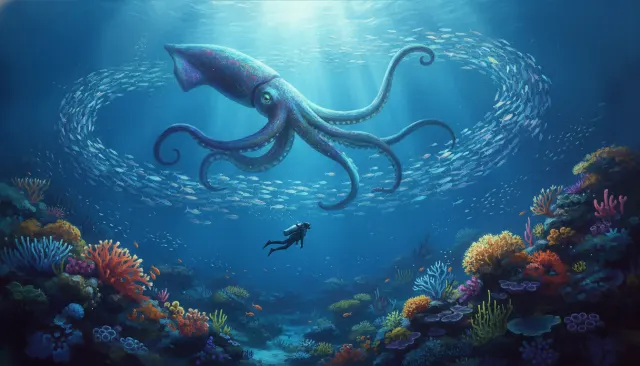
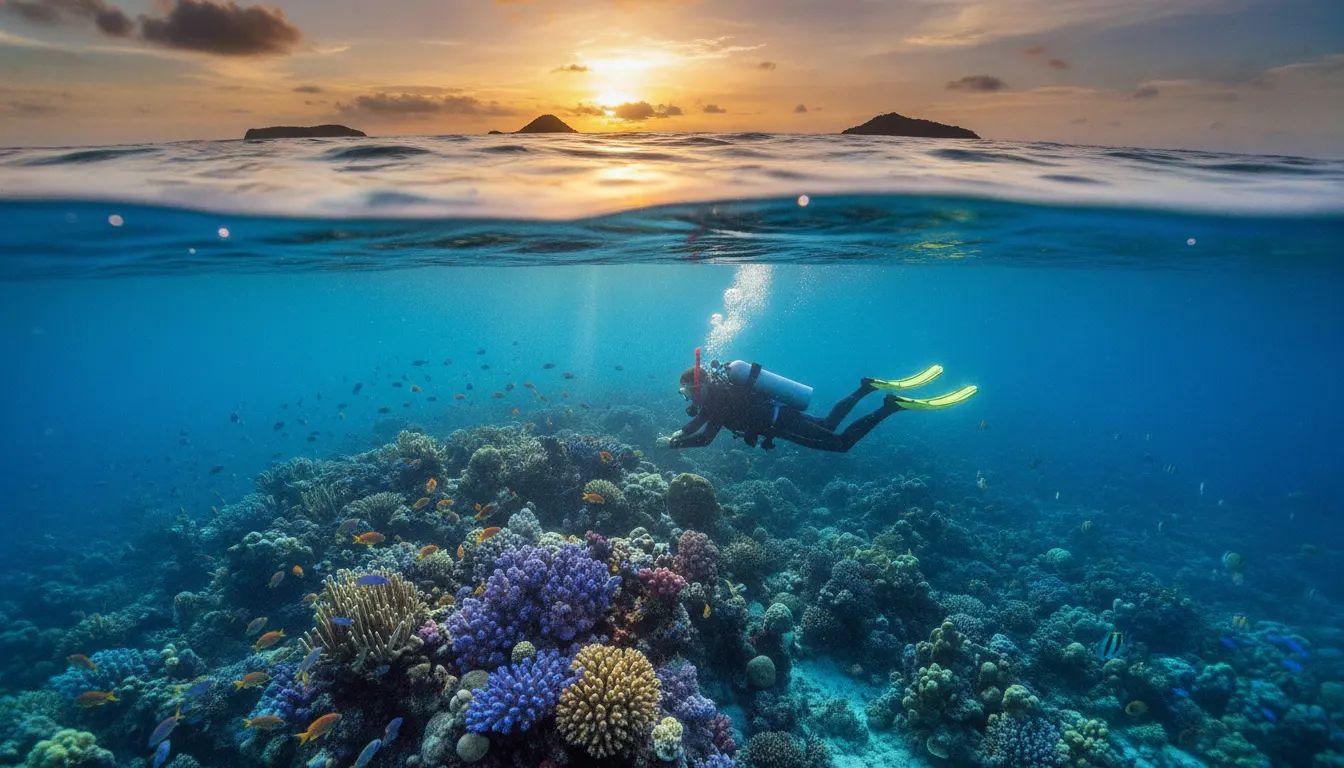
David Doubilet underwater photography. Split-frame above-and-below water, coral-reef saturated blue, NatGeo split-shot signature.
The moves a human crew would use to get here. Cue applies them for you, and knowing their names is how you ask for a change.
level (over-under) dome port photography: simultaneous above-water and below-water in a single frame
angle lens (15-20mm full-frame equivalent) positioned close to subjects to maximize clarity
green ambient underwater tones
subjects against a sun ball or bright surface for graphic impact
level exposures balanced across the water surface
David Doubilet (born 1946, New York) began diving at age 8 and photographing underwater at 13. Since his first National Geographic assignment in 1971, he has produced more than 70 stories for the magazine, making him the most published underwater photographer in its history. His work spans coral reefs, shipwrecks, kelp forests, open ocean encounters, and river systems across every ocean on Earth.
Doubilet is perhaps best known for perfecting the over-under or split-level photograph: an image that simultaneously shows above and below the waterline in a single frame. This requires custom dome ports, split neutral density filters or graduated ND gels, and precise exposure management to balance the bright sky against the dimmer underwater world. The result creates a sense of parallel worlds - the aerial and the submarine - that no other technique can replicate. His split-level images of coral reefs with stormy skies above became the defining image type for marine conservation campaigns.
Water absorbs red light within the first few meters of depth, leaving the underwater world in a monochromatic blue-green. Doubilet pioneered the use of large-format underwater strobes to restore full color at depth, often positioning multiple strobes wide to avoid backscatter from suspended particles. His color work reveals the orange, red, and violet hues of coral and sea creatures that the human eye sees only faintly without supplemental light.
Doubilet's work has documented vanishing reef ecosystems - particularly following coral bleaching events driven by ocean warming. His 2016 and 2022 coverage of the Great Barrier Reef bleaching events, shot in collaboration with partner Jennifer Hayes, brought wide public attention to the crisis. The Doubilet Foundation supports ocean conservation and early underwater photography education.
1999
*Water Light Time* , career survey photobook of underwater work
Great Barrier Reef coverage, *National Geographic* (1981, 2016, 2022)
Red Sea coral reef series, *National Geographic* (1974-1981)
Papua New Guinea underwater biodiversity, *National Geographic* (1990s)
Great Barrier Reef bleaching crisis documentation (2016, 2022)
2011
*Kingdom of Coral: Australia's Great Barrier Reef*
split-level Coral Sea island reef image, widely reproduced conservation icon
A Look is not a filter. It is a set of stored decisions the pipeline reads before it makes a single frame, so two videos in the same Look actually match.