Psychodiagnostik plates I-X
Hermann Rorschach · 1921
Original ten diagnostic inkblot plates, the precise canonical source of the aesthetic - widely reproduced and appropriated
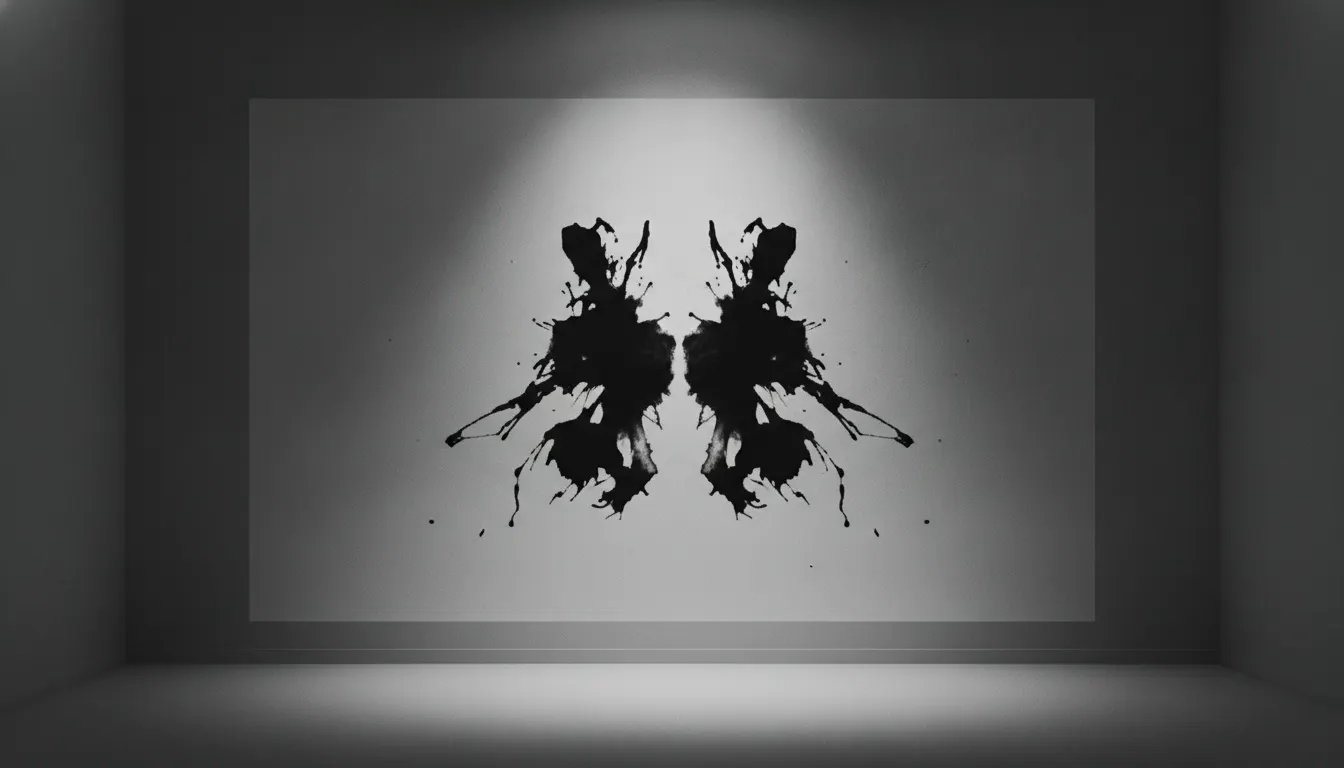
Rorschach inkblot symmetry. Black ink bilateral-mirrored on white paper, ambiguous biological form, projective-test psychology aesthetic.
The moves a human crew would use to get here. Cue applies them for you, and knowing their names is how you ask for a change.
Mirror reflection along a vertical axis producing exact left-right symmetry, the defining structural characteristic of the Rorschach form.
Lobate, irregular outer silhouette produced by ink spreading through paper fiber - no geometric regularity at the boundary.
Variation in ink density from dense black cores to lighter gray extremities, creating the illusion of depth and three-dimensionality in a flat blot.
Narrow ink extensions that break from the main blot body, suggesting creature limbs, plant forms, or visceral anatomy.
Carefully preserved unprinted areas within and adjacent to the blot, as important to the form's reading as the ink itself.
Color variants using red, blue, orange, or multi-hue inks that reference the color plates in the original Rorschach series.
Scaling the blot form to large format - wall scale, full-bleed print - which intensifies the object's presence and psychological weight.
The Rorschach inkblot aesthetic appropriates the bilateral symmetry and organic ink diffusion of the famous psychological test cards, transforming a clinical diagnostic instrument into a visual art form. The characteristic image - a mirror-symmetric blot of black ink on white, or dense chromatic ink on white - has become a powerful shorthand for psychology, the unconscious, projection, and the viewer's own interpretive mind.
Hermann Rorschach, a Swiss psychiatrist, developed his inkblot method between 1917 and 1921. His monograph Psychodiagnostik (1921) presented ten carefully selected inkblot plates intended to probe personality structure through the nature of subjects' perceptions. The ten plates - five achromatic black/gray, two with red accents, and three polychromatic - were selected from hundreds of inkblots for their particular diagnostic value, not their visual quality alone.
The Rorschach test became one of the most widely administered psychological instruments of the 20th century, particularly after Samuel Beck and Bruno Klopfer systematized its scoring in the 1930s-1940s, and John Exner developed the Comprehensive System in the 1970s. The aesthetic currency of the inkblot image spread far beyond clinical practice through cultural references in popular psychology, education, advertising, and art.
The classical Rorschach plate is made by folding a piece of paper over a wet ink blot - the bilateral fold creates perfect mirror symmetry while the ink's surface tension, viscosity, and paper absorption produce organic, unpredictable internal forms: lobate edges, veining patterns, areas of denser and lighter saturation, and complex silhouettes that resist singular interpretation.
The viewer's eye simultaneously processes the overall bilateral symmetry (which signals a face, body, or creature) and the internal textural complexity (which suggests different interpretations), producing the perceptual ambiguity that makes the Rorschach test work. Artists including Andy Warhol (Rorschach series, 1984), Damien Hirst (Butterfly paintings), and industrial designers have used the bilateral symmetry and organic form as generative methods.
Digital Rorschach generation uses fluid simulation software (Adobe Fresco fluid paint, Processing-based particle systems, Cinema 4D simulation) to generate bilateral symmetric blots with controlled but organic characteristics. The aesthetic appears in music branding (metal and industrial album art, psychology-themed podcast branding), fashion printing, and psychological thriller visual identities.
Hermann Rorschach · 1921
Original ten diagnostic inkblot plates, the precise canonical source of the aesthetic - widely reproduced and appropriated
Andy Warhol · 1984
Large-format symmetrical inkblot canvases, treating the clinical instrument as an abstract expressionist genre
Alan Moore / Dave Gibbons · 1986
The character Rorschach's constantly shifting inkblot mask became the most recognized contemporary cultural use of the form
Damien Hirst · 1994-2003
Large-format butterfly wing arrangements using bilateral symmetry and organic form that directly reference Rorschach's visual language
Watchmen film / Zack Snyder · 2009
Watchmen film adaptation brought the animated shifting inkblot mask to mainstream cultural visibility
various · 1990s-present
Ongoing use in extreme music cover art where the ambiguous organic-dark form signals psychological depth and confrontation
A Look is not a filter. It is a set of stored decisions the pipeline reads before it makes a single frame, so two videos in the same Look actually match.