Sátántangó
Béla Tarr / Gábor Medvigy · 1994
7.5-hour black-and-white Hungarian masterpiece; the extreme limit of long-take cinema
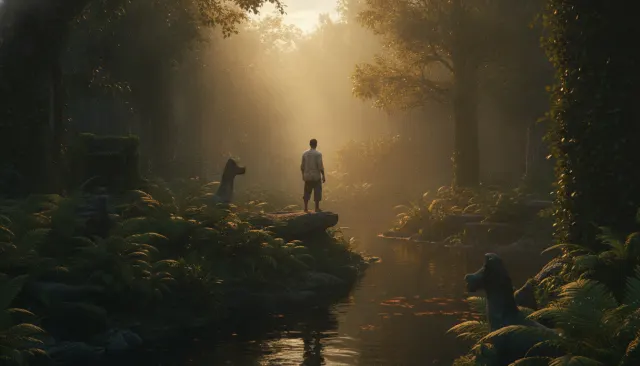
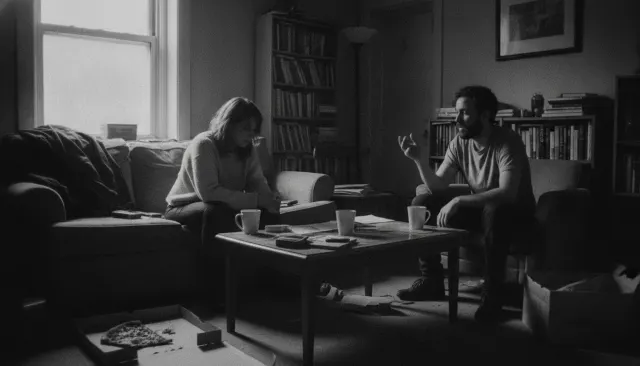
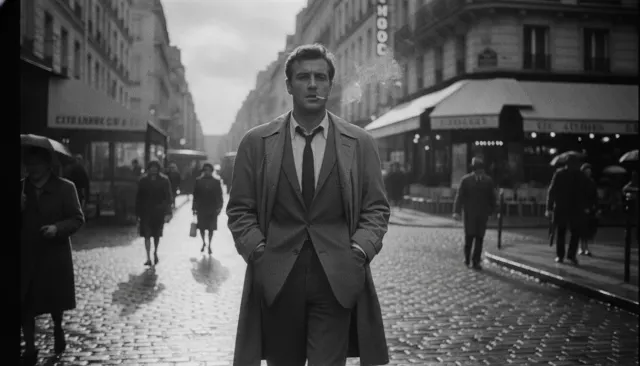
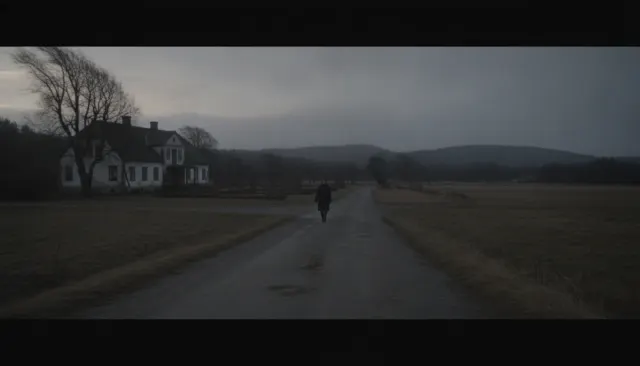
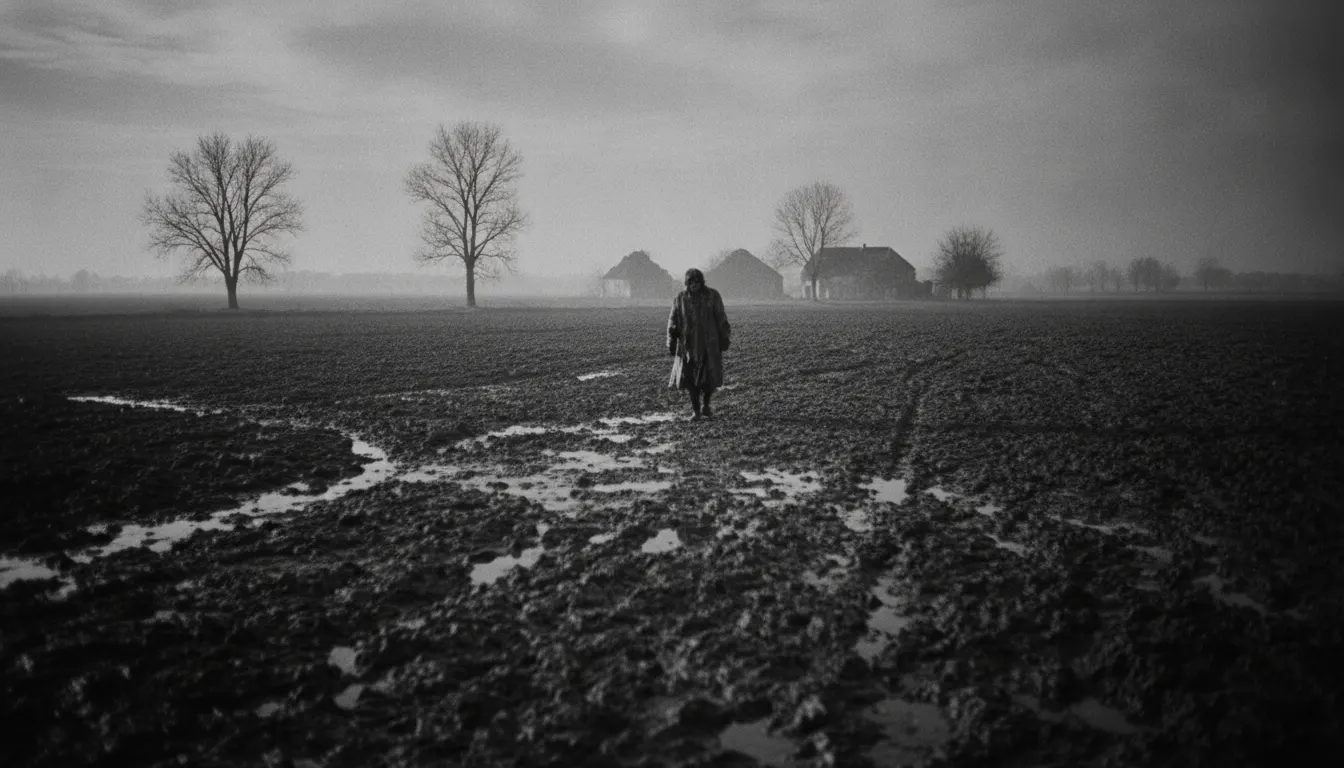
Béla Tarr slow cinema. Satantango seven-minute take, Hungarian winter mud, black-and-white wide, glacial dolly through bleak landscape.
The moves a human crew would use to get here. Cue applies them for you, and knowing their names is how you ask for a change.
Single shots lasting several minutes or more, following characters or environments with patient, non-narrative attention.
Camera movement is precisely planned but explores rather than explains, moving through environments without storytelling urgency.
Monochrome chosen for graphic rigour rather than period reference; colour would soften the moral and physical harshness.
Environmental conditions - rain, fog, wind, mud - are integral physical presences rather than atmospheric decoration.
Plot causality is reduced; the film explores presence and duration rather than incident and consequence.
Landscapes, architecture, and human figures are filmed with the same attentiveness; no hierarchy of importance.
Slow cinema is a category of art-house filmmaking characterised by long takes, minimal editing, reduced narrative causality, and a deliberate refusal of the pacing conventions that govern commercial cinema. Béla Tarr, the Hungarian director, is its most technically extreme and philosophically rigorous practitioner - his films Sátántangó (1994, 7.5 hours, average shot length exceeding 2 minutes) and Werckmeister Harmonies (2000) represent a systematic exploration of what film can communicate through duration alone.
Tarr's cinematographers - Gábor Medvigy on early films, Fred Kelemen and Robby Müller on later work - shot almost exclusively in black and white, using wide-angle lenses (24mm-35mm equivalent) with the camera mounted on a remote-controlled dolly or operated on a crane. The camera movements in Tarr's films are long, continuous, and precisely choreographed: a single shot in Sátántangó follows a drunk doctor through a village for over eleven minutes without a cut, the camera exploring its environment with the patience of a consciousness rather than the efficiency of a storytelling instrument.
The environment in Tarr's films is always Hungary's rural and post-industrial landscapes: muddy village streets, abandoned factories, bare concrete interiors. Rain, mud, fog, and wind are constant presences. The black-and-white palette is chosen not for nostalgia but for its ability to render these environments with a graphic severity that colour would soften. Faces and architecture are photographed with equal moral attention.
Tarr's approach places him within a tradition that includes Andrei Tarkovsky (Stalker, 1979; The Mirror, 1975), Theo Angelopoulos (The Travelling Players, 1975; Landscape in the Mist, 1988), Chantal Akerman (Jeanne Dielman, 1975), Carlos Reygadas (Post Tenebras Lux, 2012), and Lisandro Alonso (Los Muertos, 2004). What unites them is the refusal of narrative as a primary organising structure; duration, environment, and physical presence take its place.
Akerman's Jeanne Dielman, 23 Commerce Quay, 1080 Brussels (1975, 201 minutes) is a direct ancestor: a film whose radical slowness is itself the argument about women's domestic labour. Tarkovsky used the long take as a means of accessing what he called "sculpting in time" - the physical texture of duration as cinematic material.
Contemporary slow cinema includes Apichatpong Weerasethakul (Uncle Boonmee Who Can Recall His Past Lives, 2010), Kelly Reichardt (Certain Women, 2016; First Cow, 2019), and Chloe Zhao (Nomadland, 2020). Each adapts the long-take, environment-centred approach to specific cultural and geographic contexts.
Béla Tarr / Gábor Medvigy · 1994
7.5-hour black-and-white Hungarian masterpiece; the extreme limit of long-take cinema
Béla Tarr / Gábor Medvigy · 2000
39 shots in 145 minutes; precise choreography of bodies through a Hungarian town
Andrei Tarkovsky / Aleksandr Knyazhinsky · 1979
Soviet slow cinema; the Zone as psychological landscape in 2h 42m
Chantal Akerman / Babette Mangolte · 1975
201-minute feminist slow cinema; domestic labour as duration
Apichatpong Weerasethakul · 2010
Palme d'Or winning Thai slow cinema; forest and memory as continuous presence
Kelly Reichardt / Christopher Blauvelt · 2019
Contemporary American slow cinema; Oregon frontier photographed with Tarr-adjacent patience
A Look is not a filter. It is a set of stored decisions the pipeline reads before it makes a single frame, so two videos in the same Look actually match.