David Hockney
1986
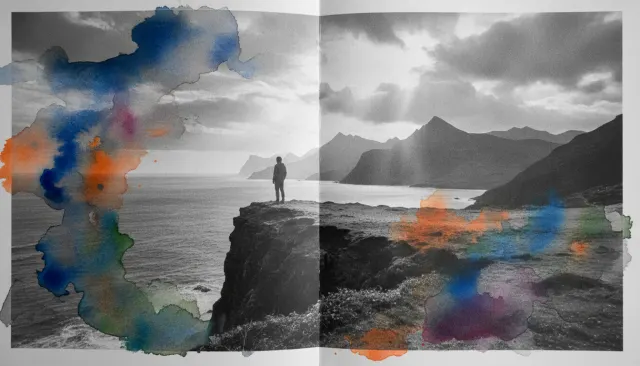
*Joiners* photocollage series (1982–1986), including *Pearblossom Hwy.*
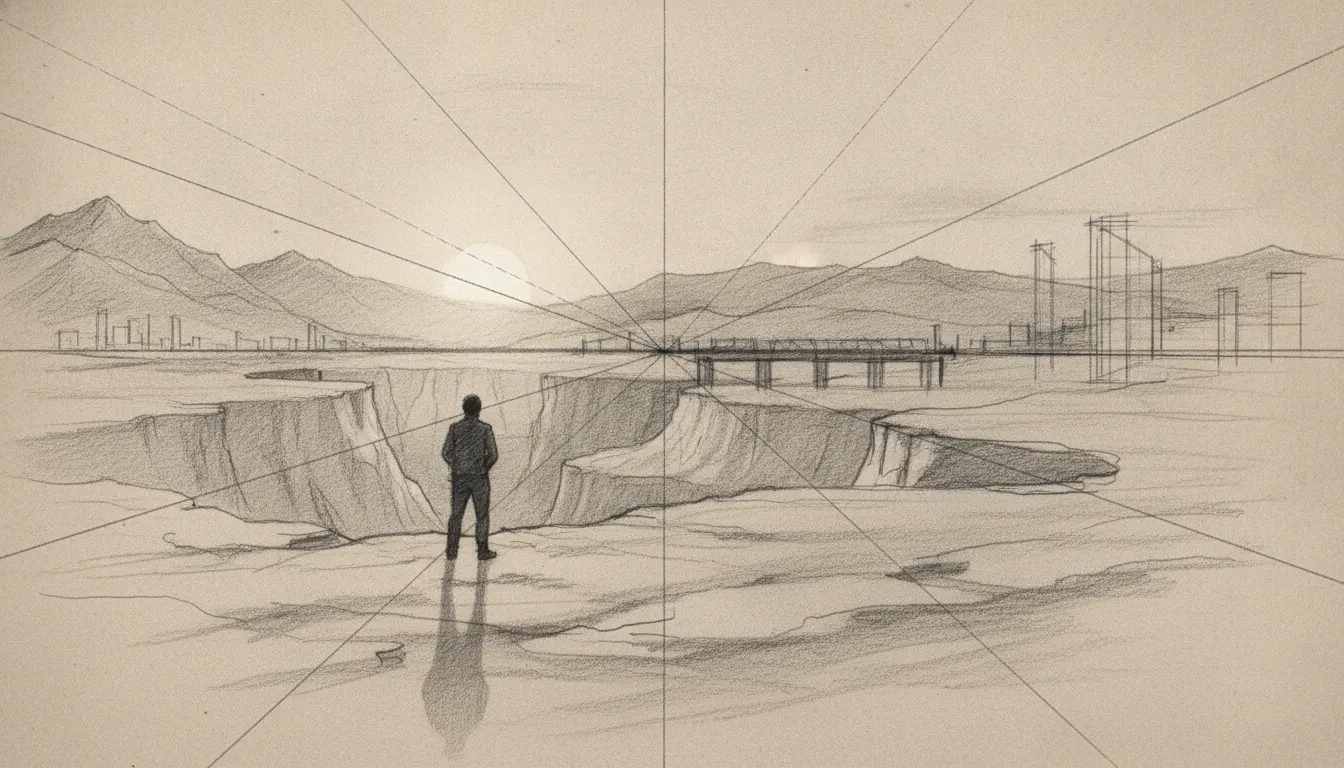
Graphite pencil sketch lines drawn over a faint photographic base. Architect-storyboard energy, construction lines, vanishing-point overlays, the photo half-erased into the drawing.
The moves a human crew would use to get here. Cue applies them for you, and knowing their names is how you ask for a change.
hatching in shadow areas, adding hand-rendered depth to photographic tone
dimension lines, arrows, labels, construction geometry over structural subjects
drawn marks in areas of emphasis, photograph bare in less important zones
thick gesture marks in foreground, fine observational lines in background
medium work, showing process rather than finish
The sketch pencil lines over photo technique draws hand-made marks – contour lines, hatching, observational notes, construction geometry – directly over or composited against photographic imagery. The photograph establishes place, likeness, or material reality; the drawn lines express the artist's interpretation, emphasis, or analytical attention. The hybrid surface makes visible the act of looking.
David Hockney's photographic collages – the Joiners he produced from 1982 onward – are not sketch-over-photo in the literal sense, but they initiated a critical conversation about photography's relationship to drawing that directly influenced subsequent hybrid work. Hockney argued that the camera's single fixed viewpoint produces a false account of perception; his multi-photo collages attempted to restore the multiple viewpoints of sustained observational looking. His 1984 works like Pearblossom Hwy. assembled hundreds of photographs into compositions with the spatial logic of Cubism.
Hockney's consistent point – that the photograph is a tool for artists to think with rather than a finished product – authorized hybrid approaches. His later iPad paintings (begun 2009, widely publicized 2010–2012) translated observational pencil drawing logic into the digital medium.
Brian Maguire (Irish, active 1970s–present) places gestural drawn marks over photographic documentation of crime scenes and conflict zones, where the drawing extends and interprets rather than decorating the photographic facts.
Architectural sketch-over-photo has a long professional tradition: Hugh Ferriss's atmospheric charcoal-over-photo New York building studies (1920s–1940s) influenced generations of architectural renderers. Lebbeus Woods' freehand drawings over urban photographs (1980s–1990s) treated the photo as a site to be speculatively reconstructed.
In contemporary illustration, pencil-over-photo is used by editorial illustrators working with layout photographs, and by fashion and product designers sketching iterations over photographic base images.
William Kentridge (South African, born 1955) developed a working method in his film series Drawings for Projection (begun 1989) where charcoal drawings are photographed progressively – drawn, filmed, erased, redrawn, filmed again – so that the final film contains both present marks and the visible ghost of erased previous marks. Projection of these films onto architectural surfaces in his later installation work creates a live drawing-over-surface relationship. Kentridge's approach insists that the history of marks is as important as the current state of the drawing, a principle directly applicable to the sketch-over-photo hybrid: the photograph is the indelible first mark; the drawn lines are the artist's subsequent response to it.
In commercial animation and concept art, sketch-over-photo techniques are standard in pre-visualization: production designers photograph location scouts and have illustrators draw proposed set elements over the photographs to show clients how a finished space will look. This professional lineage gives the sketch-over-photo hybrid an additional register of creative-process authenticity.
1986
*Joiners* photocollage series (1982–1986), including *Pearblossom Hwy.*
iPad landscape paintings (2009–2012, exhibited Royal Academy of Arts 2012)
charcoal architectural renderings over photographic studies (1922–1962, *The Metropolis of Tomorrow* 1929)
freehand urban speculation drawings over photographic bases (1980s–1990s)
drawn mark over conflict-zone photography (1990s–present)
charcoal drawing and erasure film series, drawn over photographic projection (1989–present)
sketchbook ink-over-photograph travel journals (2000s–present)
A Look is not a filter. It is a set of stored decisions the pipeline reads before it makes a single frame, so two videos in the same Look actually match.