ILLUSTRATORS EXTENDED · 1960S · USA
Saul Steinberg New Yorker Line
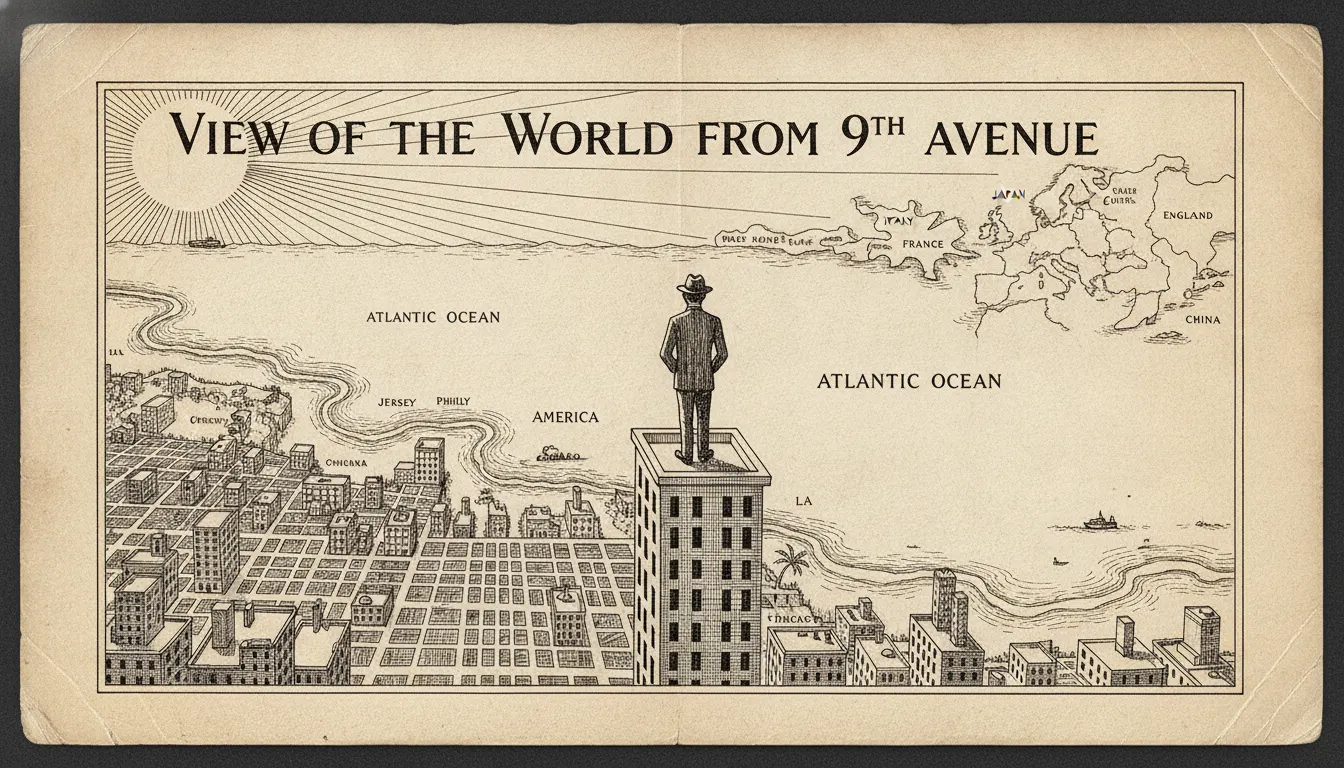
Saul Steinberg New Yorker cover line drawing. View of the World from 9th Avenue, fine ink line, witty Manhattan-centric perspective, intellectual cartoon.
steinbergnew-yorkerlinewitty
LUT steinberg-new-yorker-line
WHEN TO USE
- Editorial illustration for long-form journalism, essays, or cultural criticism where visual wit and intellectual authority are equally required
- Brand content in publishing, media, or culture that wants to reference The New Yorker's tradition of sophisticated graphic storytelling
- Maps, infographics, or data visualisation projects where subjective geography and witty perspective-distortion are the goal
- Identity, documentation, or bureaucracy-themed creative projects that want Steinberg's meta-commentary register
- Title sequences or chapter openers in film and publishing content where a single elegant line carries the tonal weight
WHEN NOT TO USE
- Youth or entertainment content where the sophisticated, literary register creates distance
- High-energy action or sports content where the contemplative line is tonally incompatible
- Content requiring full-colour illustration or photographic texture
- International campaigns where the specifically American-intellectual-Manhattan cultural position does not translate
SIGNATURE TECHNIQUES
How the look is made.
The moves a human crew would use to get here. Cue applies them for you, and knowing their names is how you ask for a change.
- 01Clean, precise ink line with deliberate variation in weight
- thick for primary forms, fine for annotation and incidental detail
- 02Cartographic and architectural drawing conventions used to describe subjective or metaphysical spaces
- 03Deliberate foreshortening that makes familiar things (America from 9th Avenue) radically strange
- 04Mixed registers on a single page
realistic drawing alongside schematic maps alongside text as image
- 05Figures that are constructed from visual symbols and bureaucratic mark-making rather than observed anatomy
- 06Handwritten text integrated as design element
signatures, certificates, identity documents treated as art
- 07Self
referential meta-drawing: lines that comment on being lines, borders that comment on being borders
HISTORY & CONTEXT
Where it comes from.
Saul Steinberg: New Yorker Line
Saul Steinberg (1914-1999) was born in Romania, trained as an architect in Milan, and spent his career in New York producing drawings that occupy a unique position between visual art, philosophy, and comedy. His work for The New Yorker -- 85 covers and hundreds of interior drawings from 1945 to 1999 -- constitutes one of the most sustained single-artist collaborations in American magazine history.
The New Yorker Relationship
Steinberg's first New Yorker cover appeared in 1945. He was not a cartoonist in the conventional sense -- his work rarely carried conventional punch-line structure -- but something closer to a visual philosopher: drawings that made arguments about language, representation, America, art history, and consciousness. His line is clean, precise, and self-aware: it knows it is a line and occasionally says so.
View of the World from 9th Avenue (1976)
The most famous single image in New Yorker history, and among the most famous magazine covers ever published. The view looks west from 9th Avenue in Manhattan: 9th Avenue and 10th Avenue in crisp foreground detail, then the Hudson River, then a vastly foreshortened America -- with the Rocky Mountains a modest bump -- and then China, Japan, Russia, and the Pacific Ocean in summary shorthand. The cover ran on March 29, 1976, and was such an immediate sensation that it was widely stolen from newsstands. It has been endlessly parodied and localised.
Visual Philosophy
Steinberg drew identity documents, passports, and certificates of authenticity as art objects. He drew borders, maps, and the architecture of bureacracy as philosophical commentary. He drew figures that were themselves drawings of figures -- a meta-layer that anticipates postmodern visual art. His masks (literal drawn paper masks that his subjects wore for photographs) comment on the relationship between representation and reality. He influenced everyone from Art Spiegelman to contemporary illustrators.
NOTABLE WORKS
Where you have seen it.
The Passport (book, 1954) -- first major collection
The Labyrinth (book, 1960)
The New World (book, 1965)
Steinberg at the Smithsonian exhibition
1973
Untitled (Masks series, 1966-1973) -- figures wearing photographically realistic paper masks
THE RECIPE
The exact knobs
the renderer turns.
A Look is not a filter. It is a set of stored decisions the pipeline reads before it makes a single frame, so two videos in the same Look actually match.
SettingValue
GradeColour LUT applied to every frame
steinberg-new-yorker-lineTransitionHow one shot becomes the next
hard cuts · 160ms · linearKen BurnsCamera move applied to stills
Slow push · 0.02 · centerTypographyDisplay / body / mono pairing
Adobe Caslon Pro · Caslon · JetBrains MonoMusic moodWhat the bed under the voice sounds like
gershwin-rhapsody · jazz-piano-loungePrompt suffixAppended to every shot prompt in this Look
Saul Steinberg New Yorker cover line drawing, View of the World from 9th Avenue, fine ink line, witty Manhattan perspective, intellectual cartoonPALETTE
Primary
#0A0A0A
Secondary
#F5F0E0
Accent
#D62828
Text/Light
#0A0A0A
Text/Dark
#FFFFFF
BG 900
#F5F0E0
BG 800
#E8E0CC
RELATED LOOKS
Next to it on the shelf.
 Illustrators ExtendedCharles Schulz Peanuts Minimalist Strip
 Illustrators ExtendedPosy Simmonds UK Graphic Novel
 Illustrators ExtendedDaniel Clowes Deadpan Suburban Comic
 Illustrators ExtendedAdrian Tomine Clean Graphic Novel
 Poster Trad ExtendedBauhaus Typography Experiment
 Magazine Print DesignBrutalist Magazine Cover
Your first cut
is on us.
+ New videoFree plan · no card · 1080p export