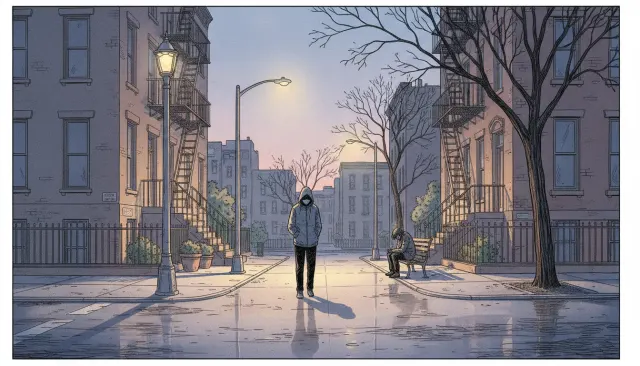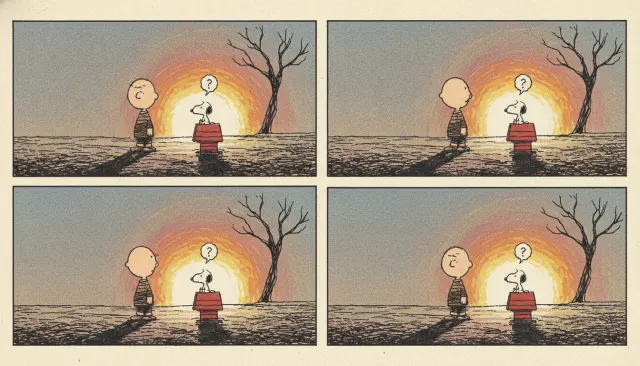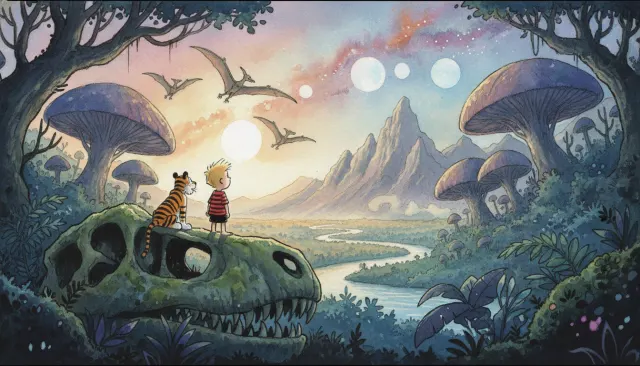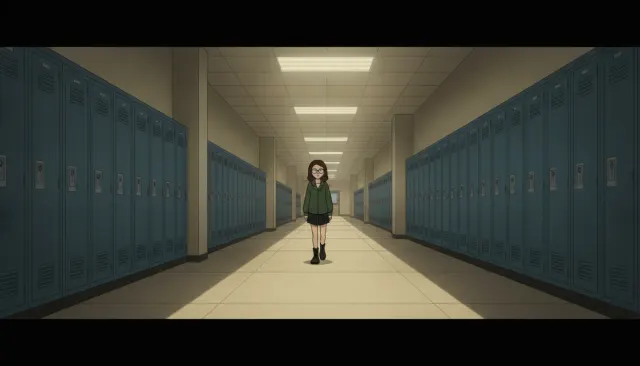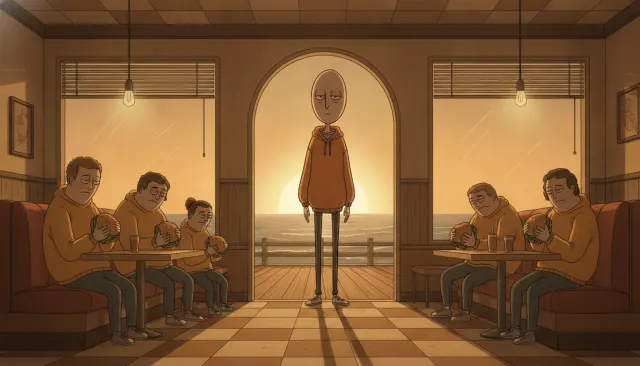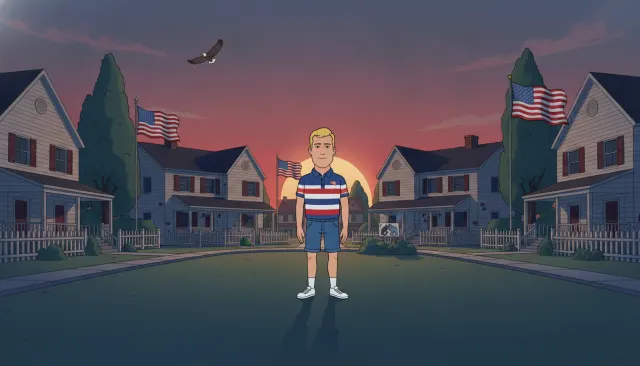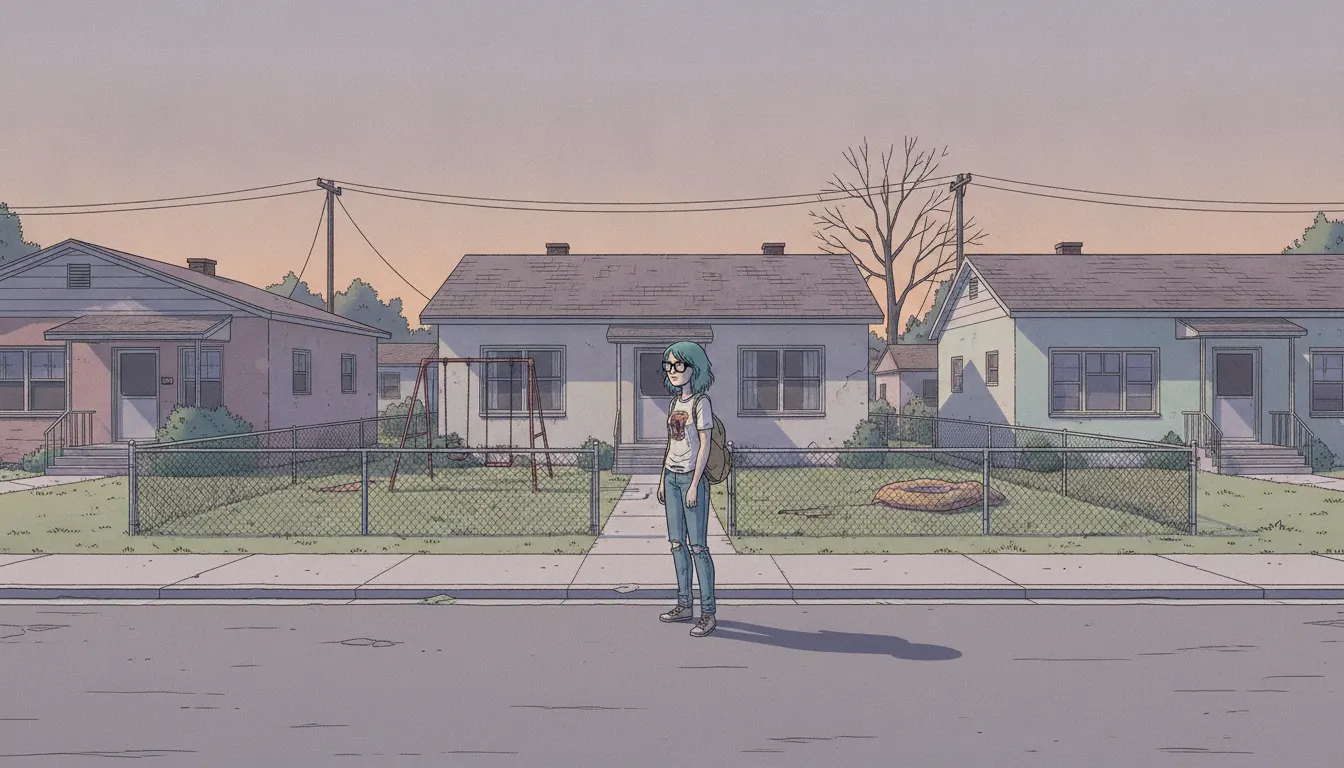
Ghost World
Daniel Clowes · 1997
Collected graphic novel; definitive text of suburban alt-comics alienation
Daniel Clowes Ghost World deadpan comic. Cool flat ink line, retro suburban Americana, alienated teen protagonists, Eightball-era indie graphic novel.
The moves a human crew would use to get here. Cue applies them for you, and knowing their names is how you ask for a change.
Fixed, equal-sized panels arranged in rigid grids reinforce emotional containment and suburban repetition.
Faces drawn with slight symmetrical perfection and fixed expressions, giving figures an uncanny quality between human and mannequin.
Desaturated khakis, muddy greens, and muted blues evoke fluorescent-lit commercial spaces; saturated accents are used sparingly for effect.
Strip malls, parking lots, and ranch-house interiors rendered with documentary precision, making setting oppressive rather than atmospheric.
Spoken lines are mundane or tangential, with subtext carried entirely by visual juxtaposition rather than inflection.
Visual language drawn from 1950s Harvey Comics, advertising illustration, and mid-century package design without nostalgic warmth.
Daniel Clowes is an American cartoonist and screenwriter born in 1961 in Chicago, whose work from the 1980s onward established a distinctly cold, fluorescent-lit register for the American alternative comics scene. His style synthesizes mid-century commercial illustration with a clinical emotional distance that renders suburban ennui as something approaching existential horror.
Clowes began publishing in the anthology Eightball (Fantagraphics, 1989-2004), where serialized stories accumulated into his most celebrated books. Ghost World (serialized 1993-1997, collected 1997) follows two teenage girls - Enid Coleslaw and Rebecca Doppelmeyer - drifting through the dead zone between high school and adulthood in a nameless American suburb. The book became the template for a generation of alt-comics: precise draftsmanship, muted color schemes (originally black and green, later full color), dialogue that never lands where sentiment expects.
David Boring (2000) pushed the formal experiment further, layering a murder mystery within a young man's obsessive visual cataloging of women. Ice Haven (2005) reworked a suburban kidnapping narrative using multiple strip formats - newspaper gag strip, soap opera continuity strip, psychological profile - within a single book. His screenplay for the Ghost World film (2001, dir. Terry Zwigoff) brought these aesthetics to a wider audience.
Clowes draws in a style that quotes 1950s commercial illustration and Harvey Comics without nostalgia. Faces are slightly too symmetrical, expressions slightly too fixed, giving figures the quality of automata performing human affect. Backgrounds are rendered in flat architectural detail - strip malls, parking lots, ranch houses - with a precision that makes the setting feel oppressive rather than observed.
Color in his later work favors desaturated khakis, muddy greens, and institutional blues punctuated by the occasional jarring primary. Panel composition is classically grid-based, rarely dynamic, reinforcing the sense of life as a series of interchangeable compartments. Lettering is clean and hand-done, dialogue frequently mundane with a dark undertow.
Clowes's deadpan register directly influenced Adrian Tomine (Optic Nerve), Chris Ware (Jimmy Corrigan, 2000), and a generation of literary graphic novelists. His visual language of suburban alienation recurs in indie animation, lo-fi music videos, and zine design seeking credibility through studied flatness.
This look translates to video through a deliberate flatness of framing - centered compositions, static camera, institutional lighting stripped of atmosphere. Color grading toward bleached-out midrange tones with occasional saturated accent objects (a red couch, a yellow sign) mimics the Clowes palette. Dialogue delivered without performance emphasis, over environments that feel simultaneously familiar and hostile, lands the register.
Daniel Clowes · 1997
Collected graphic novel; definitive text of suburban alt-comics alienation
Daniel Clowes · 1989
Debut anthology issue establishing the Clowes visual and tonal register
Daniel Clowes · 2000
Murder mystery overlaid on obsessive visual cataloging; experiments with unreliable visual narration
Daniel Clowes · 2005
Suburban kidnapping told across multiple strip formats within a single volume
Terry Zwigoff (dir.), Daniel Clowes (screenplay) · 2001
Clowes-adapted film; brought deadpan suburban comic register to live-action
Daniel Clowes · 2011
Superhero deconstruction in Clowes's institutional palette; first published Eightball #23 (2004)
Daniel Clowes · 2016
Noir time-travel graphic novel; most expressionistic color work in his catalog
A Look is not a filter. It is a set of stored decisions the pipeline reads before it makes a single frame, so two videos in the same Look actually match.