ART MOVEMENT CLASSICAL · 1830S · FRANCE
Romanticism Delacroix
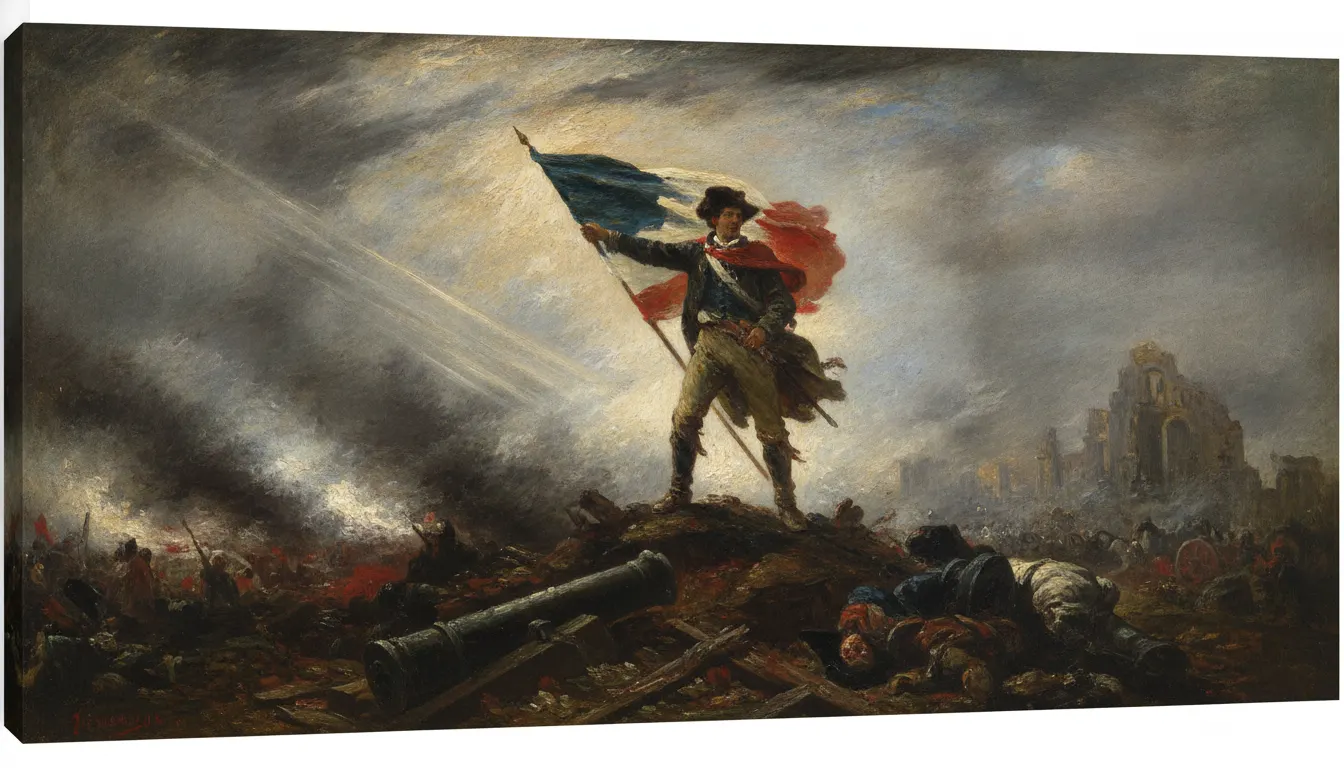
Eugene Delacroix Romantic turbulence. Liberty Leading the People dynamism, smoke and tricolour, brushy emotional palette.
romanticturbulentpainterlyrevolutionary
WHEN TO USE
- Historical, political, or epic narrative content that needs the register of passionate, committed engagement
- Revolutionary, liberation, or social movement content where Liberty Leading the People's visual vocabulary is appropriate
- Literary adaptation content -- Shakespeare, Byron, Hugo -- that wants the painterly drama of the Romantic tradition
- Music, film, or cultural brand content that wants to claim serious artistic ambition and emotional intensity
- Art-historical or educational content about 19th-century France, Romanticism, or the Louvre collection
WHEN NOT TO USE
- Light, playful, or comedic content where the passionate gravity reads as overwrought
- Minimalist or modern brand content where the dense, tumultuous compositions are too busy
- Corporate or financial content where the revolutionary associations are off-brand
- Content requiring photographic naturalism where painterly exaggeration breaks the illusion
SIGNATURE TECHNIQUES
How the look is made.
The moves a human crew would use to get here. Cue applies them for you, and knowing their names is how you ask for a change.
- 01Explosive diagonal compositions organising turbulent groups of figures across the canvas
- 02Rich, saturated colour deployed in complementary pairs
- reds against greens, oranges against blues
- 03Loose, gestural brushwork that is visible and directional, giving surfaces an energetic, unresolved quality
- 04Dramatic chiaroscuro contrasts
intense highlights on pale flesh or metal against deeply shadowed areas
- 05Turbulent movement throughout the composition
drapery, smoke, limbs, and manes all in kinetic states
- 06Literary and historical subjects treated as pretexts for extreme emotional and compositional exploration
- 07Figures in extreme physical and psychological states
- dying, grieving, killing, triumphing
HISTORY & CONTEXT
Where it comes from.
Romanticism: Delacroix
Eugène Delacroix (1798-1863) is the supreme painter of French Romanticism and one of the most technically audacious colourists in the Western tradition. His work is the visual antithesis of Neoclassicism: where David and Ingres prize clarity, restraint, and the authority of the antique, Delacroix prizes movement, colour, passion, and the irrationality of history and emotion.
Subject and Ambition
Delacroix drew his subjects from Shakespeare (Hamlet series, Romeo and Juliet), Byron (The Death of Sardanapalus, 1827, Louvre -- derived from Byron's 1821 play), Dante (Dante and Virgil Crossing the Styx, 1822, Louvre), Scott, and contemporary historical events. Liberty Leading the People (1830, Louvre) was painted in response to the July Revolution that overthrew Charles X; the allegorical figure of Liberty -- bare-breasted, tricolour raised -- steps over the bodies of the fallen across a smoking Paris barricade. It is simultaneously a historical document, a political painting, and a figure composition of extraordinary power.
The Death of Sardanapalus (1827) is his most extreme work: the Assyrian king, facing defeat, orders the destruction of all his possessions -- horses, servants, and concubines -- from his deathbed. The canvas (392 x 496 cm) is organised as a diagonal tide of bodies, crimson drapery, and gleaming flesh, technically audacious to the point of scandal at the Salon.
Technique and Colour Theory
Delacroix was the first European painter to make extensive notes on colour theory. His journal records observations about simultaneous contrast, shadow colour, and complementary pairs that would directly influence the Impressionists -- particularly Monet, Pissarro, and eventually Seurat. He placed complementary colours in direct adjacency rather than mixing them, pre-figuring Divisionism. His brushwork is loose, gestural, and directional; surfaces vibrate with optically mixed colour.
NOTABLE WORKS
Where you have seen it.
The Massacre at Chios (1824, Louvre) -- contemporary Greek War of Independence
The Death of Sardanapalus (1827, Louvre) -- Byron source, critical scandal
Liberty Leading the People (1830, Louvre) -- July Revolution allegory
Women of Algiers in their Apartment (1834, Louvre) -- after North Africa trip
The Entry of the Crusaders into Constantinople (1840, Louvre)
THE RECIPE
The exact knobs
the renderer turns.
A Look is not a filter. It is a set of stored decisions the pipeline reads before it makes a single frame, so two videos in the same Look actually match.
SettingValue
TransitionHow one shot becomes the next
hard cuts · 160ms · linearKen BurnsCamera move applied to stills
Slow push · 0.02 · centerTypographyDisplay / body / mono pairing
Playfair Display · Lora · JetBrains MonoMusic moodWhat the bed under the voice sounds like
orchestral-overture · brass-fanfarePrompt suffixAppended to every shot prompt in this Look
Eugene Delacroix Romantic painting, Liberty Leading the People, turbulent diagonal composition, smoke, brushy emotional French RomanticismPALETTE
Primary
#0033A0
Secondary
#F5F5F5
Accent
#EF4135
Text/Light
#0A0820
Text/Dark
#FFFFFF
BG 900
#0A0820
BG 800
#1A1A2A
RELATED LOOKS
Next to it on the shelf.

Your first cut
is on us.
+ New videoFree plan · no card · 1080p export