ART MOVEMENT CLASSICAL · 1500S · ITALY
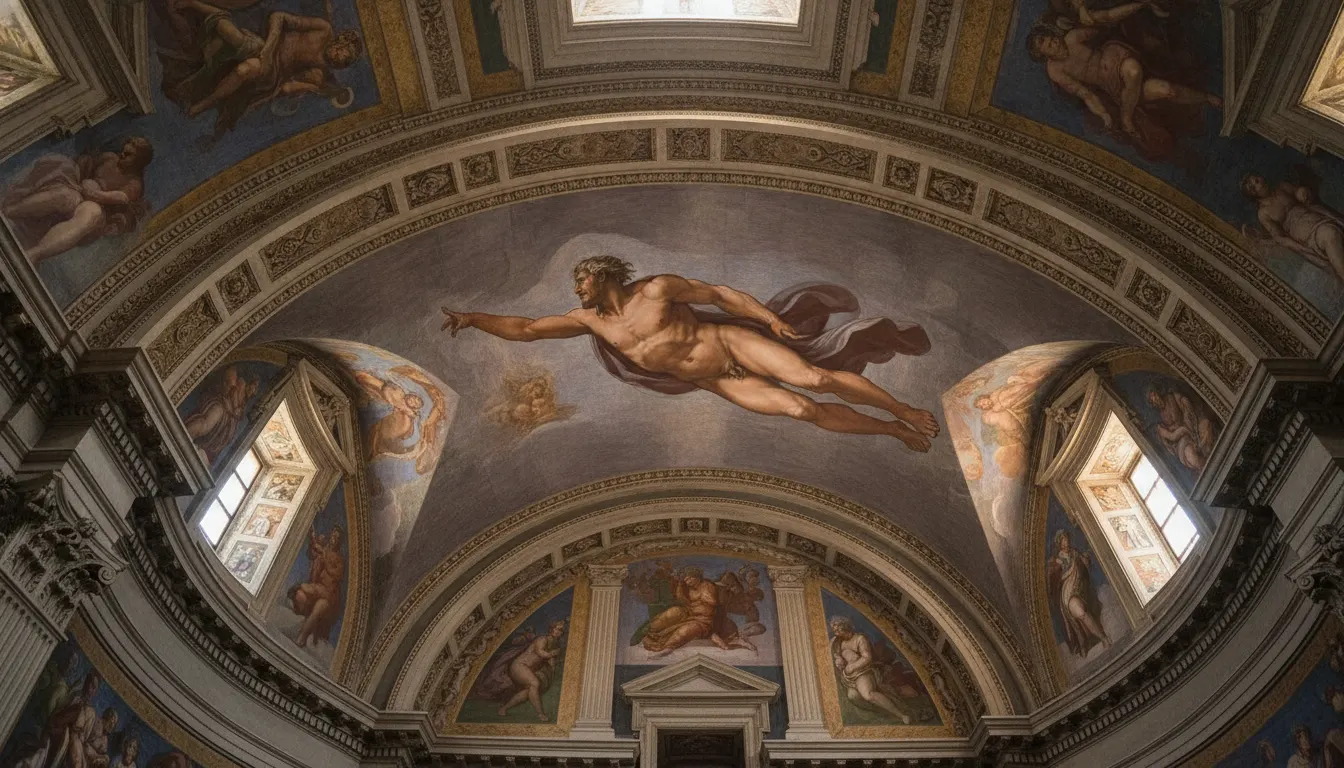
Renaissance Fresco Michelangelo
High Renaissance fresco in the Michelangelo Sistine Chapel manner. Anatomical muscular figures, ceiling vault perspective, plaster-matte color.
classicalmonumentalsacredpainterly
WHEN TO USE
- Historical, art-historical, or religious content that needs the full authority of the Western figurative tradition
- Epic or mythological narrative content -- film, game, publishing -- requiring monumental human figures and theological scale
- Museum, gallery, or cultural institution content where the Renaissance registers prestige and depth
- Brand campaigns in luxury goods, architecture, or fashion that draw on classical European heritage
- Documentary or educational content about the Italian Renaissance, Vatican, or the history of Christianity
WHEN NOT TO USE
- Contemporary, ironic, or pop-culture content where the reverent monumentality reads as pompous
- Quick-turnaround social content where the formal grandeur is inappropriate to the platform
- Brand campaigns seeking accessibility, approachability, or youth appeal
- Digital-native content where the fresco's physical materiality and surface age cannot be convincingly referenced
SIGNATURE TECHNIQUES
How the look is made.
The moves a human crew would use to get here. Cue applies them for you, and knowing their names is how you ask for a change.
- 01Monumental, heroic figures in dynamic contrapposto poses
- weight shifted, torso twisting against the hips
- 02Earth
tone palette constrained by buon fresco chemistry: ochre, umber, sienna, lime white, and verdigris
- 03Illusionistic architectural framing painted onto a flat surface: false niches, cornices, and pilasters that create fictive depth
- 04Muscular, anatomically idealised bodies derived from close study of classical sculpture and dissection
- 05Foreshortening in extreme perspectives
- figures seen from below, from behind, in complex spatial positions
- 06Narrative compressed across a single surface
simultaneous scenes from different moments in the same architectural zone
- 07*Sfumato*
influenced soft transitions between light and shadow in flesh, with hard clear outlines elsewhere
HISTORY & CONTEXT
Where it comes from.
Renaissance Fresco: Michelangelo
Michelangelo Buonarroti (1475-1564) created the supreme achievement of Italian Renaissance painting in a medium he consistently claimed to dislike: fresco. The Sistine Chapel ceiling (1508-1512) and The Last Judgement (1536-1541) on the altar wall represent the most studied and influential painted surfaces in Western art.
The Sistine Ceiling (1508-1512)
Pope Julius II commissioned Michelangelo in 1508 to paint the Sistine Chapel ceiling, originally envisioned as the twelve apostles in shallow niches. Michelangelo rejected this scheme and proposed the complex theological programme we know: nine central narrative panels from Genesis, flanked by alternating ignudi (nude male figures), prophets and sibyls in large thrones, and smaller narrative scenes in the corners. The Creation of Adam -- in which God's and Adam's fingers nearly touch across a void -- is the most reproduced detail. God Separating Light from Darkness, The Flood, and the Drunkenness of Noah complete the ceiling's theological arc. The entire ceiling, roughly 40 x 14 metres, was painted by Michelangelo largely alone over four years, working on scaffolding designed specifically for the project.
The Last Judgement (1536-1541)
Commissioned by Pope Clement VII and completed under Paul III, The Last Judgement fills the entire altar wall (13.7 x 12 metres). Christ the Judge occupies the centre; the saved ascend on the left, the damned are dragged to hell on the right by Charon's boat. The palette is more saturated than the ceiling -- blues dominate -- and the figures are more muscular and tormented, reflecting Michelangelo's darker late style. His self-portrait appears as the flayed skin held by Saint Bartholomew.
Technical Context: Buon Fresco
Buon fresco ("true fresco") applies pigments mixed in water directly to wet plaster (intonaco). The pigment bonds with the plaster chemically as it dries, producing unalterable colour. Michelangelo worked in giornate -- daily sections of fresh plaster, the joins visible under raking light. The palette is constrained by which pigments are alkali-stable: earth tones (ochre, umber, sienna), lime white, and copper greens and blues.
NOTABLE WORKS
Where you have seen it.
The Creation of Adam (1511, detail of Sistine ceiling) -- the most reproduced detail
The Last Judgement (1536-1541, Sistine Chapel altar wall) -- 300+ figures
Cappella Paolina frescoes: Crucifixion of St Peter and Conversion of St Paul (1542-1550, Vatican)
Raphael's comparison: School of Athens (1509-11, Stanza della Segnatura, Vatican) -- Michelangelo as Heraclitus
THE RECIPE
The exact knobs
the renderer turns.
A Look is not a filter. It is a set of stored decisions the pipeline reads before it makes a single frame, so two videos in the same Look actually match.
SettingValue
TransitionHow one shot becomes the next
hard cuts · 160ms · linearKen BurnsCamera move applied to stills
Slow push · 0.02 · centerTypographyDisplay / body / mono pairing
Playfair Display · Lora · JetBrains MonoMusic moodWhat the bed under the voice sounds like
gregorian-chant · choral-sacredPrompt suffixAppended to every shot prompt in this Look
Michelangelo Sistine Chapel fresco, High Renaissance Italian master, anatomical muscular figures, ceiling vault foreshortening, plaster matte pigmentPALETTE
Primary
#C7A26E
Secondary
#3A4A6E
Accent
#7A2030
Text/Light
#1F1408
Text/Dark
#F5E6C8
BG 900
#1A140A
BG 800
#2A2010
RELATED LOOKS
Next to it on the shelf.
Your first cut
is on us.
+ New videoFree plan · no card · 1080p export