ART MOVEMENT CLASSICAL · 1880S · FRANCE
Post-Impressionism Van Gogh
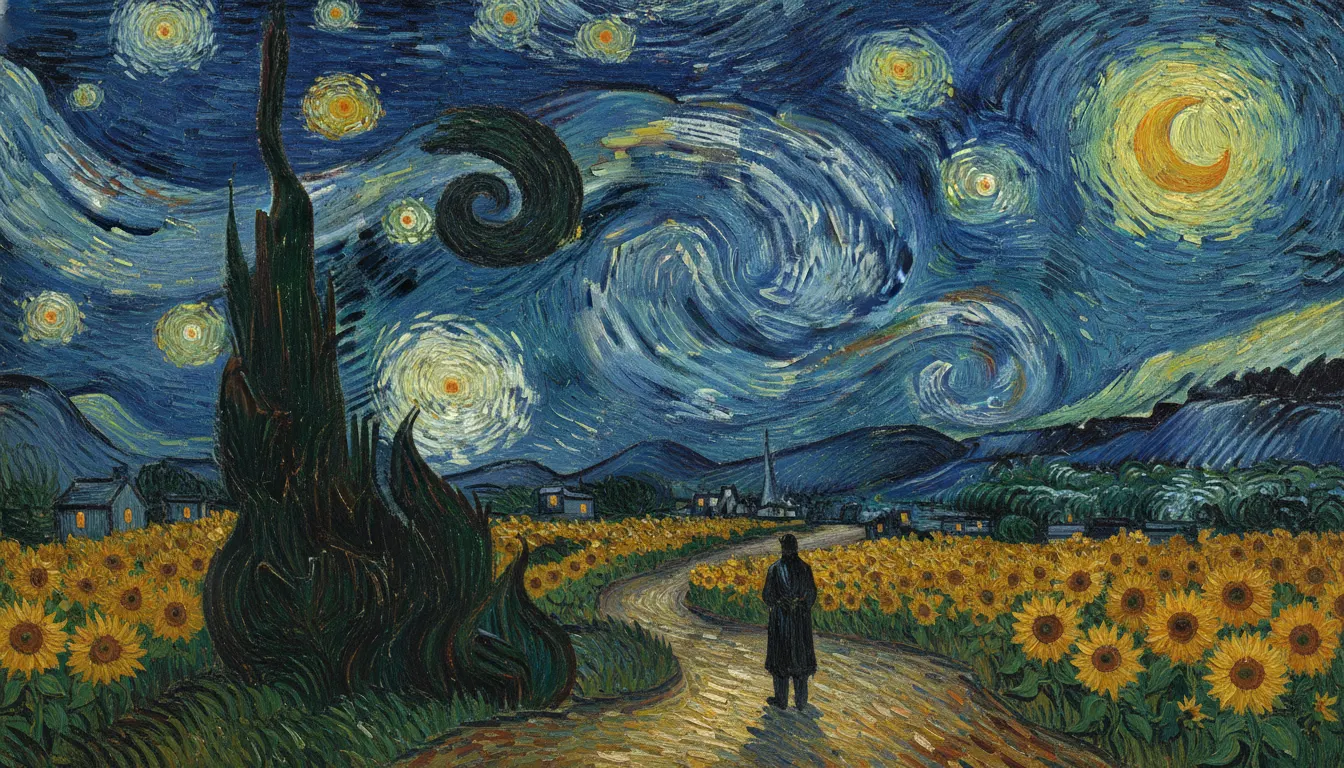
Vincent van Gogh Post-Impressionist impasto. Swirling thick brushstrokes, Starry Night cypress, sunflower yellow, cobalt night.
post-impressionistimpastoswirlingemotional
WHEN TO USE
- Emotionally intense narrative content -- portrait profiles, mental health stories, artist biographies -- where swirling expressionism reinforces interior states
- Travel, nature, or landscape content where expressive colour and energetic sky treatment adds poetry
- Art or museum brand content and educational explainers about fine art movements
- Music videos, lyric videos, or short films seeking a painterly, emotive visual texture
- Social content around creativity, passion, or obsession where the tortured-genius register is appropriate
WHEN NOT TO USE
- Corporate, financial, or B2B content where the expressive emotional intensity reads as unstable
- Minimalist or clean-design brands where the impasto density is visually overwhelming
- Comedy or light-entertainment content where the overwrought painterly atmosphere undercuts the tone
- Photojournalism or documentary content requiring apparent objectivity
SIGNATURE TECHNIQUES
How the look is made.
The moves a human crew would use to get here. Cue applies them for you, and knowing their names is how you ask for a change.
- 01Thick impasto brushwork with directional, sinuous strokes that describe the energy of the subject -- sky, wheat, water -- rather than its static appearance
- 02Complementary colour juxtapositions (yellow/violet, orange/blue) for maximum vibrational contrast
- 03Swirling, concentric, or radiating mark patterns in skies, water, and foliage
- 04High
key, hot palette in Arles and Saint-Rémy periods: cadmium yellow, chrome orange, ultramarine, viridian
- 05Heavy, visible outlines around forms in dark blue or black, derived from Japanese woodblock influence
- 06Paint applied in parallel hatched strokes in some areas (Pointillist influence) and in thick fluid curves in others
- 07Dramatic, compressed compositional space
horizon lines pushed high, subjects filling the frame
HISTORY & CONTEXT
Where it comes from.
Post-Impressionism: Van Gogh
Vincent van Gogh (1853-1890) is the defining figure of Post-Impressionism: the movement that took Impressionism's liberation of colour and brushwork and pushed it toward personal, psychological, and expressive intensity. In a painting career spanning only a decade -- and intensely productive only from 1888-1890 -- van Gogh produced more than 2,100 artworks that became the most recognisable in Western art history.
Style Development
Van Gogh moved from the dark, earthy palette of his Dutch period (The Potato Eaters, 1885, Van Gogh Museum) through a revolutionary encounter with French Impressionism in Paris (1886-88), where Seurat's Pointillism and Japanese woodblock prints permanently altered his sense of colour. His mature style emerged in Arles, southern France, in 1888: The Night Café (1888, Yale University Art Gallery), The Yellow House (1888, Van Gogh Museum), and the first Sunflowers series (1888, National Gallery London; 1889, Van Gogh Museum).
At the Saint-Paul-de-Mausole asylum in Saint-Rémy (1889-90), van Gogh produced his most celebrated works: The Starry Night (June 1889, MoMA) -- the swirling night sky over Saint-Rémy with its turbulent cypresses -- and a further Sunflowers variant. At Auvers-sur-Oise in the final 70 days before his death, he painted Wheatfield with Crows (July 1890, Van Gogh Museum) -- three forking paths and a threatening sky, long read as a premonition.
Technique
Van Gogh's mark-making is the most imitated and recognisable in painting history. Brushstrokes are thick, directional, and autonomous -- each stroke records a physical gesture. He applied paint straight from the tube in some areas, building impasto ridges up to a centimetre high. Colour oppositions are deliberate: complementary pairs (yellow/violet, orange/blue, red/green) are juxtaposed to generate maximum vibrational intensity.
NOTABLE WORKS
Where you have seen it.
Sunflowers (1888, National Gallery London; 1889, Van Gogh Museum) -- Arles series
The Night Café (1888, Yale University Art Gallery) -- "clashing and jarring" colour as distress
The Starry Night (1889, MoMA) -- swirling night sky over Saint-Rémy
Irises (1889, J. Paul Getty Museum) -- Saint-Paul garden
Wheatfield with Crows (1890, Van Gogh Museum) -- final Auvers period
Self-Portrait with Bandaged Ear (1889, Courtauld Gallery London)
THE RECIPE
The exact knobs
the renderer turns.
A Look is not a filter. It is a set of stored decisions the pipeline reads before it makes a single frame, so two videos in the same Look actually match.
SettingValue
TransitionHow one shot becomes the next
hard cuts · 160ms · linearKen BurnsCamera move applied to stills
Slow push · 0.02 · centerTypographyDisplay / body / mono pairing
Playfair Display · Lora · JetBrains MonoMusic moodWhat the bed under the voice sounds like
solo-violin-yearning · orchestral-swellPrompt suffixAppended to every shot prompt in this Look
Vincent van Gogh Post-Impressionist painting, swirling impasto brushstroke, Starry Night cypress, sunflower yellow, cobalt night skyPALETTE
Primary
#F5C144
Secondary
#1A3A8E
Accent
#E8A05A
Text/Light
#1F1A08
Text/Dark
#FFF1D0
BG 900
#0A1024
BG 800
#1A2444
RELATED LOOKS
Next to it on the shelf.
Your first cut
is on us.
+ New videoFree plan · no card · 1080p export