ART MOVEMENT CLASSICAL · 1880S · FRANCE
Pointillism Seurat
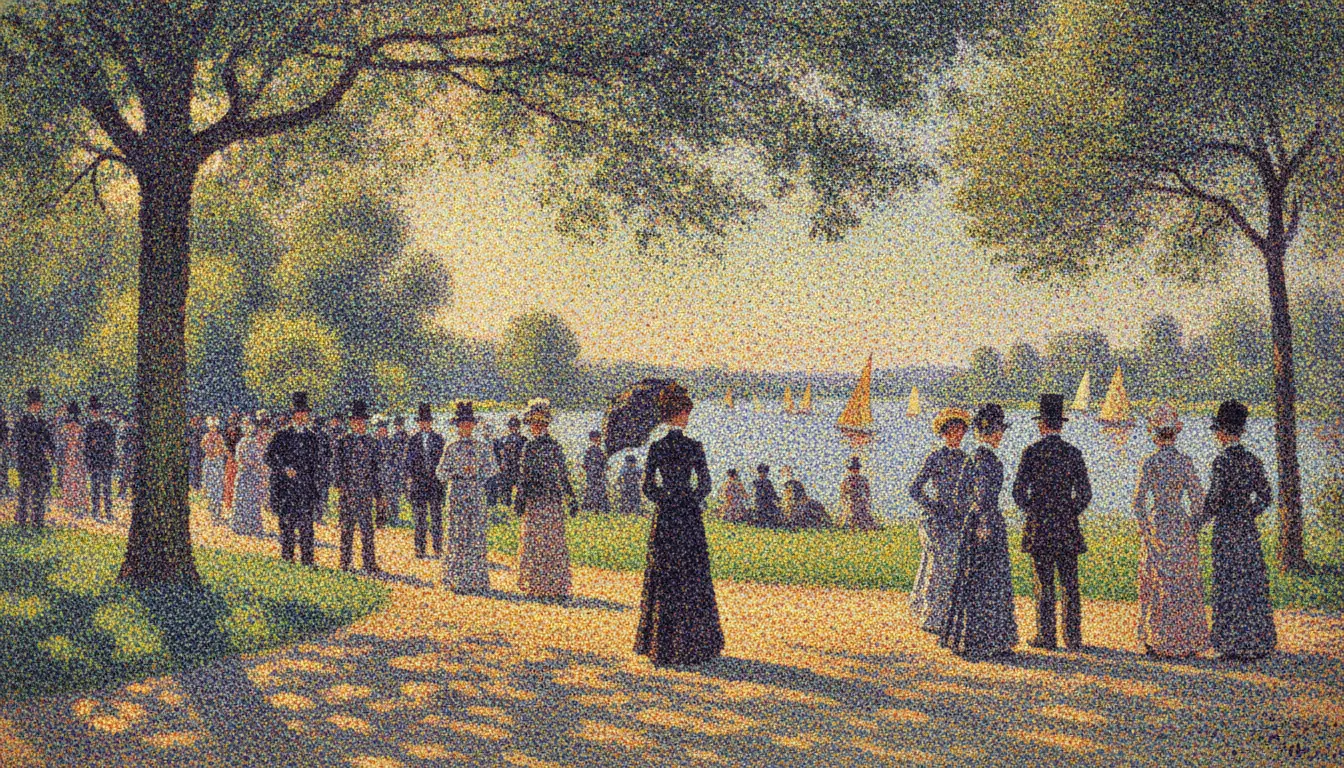
Georges Seurat Pointillist dot painting. Sunday on La Grande Jatte, parasol crowd, optical color mixing from tiny dots.
pointillistleisureddottedoptical
WHEN TO USE
- Art-historical or cultural content exploring Impressionism, Post-Impressionism, or 19th-century Paris
- Brand or campaign visuals that want to evoke luminous, sunlit leisure -- outdoor lifestyle, wellness, summer events
- Animated sequences where a mosaic or stippled texture adds visual poetry and craft
- Print-inspired digital art where optical colour mixing is the central conceit
- Music videos or short films set in 19th-century or Belle Epoque contexts
WHEN NOT TO USE
- High-speed, dynamic content where the static, contemplative quality is at odds with the energy
- Corporate or B2B content where the Fine Art register seems pretentious or inaccessible
- Dark, moody, or high-contrast content -- the technique depends on luminosity and pale tones
- Digital-native content where the retro-fine-art aesthetic signals inauthenticity
SIGNATURE TECHNIQUES
How the look is made.
The moves a human crew would use to get here. Cue applies them for you, and knowing their names is how you ask for a change.
- 01Small, uniform dots or dashes of unmixed, pure colour applied with a round brush
- 02Optical colour mixing
complementary colours placed adjacently create luminous in-between tones when viewed at distance
- 03Painted border of dots in complementary tones framing the canvas edge
- 04Pale, light
flooded palette emphasising yellows, oranges, pinks, and their complementary blue-greens
- 05Rigid, static figural poses that give scenes a frieze
like, monumental quality
- 06Careful balance of warm/cool temperature across the composition
- 07Systematic, all
over dotwork even in shadow areas -- no area left as flat tone
HISTORY & CONTEXT
Where it comes from.
Pointillism: Seurat
Pointillism -- or Divisionism, Seurat's preferred term -- is a Post-Impressionist technique developed by Georges Seurat (1859-1891) and refined alongside Paul Signac (1863-1935). Rather than blending pigments on a palette, the painter applies small, distinct dots or dashes of pure colour directly to the canvas and relies on the viewer's eye to blend them optically at a distance.
Theory and Science
Seurat grounded his method in contemporary colour theory, particularly the work of Michel Eugène Chevreul (On the Law of the Simultaneous Contrast of Colours, 1839) and Ogden Rood (Modern Chromatics, 1879). The principle is simultaneous contrast: adjacent complementary colours (orange and blue, red and green) appear more vibrant when placed next to each other than when mixed. By keeping colours unmixed on the canvas, Seurat aimed for a painting that vibrated with light. He also studied Charles Henry's theory of emotional directional lines: ascending diagonal lines produce joy; descending lines, sadness.
Defining Works
A Sunday Afternoon on the Island of La Grande Jatte (1884-1886, Art Institute of Chicago) is Seurat's masterwork: a 10 x 7-foot canvas depicting Parisian bourgeoisie at leisure on the Seine island. Two years in the making, it contains millions of individual dots and established Pointillism as a movement. Bathers at Asnières (1884, National Gallery, London) -- actually completed before La Grande Jatte -- shows working-class men swimming in the Seine and employs a slightly looser, proto-Pointillist touch.
La Parade de Cirque (1887-88), Le Chahut (1889-90), and The Circus (1890-91) demonstrate his later interest in applying emotional line theory to scenes of performance and popular entertainment. Seurat died at 31, but Signac carried the movement forward, influencing Van Gogh (who used choppy dashes rather than dots), Matisse, and Henri-Edmond Cross.
NOTABLE WORKS
Where you have seen it.
A Sunday Afternoon on the Island of La Grande Jatte (1884-86, Art Institute of Chicago) -- defining Pointillist masterwork
La Parade de Cirque / Circus Sideshow (1887-88, Metropolitan Museum of Art)
Le Chahut (1889-90, Kroller-Muller Museum) -- cancan dancers, emotional line theory applied
The Circus (1890-91, Musée d'Orsay) -- unfinished at Seurat's death
Paul Signac, D'Eugène Delacroix au Néo-Impressionnisme -- the movement's manifesto text
1899
THE RECIPE
The exact knobs
the renderer turns.
A Look is not a filter. It is a set of stored decisions the pipeline reads before it makes a single frame, so two videos in the same Look actually match.
SettingValue
TransitionHow one shot becomes the next
hard cuts · 160ms · linearKen BurnsCamera move applied to stills
Slow push · 0.02 · centerTypographyDisplay / body / mono pairing
Playfair Display · Lora · JetBrains MonoMusic moodWhat the bed under the voice sounds like
satie-gymnopedie · chamber-pastoralPrompt suffixAppended to every shot prompt in this Look
Georges Seurat Pointillist painting, Sunday on La Grande Jatte, parasol park crowd, tiny color dots optical mixingPALETTE
Primary
#7DB9D7
Secondary
#A8D5BA
Accent
#E8A05A
Text/Light
#1A2A30
Text/Dark
#F5FAFF
BG 900
#1A2A30
BG 800
#2A3A40
RELATED LOOKS
Next to it on the shelf.

Your first cut
is on us.
+ New videoFree plan · no card · 1080p export