Uncharted 4: A Thief's End
2016
Naughty Dog/Sony; PS4 visual benchmark
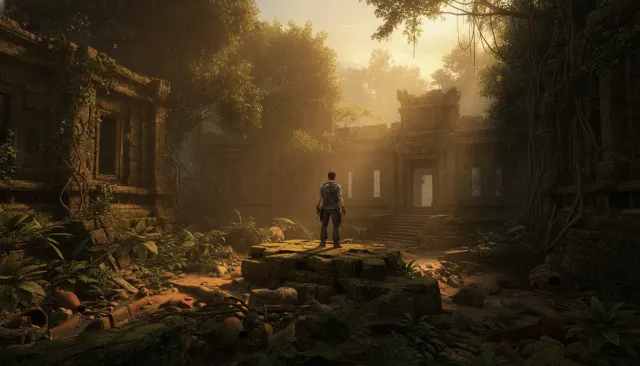
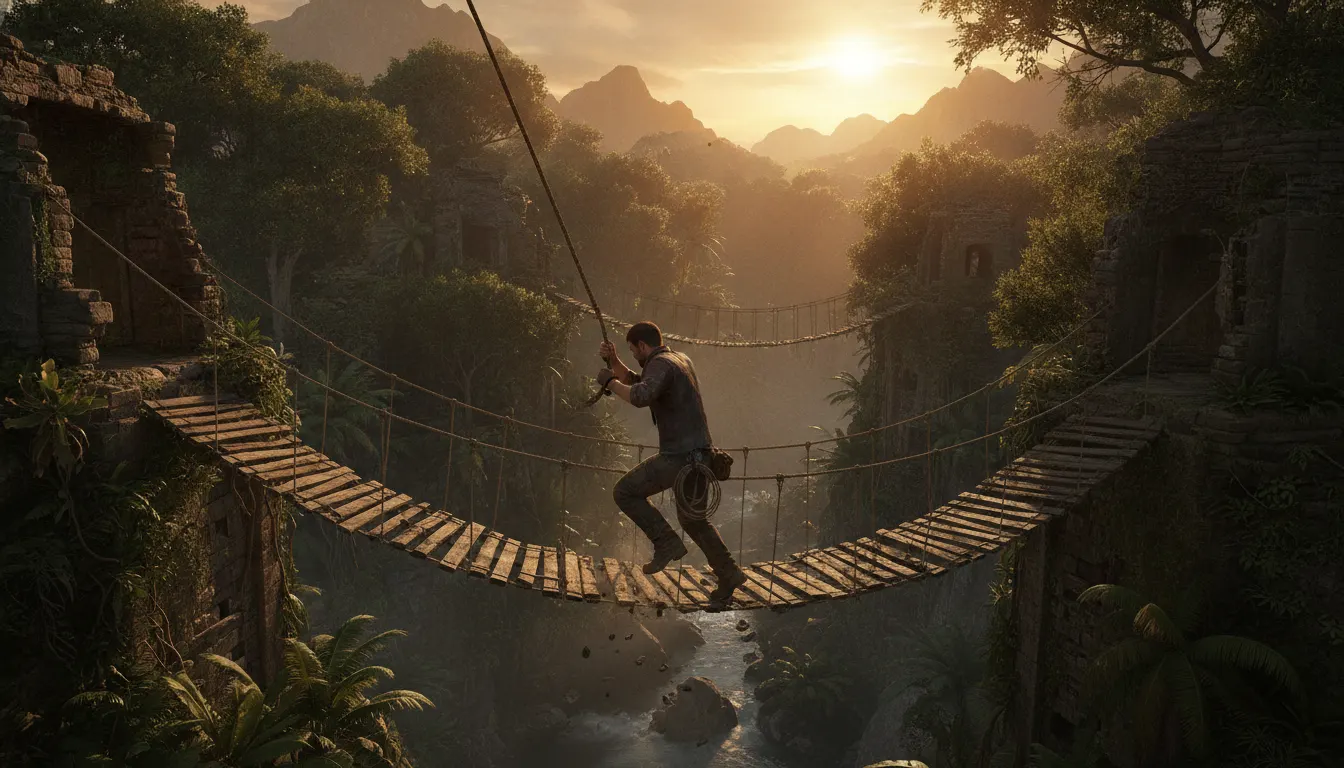
PS4 Uncharted 4 cinematic real-time CGI. Naughty Dog mocap performance, Madagascar jungle vistas, photoreal cloth and skin shader, action-set-piece staging.
The moves a human crew would use to get here. Cue applies them for you, and knowing their names is how you ask for a change.
film motivated lighting with golden-hour warm amber palette and soft fill
of-field and motion blur calibrated to film-standard settings rather than clarity-first game defaults
Uncharted 4: A Thief's End (Naughty Dog, 2016), directed by Neil Druckmann and Bruce Straley, is the definitive example of PS4-generation cinematic game rendering. Released six years after Uncharted 2 established the PS3 benchmark, Uncharted 4 demonstrated what a full console generation's technical leap enabled when applied to the same creative framework.
Naughty Dog adopted physically-based rendering (PBR) for Uncharted 4, moving away from the hand-tuned specular responses of previous PS3 work toward materials defined by metalness, roughness, and physically accurate BRDF response. This enabled surfaces - wet rock, leather jacket, jungle mud, antique wood - to respond to lighting conditions with physical accuracy rather than approximation.
The environment team used photogrammetry scanning for key environment assets, capturing real-world surfaces (coral, stone, wood grain) and importing them as high-resolution normal and albedo maps. The result was environment surfaces with observable geological and biological detail that the PS3 generation's artists would have needed to author manually.
Art director Erick Pangilinan developed a lighting philosophy that explicitly referenced film cinematography - specifically the adventure film genre (the Indiana Jones series, John Huston's The Man Who Would Be King). Key sequences were lit to evoke golden-hour travel photography and the warm-amber quality of high-end adventure documentary footage.
Drake's model in Uncharted 4 - approximately 100,000 polygons, with detailed wrinkle maps, cavity shading, and subsurface scattering on skin - became the reference point for character rendering expectations on PS4. The performance-capture workflow, which integrated simultaneous face and body capture with actors performing full scenes, produced character animation that critics described as reaching the threshold of emotional cinematic performance.
The Madagascar jeep chase sequence is frequently cited as the PS4 generation's single most technically demanding real-time action sequence. The scene runs continuously through a living coastal town, down market streets, across rooftops, and into a collapsing bell tower. Dynamic crowd simulation, destructible environment geometry, vehicle physics, mud interaction, and rain rendering all run simultaneously, intercutting with dialogue action. The combination of individual benchmark-level systems operating in parallel within a single continuous sequence established Uncharted 4 as the primary reference for evaluating action-game cinematic production values across the PS4 generation.
The Last of Us Part I (Naughty Dog, 2022), a full remake of the 2013 PS3 original built entirely in the PS5 engine, demonstrates how directly the Uncharted 4 pipeline translated to the next generation. The fundamental approach - PBR materials, performance capture, art-directed cinematography - remained consistent, while Nanite-adjacent asset management and Lumen-influenced lighting elevated the visual fidelity. The remake is instructive as a comparison: the same artistic decisions that defined Uncharted 4 in 2016 produce dramatically different results at PS5 hardware capability, confirming that the aesthetic vision was always ahead of the hardware rather than defined by it.
2016
Naughty Dog/Sony; PS4 visual benchmark
2017
Naughty Dog/Sony; visual consistency in smaller-scope format
2020
Naughty Dog/Sony; evolved rendering generation
2017
Guerrilla Games/Sony; open-world PS4 rendering sibling
2018
Santa Monica Studio/Sony; Norse mythology PS4 visual achievement
2018
Rockstar Games; parallel open-world PS4 photoreal benchmark
A Look is not a filter. It is a set of stored decisions the pipeline reads before it makes a single frame, so two videos in the same Look actually match.