Avengers: Infinity War
2018
Weta Digital; Thanos digital performance
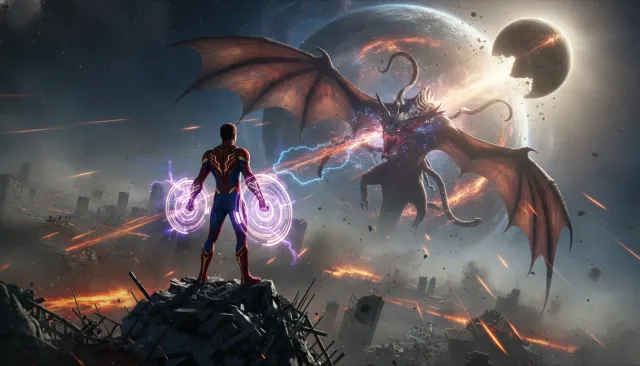
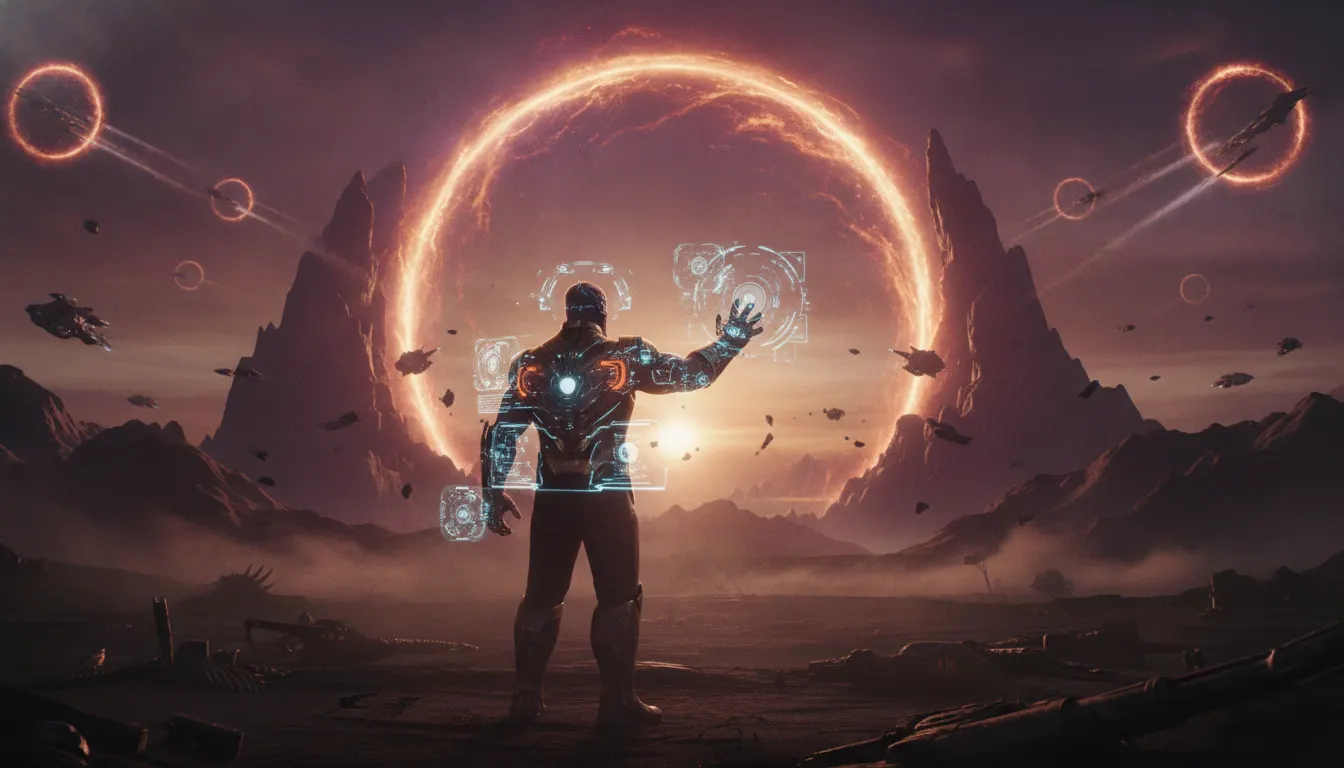
Marvel Cinematic Universe photoreal VFX CGI. Iron Man HUD, Thanos mocap, Endgame battle-portal spectacle, Industrial Light and Magic vendor stack.
The moves a human crew would use to get here. Cue applies them for you, and knowing their names is how you ask for a change.
layer subsurface scattering calibrated to individual character skin tones and ages
groom hair simulation with wind, water, and physical contact response
corneal refraction, iris detail, moisture layer
set captures matched to virtual scenes
body simulation for costumes and skin deformation under motion
truth color matching between CG and plate photography under identical conditions
Within the broader MCU visual effects pipeline, the photoreal tier refers specifically to the highest-fidelity work: digital doubles indistinguishable from their practical counterparts, environment replacements that pass scrutiny on 4K screens, and hero CG characters sustaining dramatic close-ups. This sub-aesthetic sits above general MCU blockbuster VFX and is the benchmark cited by VFX supervisors when evaluating character fidelity.
Weta Digital's work on Avengers: Infinity War (2018) and Avengers: Endgame (2019) defined the modern standard. Thanos - voiced and performed by Josh Brolin - required physically-based rendering that captured skin pore detail, eye moisture, and muscle deformation through facial capture translated to a non-human anatomy. The challenge was emotional legibility: a fully digital face must carry grief, menace, and conviction.
ILM's digital doubles for the portal sequence in Endgame required building hero-grade assets for more than 30 characters, each needing hero-level skin shading and cloth simulation. The constraint was that audiences who had spent 11 years with these characters would immediately detect shortcuts in groom, skin tone, or eye shading.
Black Panther: Wakanda Forever (2022) extended this into underwater environments, where Namor's motion and water interaction demanded a new pass on fluid-skin compositing that Framestore had pioneered in Aquaman (2018, Warner Bros.) but under different lighting constraints.
Standard blockbuster VFX often accepts approximations in medium and wide shots - the Hulk in Infinity War's opening holds a wide, but close-up drama falls back to practical. Photoreal-tier work removes that fallback. It requires multi-layered subsurface scattering calibrated per character skin tone, per-groom simulation on hair and facial hair that responds to wind and water, physically accurate eye corneal refraction, and specular response to on-set practical lighting replicated in the virtual scene.
A critical tool in MCU photoreal production is light stage capture: actors or reference objects are photographed under dozens of individually controlled light directions, producing a dataset that allows the compositing team to relight a digital double from any angle using real measured reflectance. ILM pioneered this approach in the 2000s and it has since become the standard method for photoreal digital human relighting. The practical consequence is that a digital double of an actor can be placed into a virtual scene with a completely different lighting setup - a golden-hour practical exterior, a fluorescent interrogation room - and relit using the actor's genuine skin reflectance data.
The result is footage that, when cut against genuine live photography, raises the live footage's apparent quality rather than dragging the VFX sequence into obvious artificiality.
2018
Weta Digital; Thanos digital performance
2019
ILM/multiple vendors; 30+ hero digital doubles in portal sequence
2022
Framestore; underwater Namor integration
2016
ILM; young Tony Stark de-aging
2017
Lola VFX; young Kurt Russell
2017
Method Studios; Surtur and fire-giant crowd simulation
2022
Digital Domain; dimensional fracture environments
A Look is not a filter. It is a set of stored decisions the pipeline reads before it makes a single frame, so two videos in the same Look actually match.