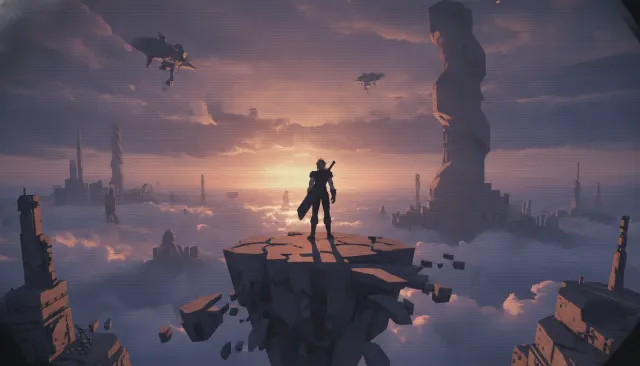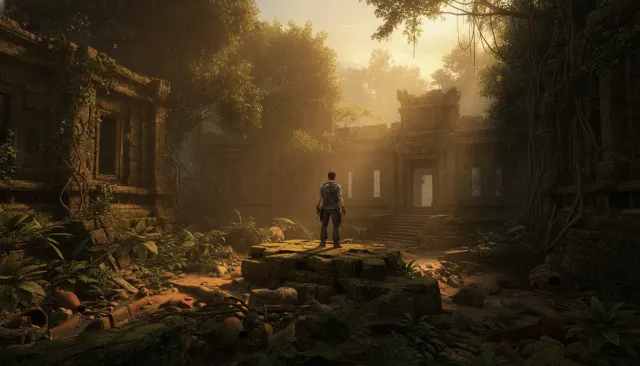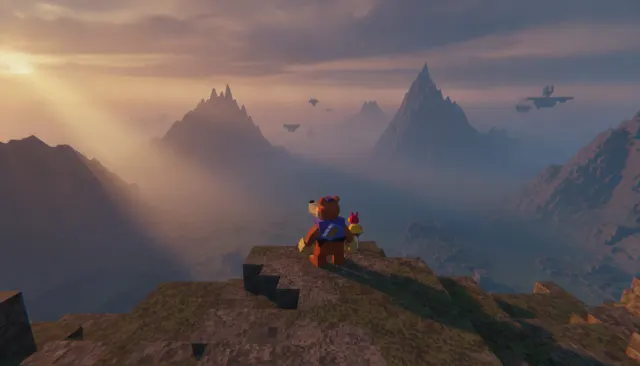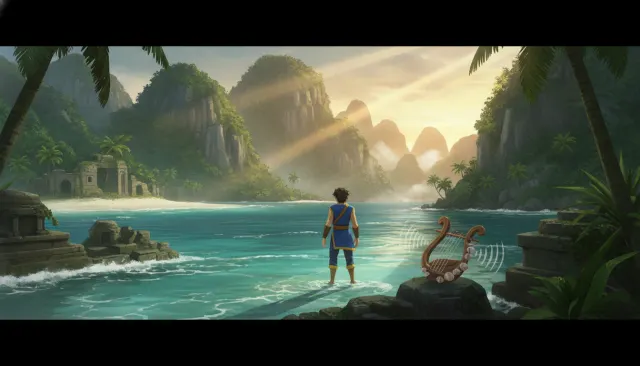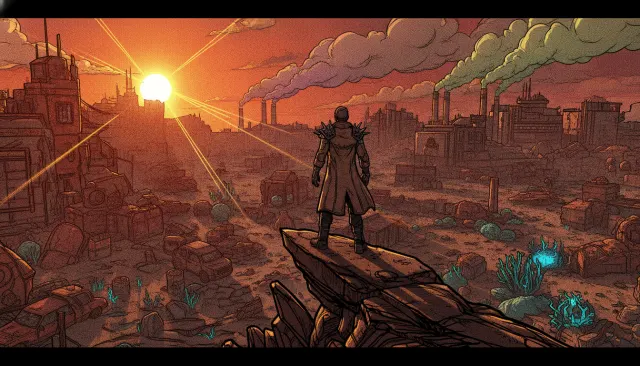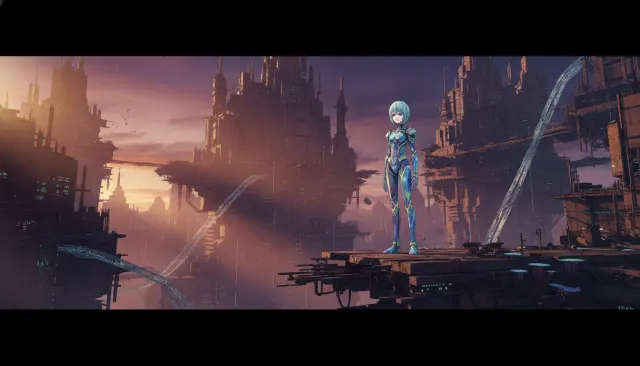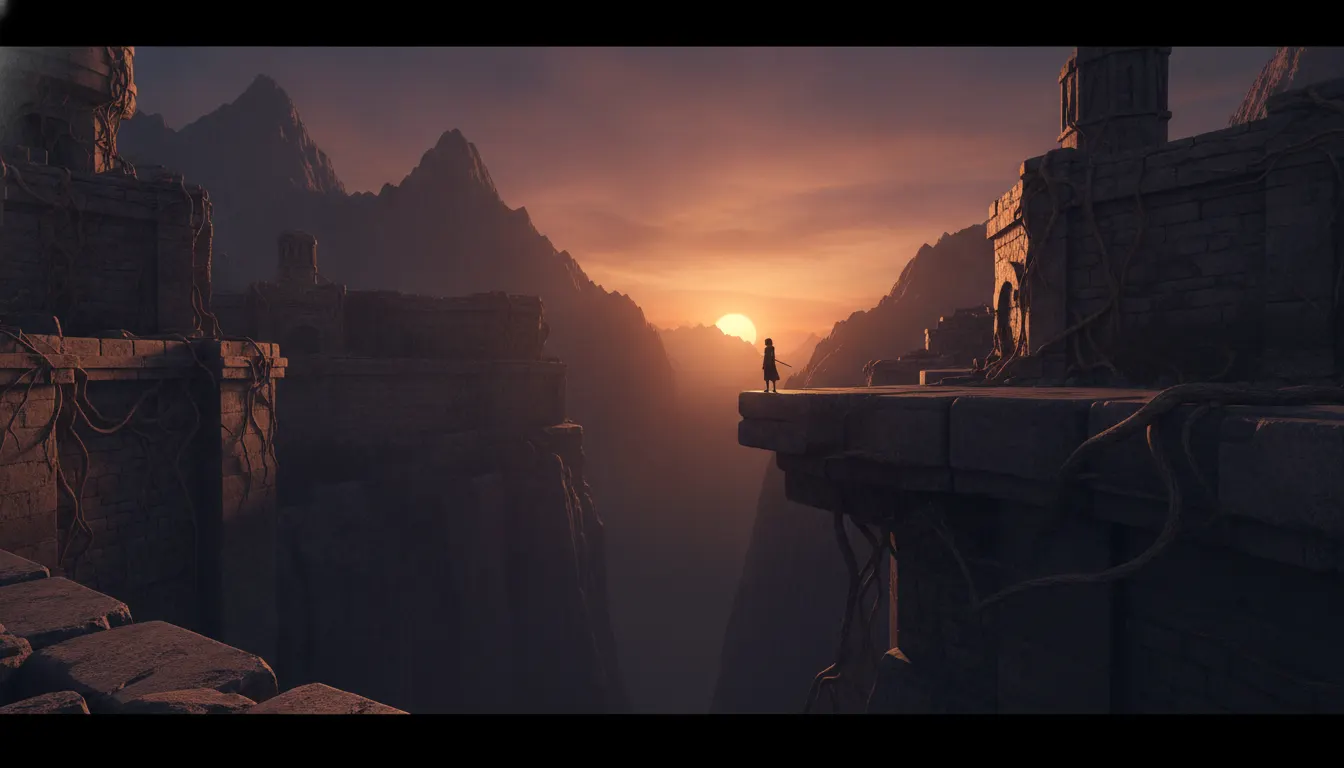
Ico
2001
Team Ico/Sony, Fumito Ueda; atmospheric PS2 minimalism
PlayStation 2 stylized era. Cleaner geometry, real-time lighting attempts, ICO and Shadow of the Colossus mood, Metal Gear cutscenes.
The moves a human crew would use to get here. Cue applies them for you, and knowing their names is how you ask for a change.
lit polygon models with per-vertex color providing primary surface shading
resolution texture maps in saturated color palettes emphasizing design over surface detail
The PlayStation 2 (Sony Computer Entertainment, 2000-2013) produced a 3D game aesthetic that sits between the raw jank of PS1 and the texture-rich photorealism of PS3. The PS2 era's visual identity is defined by vertex-lit polygon rendering, higher polygon counts than PS1 allowing for smoother organic silhouettes, but texture resolution and shader complexity that encourage artists toward stylization rather than photorealism.
PS2's hardware - the Emotion Engine CPU and Graphics Synthesizer GPU - excelled at polygon throughput but had limited texture cache and no programmable pixel shaders (shader model 2.0 equivalent). This pushed developers to rely on vertex lighting (per-vertex color baked into models) and relatively low-resolution, flat-colored texture maps. The visual response was creative stylization: exaggerated character proportions, strong silhouettes, and flat-shaded color areas where photorealistic surface detail would be unconvincing.
Ico (Team Ico/Sony, 2001) - directed by Fumito Ueda - used PS2's constraints to achieve a deliberately minimalist aesthetic: soft, blown-out sunlight, vast empty stone environments, and two fragile character silhouettes as visual anchor. The bloom lighting and atmospheric haze were partly technical artifact (the PS2's limited depth buffer) that Ueda's team elevated into artistic choices. The result is still cited as one of the most visually distinctive games of the era.
Shadow of the Colossus (Team Ico/Sony, 2005) extended this into epic scale: colossi built from massive polygon assemblies with vertex-painted moss, stone, and organic texture, rendered in a desaturated amber-and-dust atmospheric palette that made the PS2's limited resolution feel painterly rather than inadequate.
Kingdom Hearts (Square/Disney, 2002) demonstrated the platform's cartoon potential: high-contrast cel-adjacent character designs for Disney characters, saturated world color palettes, and relatively fluid character animation using the PS2's higher polygon counts for smoother joint deformation than PS1 could achieve.
Okami (Clover Studio/Capcom, 2006) stands as the most artistically distinctive PS2 game and one of the most remarkable uses of hardware constraints in game aesthetics. Director Hideki Kamiya and artist Ikumi Nakamura developed a visual system based on Japanese sumi-e ink painting, using the PS2's flat-shading capabilities to render the world in bold ink outlines, flat color washes, and brush-stroke particle effects. The technical constraints that made photorealism impossible on PS2 made the ink-painting aesthetic not only achievable but natural: flat, non-photorealistic shading is precisely what PS2 hardware rendered most efficiently. Okami is the canonical example of a game that discovered its aesthetic by understanding its hardware rather than fighting it.
2001
Team Ico/Sony, Fumito Ueda; atmospheric PS2 minimalism
2002
Square/Disney; cartoon-influenced PS2 character rendering
2005
Team Ico/Sony; epic-scale PS2 atmospheric aesthetic
2006
Clover Studio/Capcom; sumi-e ink painting on PS2 geometry
2005
Santa Monica Studio/Sony; action combat PS2 visual peak
2001
Capcom; stylized action character design on PS2
A Look is not a filter. It is a set of stored decisions the pipeline reads before it makes a single frame, so two videos in the same Look actually match.