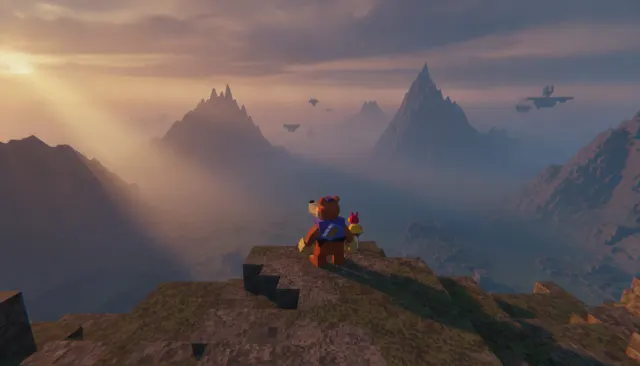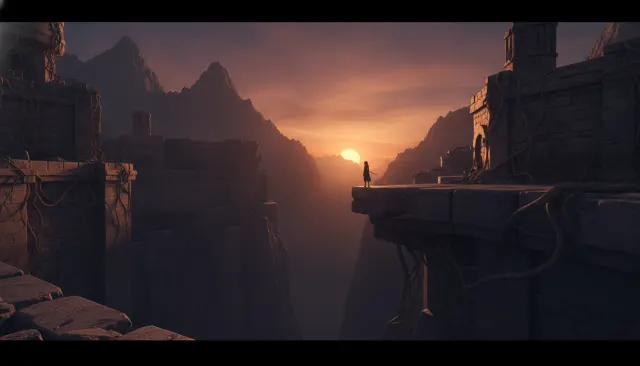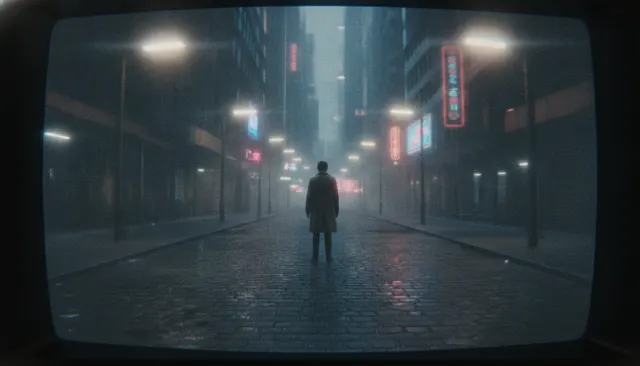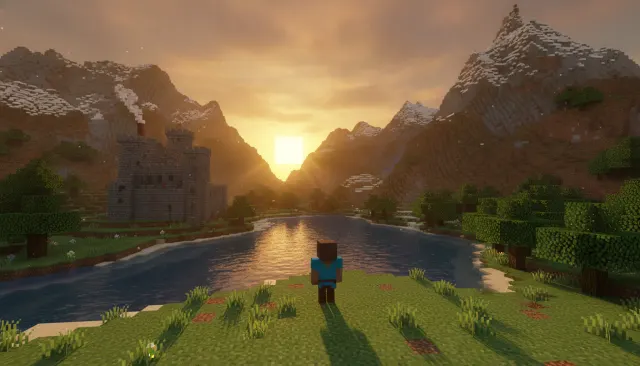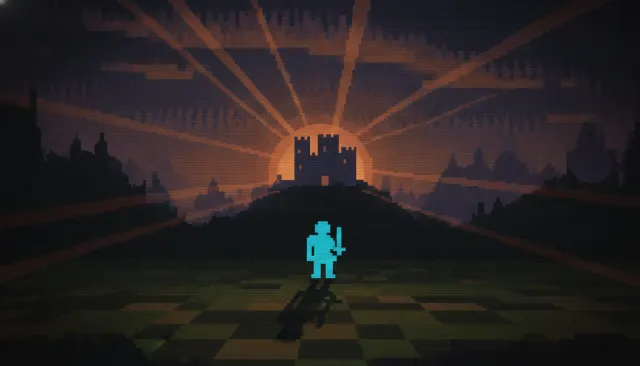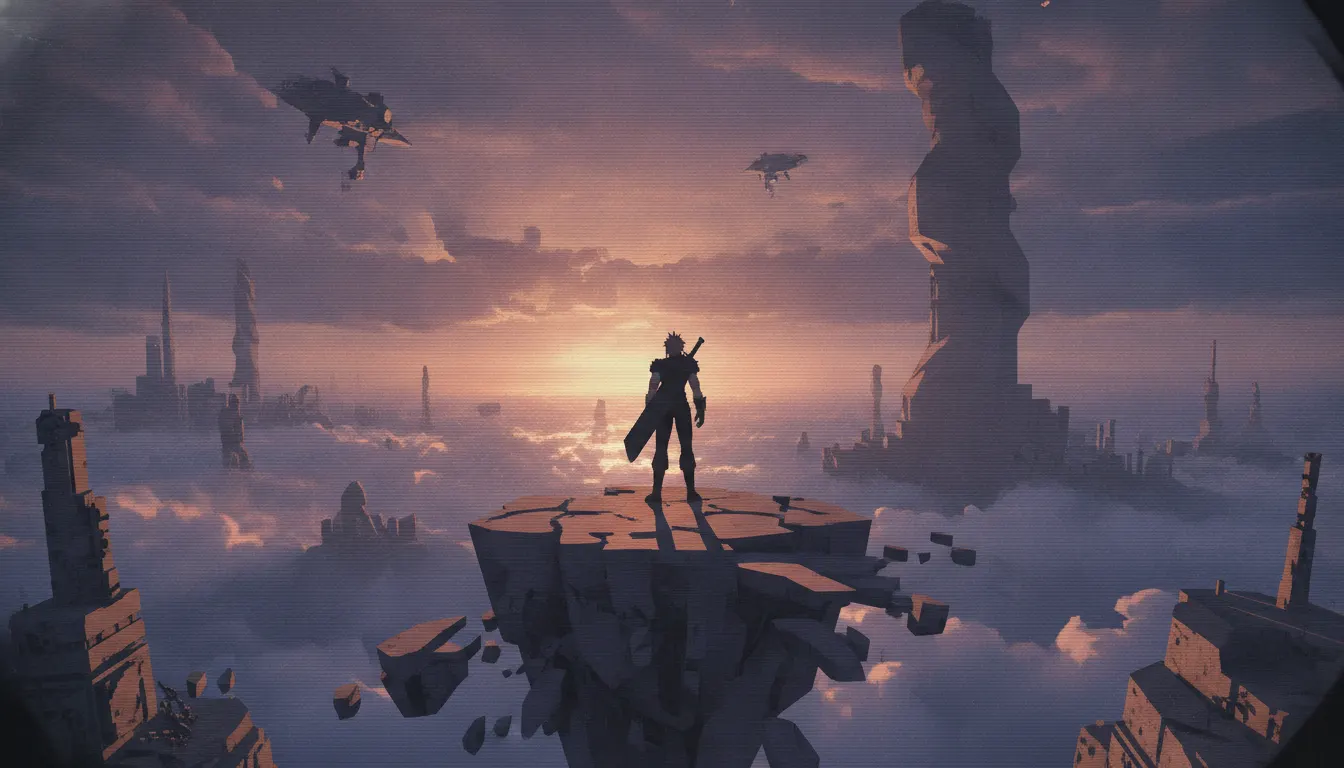
Final Fantasy VII
1997
Squaresoft; iconic pre-rendered background + low-poly character hybrid
PlayStation 1 low-poly era. Affine texture-warp, vertex jitter, jagged edges, 480i CRT scanlines, Final Fantasy VII feel.
The moves a human crew would use to get here. Cue applies them for you, and knowing their names is how you ask for a change.
rendered background plates with fixed camera angles and 3D character composited over them
polygon character models with flat shading and visible polygon edges
small texture maps with compressed color ranges
process aesthetic layer
The original PlayStation (Sony Computer Entertainment, released 1994 in Japan, 1995 in North America and Europe) produced one of the most culturally persistent game aesthetic categories: a low-polygon 3D look defined by affine texture mapping, vertex position snapping, and aggressive dithering that has aged into a beloved retro-gaming visual identity.
The PS1's GPU processed 3D geometry without floating-point precision - vertex positions were calculated in integer arithmetic, causing polygons to 'jitter' slightly as the camera moved. This vertex swimming, visible in every PS1 3D game as a subtle but constant polygon vibration, is the most distinctively jarring element of the aesthetic when viewed today. Final Fantasy VII (Squaresoft, 1997), Silent Hill (Konami, 1999), and Metal Gear Solid (Konami, 1998) all show this vertex oscillation prominently.
The PS1 used affine texture mapping - texture coordinates were interpolated linearly across polygon surfaces rather than perspective-corrected. On small polygons this is imperceptible, but on large surfaces (floors, walls, character torsos) it produced the distinctive 'texture warping' that made patterns distort and stretch as polygons rotated. This warping is arguably the single most recognizable visual signature of the era.
PS1's visual vocabulary - low-poly character models with blocky limbs, affine-warped textures, pre-rendered background plates with rigid 3D camera positions, and CRT scanline overlay - is now a deliberate aesthetic choice for indie games, lo-fi horror, and retro gaming content. Bloodborne PSX (2022) reimagined FromSoftware's 2015 game in authentic PS1 visual style as a fan project. Signalis (rose-engine, 2022) used PS1-era visual constraints deliberately for horror atmosphere. The lo-fi horror and 'PSX horror' genre on itch.io constitutes an active community of creators using authentic PS1 rendering techniques.
The PS1 era's technical defects - vertex swimming, texture warping, dithering patterns - were invisible to original players who lacked a visual baseline for comparison. Viewed today against smooth modern renders, they read as expressive artifacts rather than failures. The vertex jitter creates a sense that space is not stable, which is perceptually disturbing in exactly the way good horror production design requires. The affine texture warping gives flat surfaces a hand-drawn quality - patterns that shift and breathe rather than sitting static. These effects are now emulated in software (the Retro3D Shader in Godot, the PSX shader for Unity's URP) specifically because developers want these artifacts, not despite them. The PS1 era proved that technical limitation, when absorbed by a generation of players, becomes aesthetic memory.
1997
Squaresoft; iconic pre-rendered background + low-poly character hybrid
1998
Konami, Hideo Kojima; cinema-influenced PS1 3D
1999
Konami; fog-heavy PS1 horror aesthetic
1996
Naughty Dog; character-driven PS1 platformer
1996
Capcom; pre-rendered horror background aesthetic
2000
Squaresoft; higher-polygon PS1 late-era JRPG
A Look is not a filter. It is a set of stored decisions the pipeline reads before it makes a single frame, so two videos in the same Look actually match.