Minecraft Java Edition
2011
Mojang Studios, Markus Persson; original release
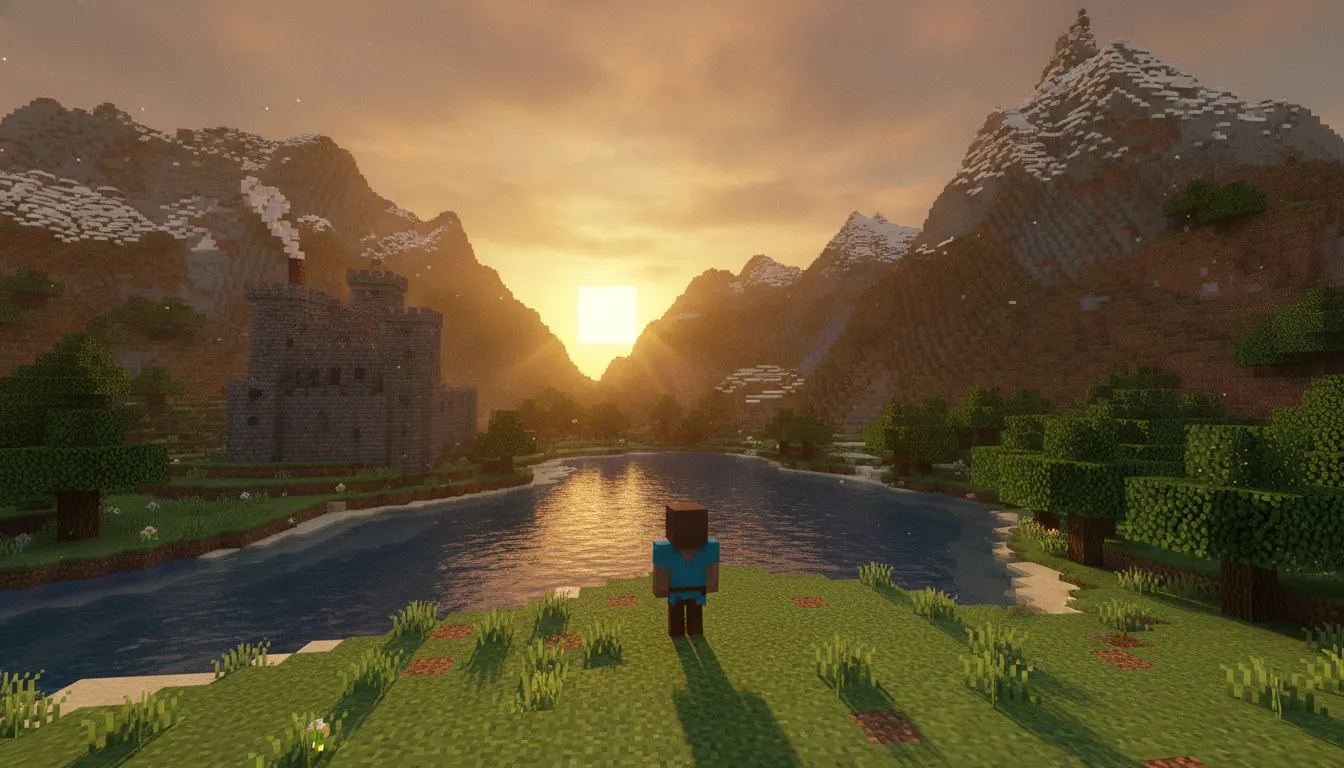
Minecraft voxel 3D world. Cubic block construction, low-res pixel texture, blocky character, sandbox creativity.
The moves a human crew would use to get here. Cue applies them for you, and knowing their names is how you ask for a change.
aligned cube geometry at uniform grid scale with no curves
per-face texture maps with hand-painted material identity
proportion character designs with square heads and boxy limbs
based color palettes: plains greens, desert sandstone, nether reds, deep ocean blues
night cycle color shifts from warm dawn orange to cool midnight blue
Minecraft, developed by Mojang Studios and originally released by Markus 'Notch' Persson in 2011, created the dominant visual template for voxel-based aesthetics in games and media. Its cube-world language has become so culturally embedded that 'voxel look' and 'Minecraft look' are often used interchangeably, even though voxel rendering predates Minecraft by decades.
Minecraft's aesthetic rests on a single constraint: all geometry derives from axis-aligned cubes at a fixed scale. Terrain, characters, trees, structures, and animals are all built from the same unit. This constraint is not a limitation - it is the source of the aesthetic's identity. Organic shapes become readable approximations: a tree is a cylinder of leaves atop a column of bark, a pig is a snout and body block assembly, a mountain is a staircase profile.
The original texture resolution is 16x16 pixels per face, giving every surface a tactile pixelated quality. The texture artist's craft is compressing material identity (wood grain, stone roughness, grass coloring) into 256 pixels. Microsoft's acquisition of Mojang in 2014 for $2.5 billion validated the cultural scale of this aesthetic, and subsequent texture packs, shader mods (SEUS PTGI, Continuum), and the official ray-tracing update for Bedrock (2020) have extended the base aesthetic into high-fidelity territory while preserving the cube geometry core.
The Minecraft aesthetic has spawned derivative styles across animation (Minecraft: Story Mode, Telltale Games 2015), the Minecraft Movie (Warner Bros./Legendary, 2025), YouTube series, and entire art movements within the game (pixel art builds, redstone engineering tutorials). The chunky-voxel character proportion - square head roughly equal in size to the body torso - became a recognizable character design shorthand for approachability and child-safe content.
Crossy Road (Hipster Whale, 2014) extended the chunky voxel aesthetic to mobile gaming, as did many idle and casual games that borrowed Minecraft's visual grammar for a younger or casual audience. The look signals accessibility, creativity, and digital-native culture.
The Minecraft modding community has produced extensive aesthetic extensions of the base game's visual system. Shader packs (SEUS PTGI, BSL Shaders, Complementary) add dynamic global illumination, realistic water reflections, and volumetric cloud rendering to the voxel base - creating scenes where the cube geometry reads as architectural abstraction against photorealistic lighting. The official Minecraft RTX Bedrock update (2020, Nvidia) integrated ray-traced global illumination, reflections, and shadows into the base engine, demonstrating that voxel geometry is compatible with the full photorealism pipeline. This extension is culturally significant: it proved the cube-world constraint is a design choice, not a visual ceiling.
2011
Mojang Studios, Markus Persson; original release
2015
Telltale Games; narrative voxel storytelling
2014
Hipster Whale; chunky voxel mobile aesthetic
Roblox Corporation; user-generated voxel/block worlds
2016
Mojang/Microsoft; educational deployment
2020
Nvidia/Mojang; ray-traced extension of voxel aesthetic
2025
Warner Bros./Legendary; live-action voxel world integration
A Look is not a filter. It is a set of stored decisions the pipeline reads before it makes a single frame, so two videos in the same Look actually match.