Haunted Mansion Grim Grinning Ghosts
Disney Imagineering (Yale Gracey) · 1969
First large-scale projection onto three-dimensional architectural elements in entertainment, establishing the core vocabulary
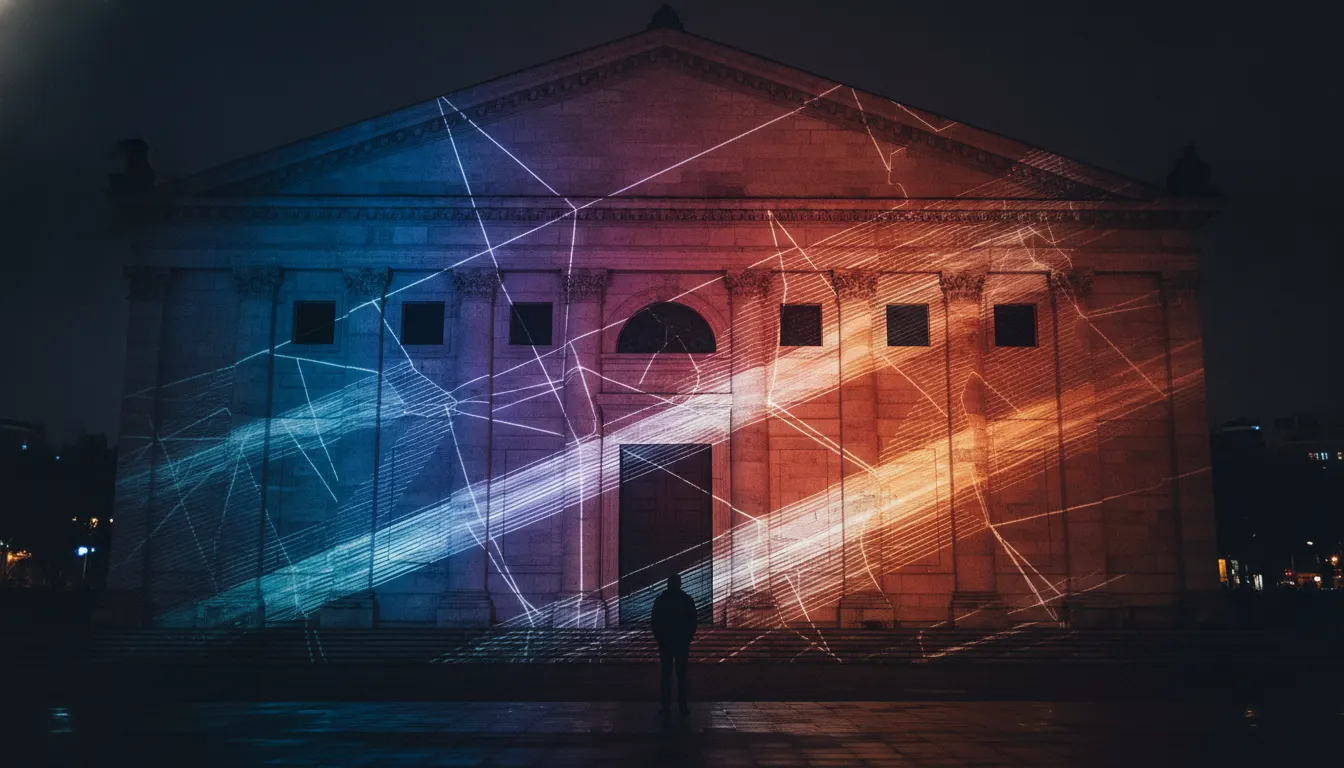
Architectural projection-mapping aesthetic. Building facade transformed at night by registered video projection, geometric morph, color sweep, parametric pattern over real stone.
The moves a human crew would use to get here. Cue applies them for you, and knowing their names is how you ask for a change.
Content designed to use window frames, columns, and cornices as compositional containers - the architecture's geometry becomes the visual grid.
Animation sequences where the facade appears to crumble, explode, or peel away to reveal interiors or alternative surfaces.
Projecting depth-cue content that makes shallow architectural surfaces appear to recede into impossible interior space.
Seamless seaming of outputs from two to fifty+ projectors covering a continuous facade surface, requiring precise brightness and color matching at overlap zones.
Visual elements timed to the repetitive rhythm of columns, floors, and windows - arpeggiated light running up floors, synchronized flashing in window grids.
Stone appearing to become water, brick becoming fire, glass becoming ice - texture substitution that reads convincingly at projection scale.
Real-time video feed or generative content keyed to audio or environmental data, making the projection responsive rather than pre-rendered.
Architectural projection mapping uses video projectors to paint light onto building facades, transforming static structures into dynamic visual canvases. Unlike flat-screen video, projection mapping accounts for the three-dimensional geometry of the architecture, warping the projected content so that windows, columns, cornices, and recesses appear to be the content's natural container. The building appears to dissolve, explode, reshape, or reveal secret interiors.
The technique has a precise origin: Disney's Haunted Mansion ride at Disneyland (1969) used pepper's ghost projection and basic surface mapping to animate the Grim Grinning Ghosts singing busts in the ballroom scene - the first widely experienced large-scale projection on three-dimensional architectural objects. The underlying mathematics for perspective-correct projection onto 3D surfaces was formalized in computer graphics through the 1980s and 1990s.
The first outdoor architectural projection mapping in the contemporary sense is credited to Michael Naimark's Displacements (1984), which projected film of a living room back onto the same room after removing the furniture. Krzysztof Wodiczko's projections onto public monuments (the Hirshhorn in Washington, 1988; the Bunker Hill Monument in Boston, 1998) established building projection as political and artistic practice.
The French/European collective AntiVJ (formed 2007) and Austrian artist Klaus Obermaier's work Apparition (2004, with Rob Tow) and Apparition with Robert Lepage defined the contemporary vocabulary. AntiVJ's projection work for Mutek festival and their open-source projection mapping toolkit catalyzed a global community. Bioluminescent (2009, AntiVJ on buildings in Berlin and Lyon) remains a reference for geometry-integrated projection design.
The software ecosystem that made widespread practice possible: MadMapper (GarageCube, 2009), Resolume Avenue (2003, added mapping 2009), and TouchDesigner (Derivative, 2010s) gave practitioners accessible geometry calibration tools. The Festival of Lights in Berlin (annually from 2005) and Fête des Lumières in Lyon (since 1999, contemporary mapping from ~2007) became annual global showcases.
Projection mapping has become a major entertainment format: Illumination shows at Disney parks (2015-present), the Opening Ceremony of the Tokyo Olympics (2021) using 1,824 drones and projection in combination, and Moment Factory's work for the Montreal Notre-Dame Basilica Aura show (2017-present, 50 projectors) represent the upper commercial scale. Box (Bot & Dolly, 2013) demonstrated synchronized robotic camera motion with projection mapping for viral video content.
Disney Imagineering (Yale Gracey) · 1969
First large-scale projection onto three-dimensional architectural elements in entertainment, establishing the core vocabulary
Michael Naimark · 1984
First contemporary-concept architectural mapping, projecting a living room back onto itself after removing its furniture
Klaus Obermaier with Robert Lepage · 2004
Projection mapping on a dancer and architectural surfaces combined, defining the performer-architecture integration vocabulary
AntiVJ · 2009
Defining work in European outdoor architectural projection, using building geometry as compositional grid
Moment Factory · 2017-present
Permanent installation using 50 projectors to animate the interior of Montreal's Notre-Dame Basilica, running nightly as a cultural attraction
Bot & Dolly / Google Creative Lab · 2013
Synchronized robotic camera and projection mapping producing geometric precision that defined the viral projection video format
A Look is not a filter. It is a set of stored decisions the pipeline reads before it makes a single frame, so two videos in the same Look actually match.