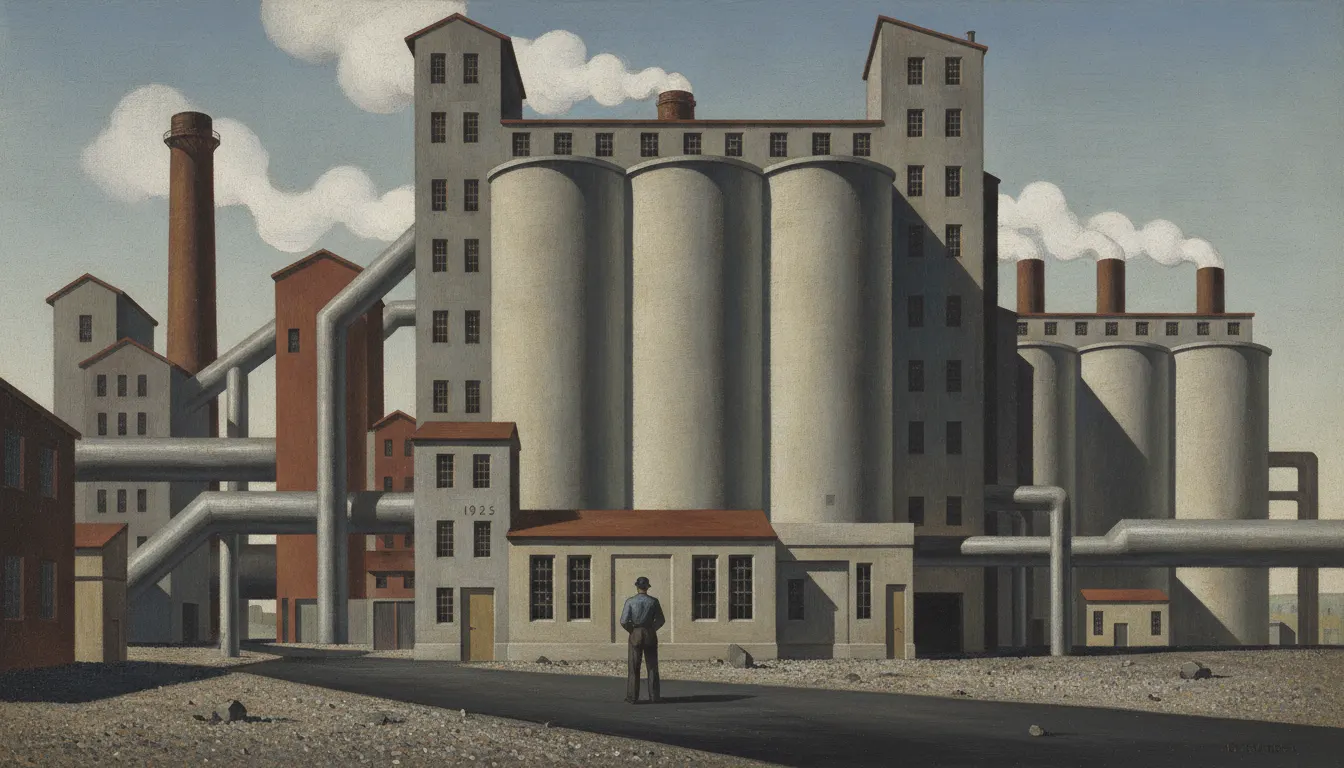
ART MOVEMENT EXTENDED · 1920S · USA
Precisionism Charles Demuth American
Charles Demuth Charles Sheeler American Precisionism. Crisp-edged grain elevators and smokestacks, geometric industrial poetry, clean modernist America.
precisionismindustrialcleanamerican
LUT precisionism-industrial-blue
WHEN TO USE
- Industrial, manufacturing, or infrastructure brand content that wants geometric clarity and modernist authority
- American history, architecture, or urban planning content from the 1910s-1940s
- Brand campaigns for engineering, construction, or technology firms where the machine-age aesthetic signals precision and capability
- Editorial illustration for pieces on American industrialisation, capitalism, or modernisation
- Album artwork or visual identity where cool geometric detachment is the desired register
WHEN NOT TO USE
- Warm, human, or community-oriented content where the cold geometric aesthetic creates emotional distance
- Nature, wellness, or organic brand content where industrial geometry conflicts with the value system
- Youth or entertainment content where the early-20th-century register feels remote
- International campaigns where specifically American industrial iconography does not resonate
SIGNATURE TECHNIQUES
How the look is made.
The moves a human crew would use to get here. Cue applies them for you, and knowing their names is how you ask for a change.
- 01Hard, clean edges with no gestural or expressive brushwork
- all surfaces rendered with technical precision
- 02Cubist
influenced geometric fragmentation and flattening of three-dimensional forms
- 03Muted, industrial palette
greys, taupes, steel blues, dusty whites, occasional accent of primary colour
- 04Architectural and mechanical subjects
- grain elevators, factory chimneys, water towers, bridges -- as primary subject matter
- 05Integration of typography, numbers, and text fragments into the composition (especially in Demuth's poster portraits)
- 06Elimination of human figures, weather, and atmospheric imprecision -- pristine, unpopulated scenes
- 07High
horizon or bird's-eye viewpoints that emphasise the geometry of industrial infrastructure
HISTORY & CONTEXT
Where it comes from.
Precisionism: Charles Demuth American
Precisionism is the first distinctly American Modernist art movement, flourishing between approximately 1915 and 1940. It applied the lessons of European Cubism and Futurism to the characteristic American subjects of the era: grain elevators, factory smokestacks, bridges, skyscrapers, and industrial architecture. The result is a visual language of cool, clean geometry -- no painterly imprecision, no Expressionist emotion -- that celebrates the machine age with the detachment of an engineer.
Charles Demuth (1883-1935)
Demuth studied at the Pennsylvania Academy of Fine Arts and in Paris, absorbing Cézanne and the Cubists. His signature contribution is the "poster portrait" -- a form he invented -- where a well-known figure is evoked through objects, words, and symbols rather than their likeness. I Saw the Figure 5 in Gold (1928, Metropolitan Museum of Art) is his masterwork: a tribute to poet William Carlos Williams and his poem "The Great Figure," combining the receding numbers 5-5-5, circular arc-light rings, and abstracted city signage into a dynamic Futurist composition. The title and Williams' initials -- W.C.W., Bill, Carlos -- are incorporated into the design.
His earlier paintings of water towers, grain elevators, and factory architecture in Lancaster, Pennsylvania (My Egypt, 1927, Whitney Museum of American Art) apply Cubist faceting and Precisionist hard edges to the American industrial landscape with a kind of reverent geometry.
Charles Sheeler (1883-1965)
Sheeler worked in parallel, frequently using his photography as source material for paintings. American Landscape (1930, MoMA) -- the Ford River Rouge plant at Dearborn -- is a river with smokestacks, cranes, and industrial infrastructure rendered in mirror-still reflection, without a human figure. Classic Landscape (1931, private collection) applies the same method to grain silos and railroad tracks. Sheeler called this "Immaculate" -- the unsentimentalised American scene.
Other Practitioners
Georgia O'Keeffe's New York skyscraper paintings of the 1920s, Elsie Driggs' Pittsburgh (1927), and Louis Lozowick's lithographs of industrial cities all belong to the Precisionist sensibility.
NOTABLE WORKS
Where you have seen it.
My Egypt (1927, Charles Demuth, Whitney Museum of American Art) -- Lancaster, PA grain elevators
American Landscape (1930, Charles Sheeler, MoMA) -- Ford River Rouge plant
Classic Landscape (1931, Charles Sheeler) -- grain silos and railroad
Pittsburgh (1927, Elsie Driggs, Whitney Museum of American Art)
Louis Lozowick, New York (1925, lithograph)
THE RECIPE
The exact knobs
the renderer turns.
A Look is not a filter. It is a set of stored decisions the pipeline reads before it makes a single frame, so two videos in the same Look actually match.
SettingValue
GradeColour LUT applied to every frame
precisionism-industrial-blueTransitionHow one shot becomes the next
hard cuts · 160ms · linearKen BurnsCamera move applied to stills
Slow push · 0.02 · centerTypographyDisplay / body / mono pairing
Futura · Inter · JetBrains MonoMusic moodWhat the bed under the voice sounds like
copland-americana · minimalist-pianoPrompt suffixAppended to every shot prompt in this Look
Charles Demuth Charles Sheeler American Precisionism painting, crisp edged grain elevators, smokestacks, geometric industrial poetry 1925PALETTE
Primary
#5C7A9C
Secondary
#3A4A5C
Accent
#D4A574
Text/Light
#0A1424
Text/Dark
#F5EFE0
BG 900
#0A1424
BG 800
#152A4A
RELATED LOOKS
Next to it on the shelf.





Your first cut
is on us.
+ New videoFree plan · no card · 1080p export