Finding Nemo
2003
Pixar Animation Studios, Andrew Stanton/Lee Unkrich
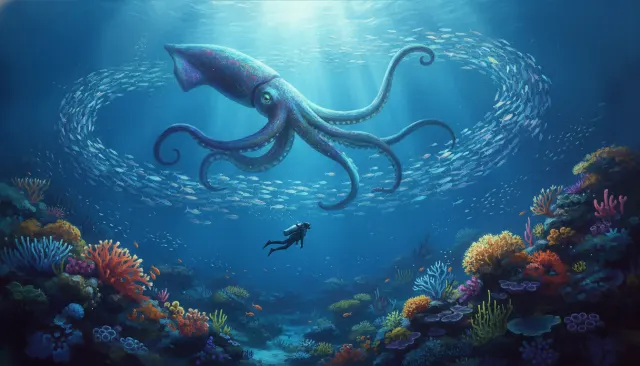
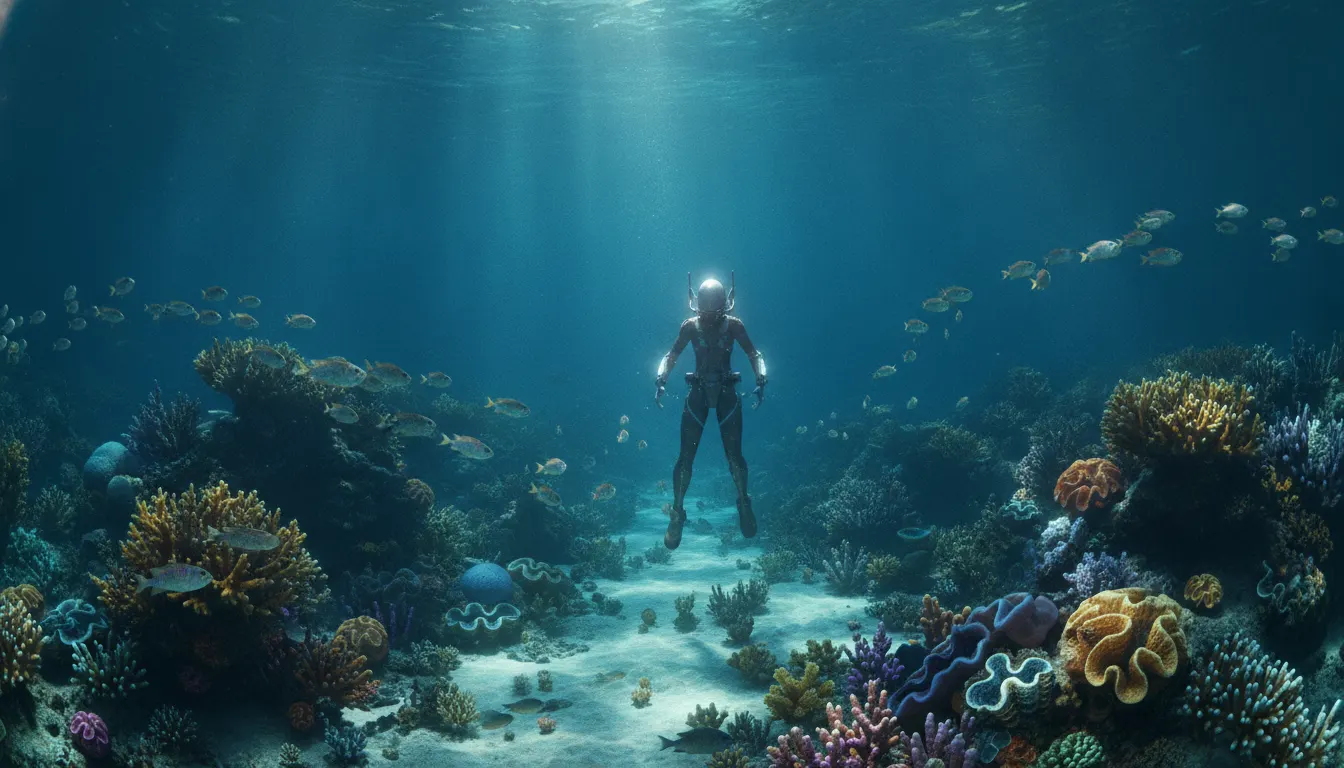
Pixar Finding Nemo underwater CGI. Great Barrier Reef sun shafts, translucent fish scales, caustics on coral, subsurface scattering breakthrough.
The moves a human crew would use to get here. Cue applies them for you, and knowing their names is how you ask for a change.
blue ambient color shifting with increasing water depth
based suspended sediment and plankton for volumetric underwater atmosphere
surface interface from below
Finding Nemo (Pixar Animation Studios, 2003), directed by Andrew Stanton and co-directed by Lee Unkrich, solved one of the central problems in computer graphics up to that point: how to render underwater environments and aquatic life with the physical light behavior that makes them visually distinct. The film's success - Academy Award for Best Animated Feature, $871 million worldwide box office - validated Pixar's bet on a setting that required inventing new rendering solutions.
Before Finding Nemo, CG characters looked like they were coated in a surface material (plastic, paint, rubber) because rendering engines treated surfaces as opaque reflectors. Skin, scales, flesh, and organic tissues are translucent - light penetrates the surface, scatters through the volume, and exits at a different point, creating the warm glow of back-lit skin or the iridescent sheen of fish scales. Pixar's rendering team developed and integrated subsurface scattering (SSS) into their RenderMan pipeline specifically for this production.
The result was immediately apparent: Nemo's clownfish scales carry a depth and light-transmission quality that no prior CG character had achieved. The SSS also transformed how water appeared - light filtering through the ocean surface created shifting caustic patterns on the sea floor, a physically accurate representation of how sunlight refracts through moving water.
Caustic light patterns - the moving web of refracted light on submerged surfaces - had been simulated in pre-rendered work before but were computationally expensive enough to avoid in feature animation. Pixar's team developed an optimized caustic simulation pipeline for Finding Nemo that created the film's most recognizable visual signature: the Great Barrier Reef's blue-green light patterns shifting across coral and seafloor throughout the film.
The color palette of the film was developed in close consultation with marine photography references and actual Great Barrier Reef footage. The result is a film where the underwater sequences feel simultaneously like a Pixar animated environment and a nature documentary.
Production designer Ralph Eggleston and director of photography Sharon Calahan faced a specific challenge: the film's primary environment is underwater, where human audiences have limited experiential reference. They solved this by establishing clear visual rules that remain consistent throughout the film. Shallow water near the reef uses warm, green-tinged filtered sunlight with visible surface caustics. Open ocean is rendered in desaturated deep blue-gray with increasing depth haze. Interior spaces (the anemone, the dentist's fish tank) use distinct lighting palettes that feel immediately recognizable as separate locations. These rules give viewers an intuitive spatial grammar for a world they have never inhabited - arguably the film's greatest achievement in world-building through cinematography.
2003
Pixar Animation Studios, Andrew Stanton/Lee Unkrich
2016
Pixar Animation Studios, Andrew Stanton; sequel aquatic rendering evolution
2016
Giant Squid Studios; game-form painterly underwater aesthetic inspired by Nemo
2016
Walt Disney Animation, Ron Clements/John Musker; ocean rendering evolution
2023
Walt Disney Studios; live-action underwater production reference
2018
Warner Bros., James Wan; photoreal underwater environment benchmark
A Look is not a filter. It is a set of stored decisions the pipeline reads before it makes a single frame, so two videos in the same Look actually match.