Coco
2017
Pixar Animation Studios, Lee Unkrich/Adrian Molina
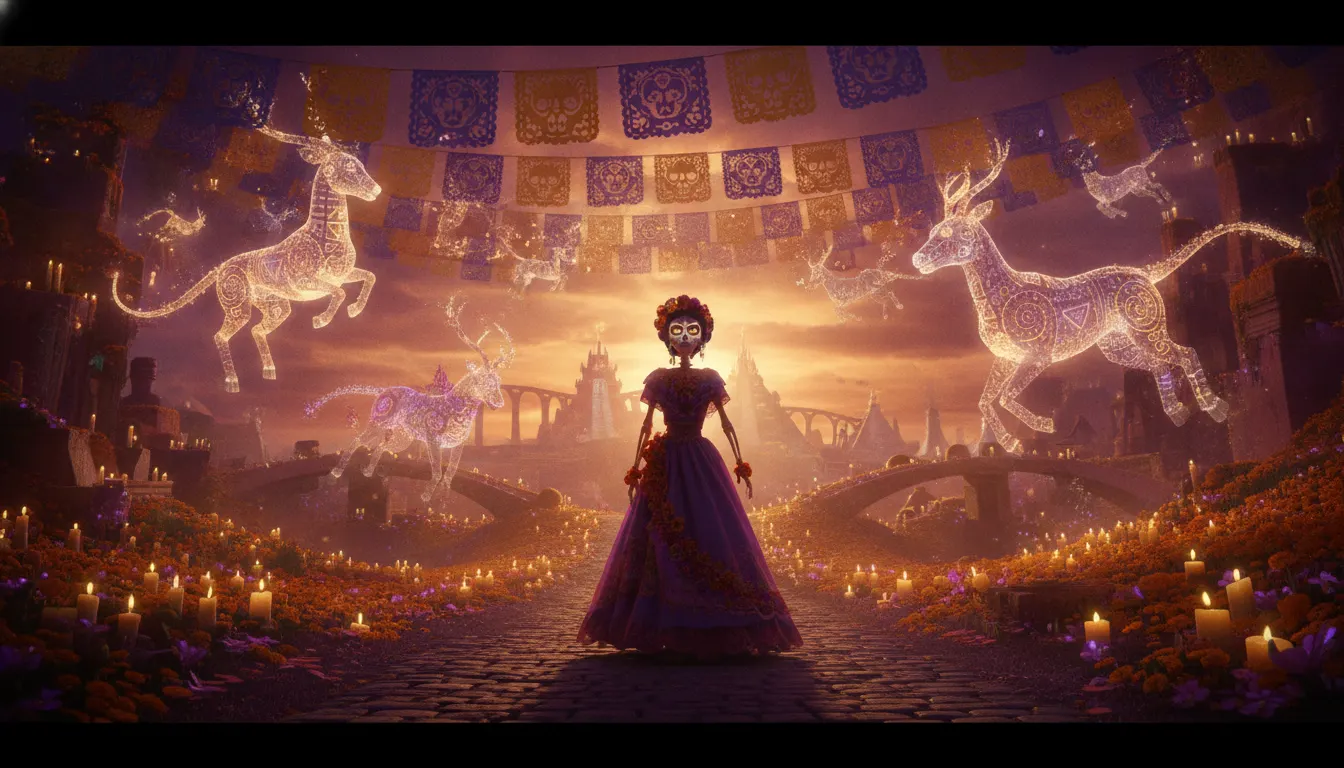
Pixar Coco Dia-de-los-Muertos CGI. Land-of-the-Dead marigold-and-violet palette, alebrije creatures, papel-picado banners, Mexican-folk magical realism.
The moves a human crew would use to get here. Cue applies them for you, and knowing their names is how you ask for a change.
saturation multi-hue stacking with dozens of competing chromatic ranges within single frames
warm contrast between living world earth tones and afterlife neon abundance
color production pipeline enabling chroma beyond sRGB display range
each district of the Land of the Dead uses a distinct hue family
specific light wrap from surrounding environment colors creating immersive ambient fill
Coco (Pixar Animation Studios, 2017), directed by Lee Unkrich and Adrian Molina, represents Pixar's most deliberately maximalist use of color as narrative language. The film's central aesthetic challenge was visualizing the Land of the Dead - a world that needed to feel simultaneously spectacular and emotionally resonant, abundant with cultural specificity while remaining universally accessible.
Production designer Harley Jessup and co-production designer John Hoffman built the film's color system around the Dia de los Muertos tradition of marigold flowers (cempasuchil) as guides for returning spirits. Marigold orange and yellow became the dominant palette of the Land of the Dead's light sources - the petal bridges, the glowing lanterns, the warm ambient fill that bathes every surface in the afterlife in a golden-amber warmth that has no equivalent in the living world's cooler, more restrained palette.
Against the marigold base, Jessup layered a compressed spectrum of every other saturated hue: teal building facades, magenta neon signs, cobalt night sky, viridian vegetation on impossible floating tower structures. The visual density - dozens of distinct hue ranges competing within a single frame - was a deliberate choice to make the Land of the Dead feel like a celebration rather than a place of mourning.
Pixar's rendering team, working with RenderMan, developed extended color range processing for the film that allowed them to work beyond sRGB display gamuts during production - the internal color data could represent hues more saturated than any current display could reproduce, ensuring the final color grade would extract maximum available chroma from theatrical projection. This 'wide-color' production pipeline was calibrated specifically for the film's requirements.
The living world of Santa Cecilia, by contrast, uses warm but comparatively gentle earth tones - terracotta, sand, deep green - that make Miguel's world feel real and grounded before the transition to the Land of the Dead's radical color abundance.
Pixar sent the production team to Mexico multiple times during development, visiting Oaxacan cemeteries during Dia de los Muertos celebrations, consulting with Mexican artists and cultural advisors, and building a cultural advisory committee that reviewed the script at multiple stages. The visual research informed specific design choices: the papel picado (cut-paper banner) motifs that appear in the Land of the Dead architecture, the marigold petal paths derived from traditional ofrenda altar practice, and the character designs that reference the diversity of regional Mexican traditional dress. The result is a film whose vivid color palette is not decorative but culturally grounded - the color abundance is the authentic chromatic language of Dia de los Muertos celebration.
2017
Pixar Animation Studios, Lee Unkrich/Adrian Molina
2014
Reel FX, Jorge Gutierrez; related Dia de los Muertos aesthetic predecessor
2021
Walt Disney Animation, Jared Bush/Byron Howard; related vibrant Latin American palette
2009
Pixar, Pete Docter; emotional color contrast precursor within Pixar
2020
Pixar, Pete Docter; jazz-world color contrast, Coco's sibling aesthetic
2022
Pixar, Domee Shi; saturated emotional color language
A Look is not a filter. It is a set of stored decisions the pipeline reads before it makes a single frame, so two videos in the same Look actually match.