Ne Zha
2019
Chengdu Coco Cartoon, Jiaozi; Chinese animated box office record
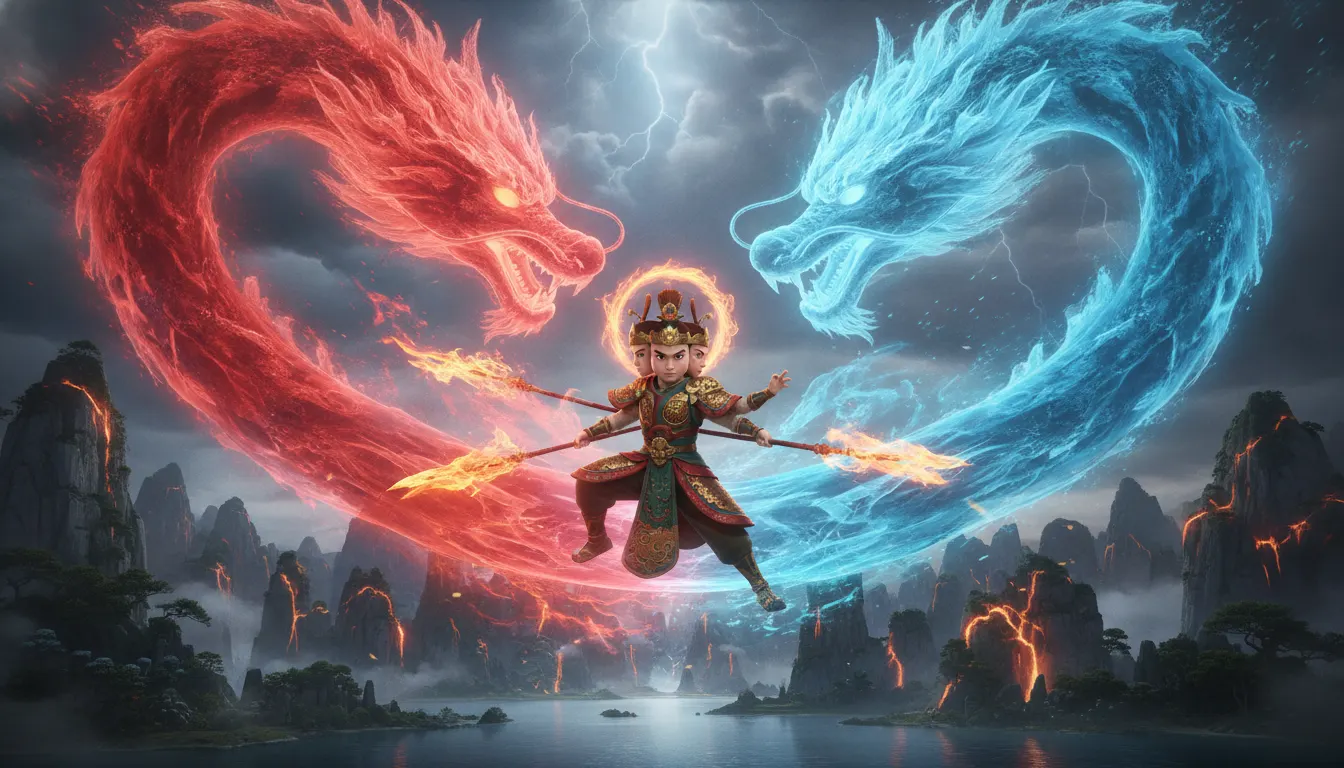
Ne Zha Chinese mythological 3D animation. Lush traditional palette, mystical fire-and-water effects, dynamic mythic action.
The moves a human crew would use to get here. Cue applies them for you, and knowing their names is how you ask for a change.
fire reds/oranges for chaotic energy, cool blues for refined power
wash painting influences in environment backgrounds and atmospheric haze rendering
saturation vibrant color palettes contrasting with ink-dark background tones
Ne Zha (哪吒之魔童降世, 2019), directed by Jiaozi (Yang Yu) at Chengdu Coco Cartoon, shattered Chinese box office records to become the highest-grossing animated film in Chinese history at the time (approximately 5 billion yuan), demonstrating that domestic Chinese animation studios could produce world-class 3D feature work.
The film draws on Chinese mythological source material - the Investiture of the Gods (封神演义) and the folklore of Ne Zha, a fiery deity child figure - and renders it through a 3D pipeline that synthesizes several distinct influences. The character designs balance stylized Western 3D animation conventions (expressive eye rigs, caricatured proportions) with aesthetic sensibilities drawn from Chinese opera, ink painting, and traditional woodblock print color palettes.
Ne Zha's design is deliberately transgressive: dark-ringed eyes, chubby body, and a chaotic energy expressed through fire-based visual effects in saturated reds and oranges. His rival Ao Bing uses cool blues and ice effects, creating an elemental color opposition that owes as much to Chinese five-element theory as to conventional film color storytelling. The ocean-deity environments draw on ink-wash painting traditions, with background mountains and water effects that recall classical shanshui (山水) landscape aesthetics rendered in 3D space.
Chengdu Coco Cartoon spent five years in production, wrestling with the complexity of fluid simulation for water and fire effects, cloth dynamics for traditional Chinese costume elements, and crowd scenes required for mythological battle sequences. The fire effects around Ne Zha's iconic fire-ring and lotus-petal wind-fire wheels were cited in industry press as a technical achievement for a Chinese studio at the time, matching effects quality seen in US and Japanese productions.
Ne Zha arrived as the flagship of a new wave of Chinese 3D animated features, following Big Fish and Begonia (B&T, 2016) and White Snake (Light Chaser Animation, 2019), and preceding Jiang Ziya (Coloroom/Beijing Culture, 2020). Together these films defined a recognizable aesthetic school: Chinese mythological source material, vivid color, expressive character design, and technically ambitious effects work from domestic studios.
The commercial and critical success of Ne Zha (2019) validated the investment thesis for large-scale domestic Chinese animation production and sparked significant industry growth. Multiple Chinese studios launched or expanded animation divisions in the years following its release. Director Jiaozi returned to develop Ne Zha 2 (2025), which continued the character arc from the first film. The sequel was highly anticipated domestically and became a major cultural event, demonstrating that the Ne Zha aesthetic had created a genuine franchise with audience loyalty comparable to major Western animated properties. The success of both films established Chengdu Coco Cartoon as one of the world's significant animation studios and drew international attention to the scope and ambition of contemporary Chinese 3D animation production.
2019
Chengdu Coco Cartoon, Jiaozi; Chinese animated box office record
2016
B&T Studio; ink-painting 3D mythological predecessor
2019
Light Chaser Animation; Chinese folklore 3D feature
2020
Coloroom/Beijing Culture; mythological 3D sequel era
2025
Chengdu Coco Cartoon; highly anticipated sequel
2015
Beijing Enlight Media; earlier Chinese 3D feature benchmark
A Look is not a filter. It is a set of stored decisions the pipeline reads before it makes a single frame, so two videos in the same Look actually match.