Paranoia Agent
2004
Madhouse/Satoshi Kon; 13-episode series
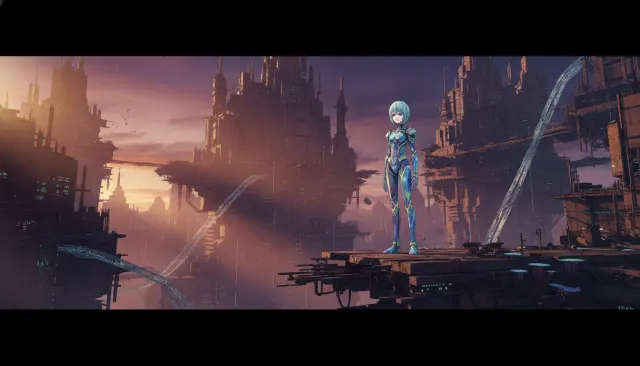
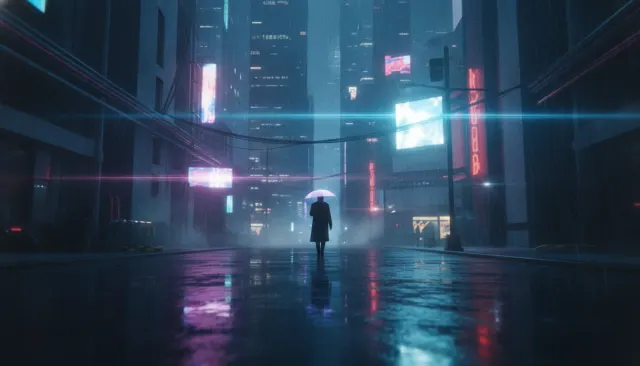
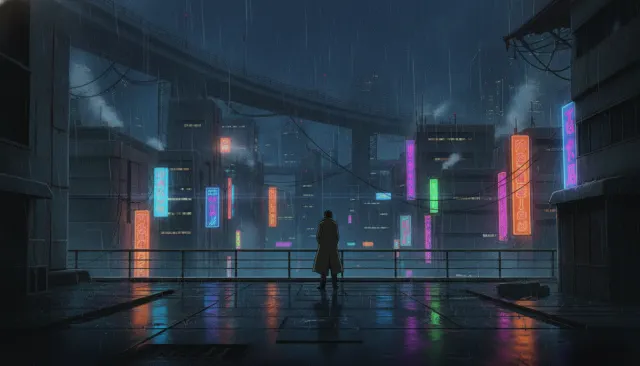
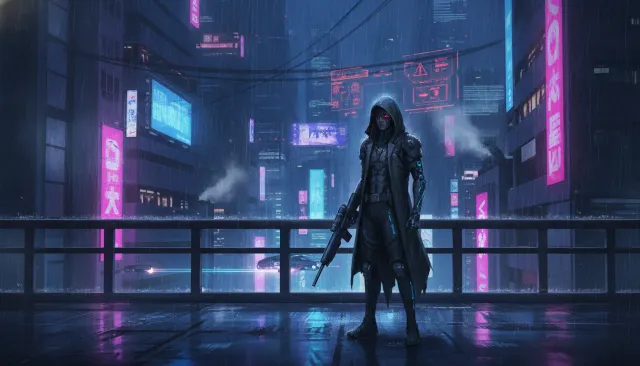
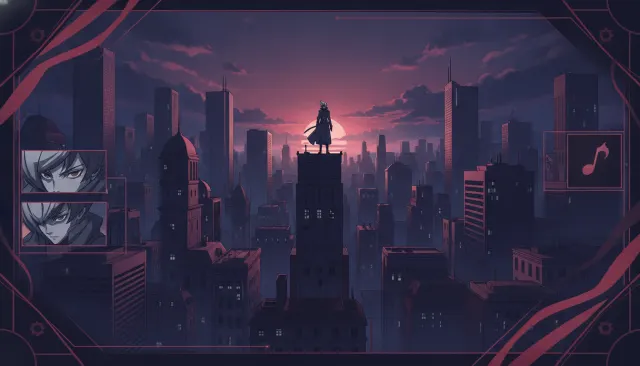
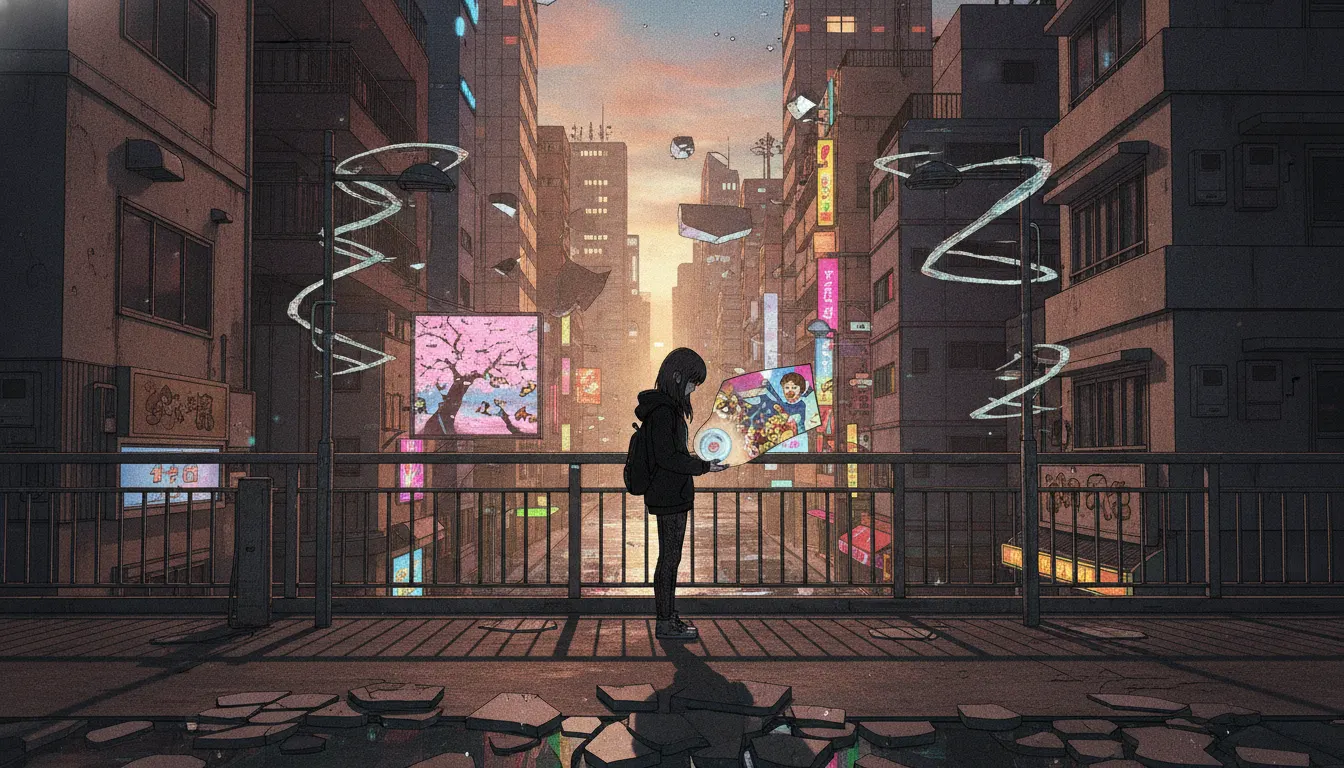
Satoshi Kon-influenced mixed 2D-3D paranoia aesthetic. Surreal urban Japan, abrupt reality shifts, fractured CG inserts.
The moves a human crew would use to get here. Cue applies them for you, and knowing their names is how you ask for a change.
ground planes tilting, perspective over-converging, horizon lines failing
universe media parody - showing 'bad' animation as a specific character's degraded perception
ramped and freeze-frame combinations at moments of psychological rupture
Paranoia Agent (妄想代理人, 2004), directed by Satoshi Kon and produced by Madhouse for WOWOW television, is one of the most visually ambitious anime series produced in the 2000s. It represents the fullest expression of Kon's signature technique: a rendering system that maintains photorealistic environmental and character detail under pressure, then deliberately breaks with hyper-real distortion, color inversion, and mixed-media insertions at psychological pivot points.
Kon had developed his distinctive approach across Perfect Blue (Madhouse, 1997) and Millennium Actress (Madhouse, 2001) - both feature films that used subjective psychological states to justify radical shifts in visual register. Paranoia Agent expanded this into a 13-episode structure that allowed each episode to occupy a different point on the spectrum between documentary realism and pure abstraction.
The show's Tokyo environments are rendered with genuine observational care: convenience store interiors, commuter-rail platforms, suburban residential streets. This specificity is crucial - the hyperreality breaks register as breaks precisely because the baseline is so grounded. When Shonen Bat (Lil' Slugger) attacks, the screen's spatial logic destabilizes: ground planes tilt, sky colors invert, and architectural perspective converges in impossible directions.
Episode 8, 'Happy Family Planning', uses a deliberately degraded, flat visual register to tell the story of three strangers attempting suicide - the aesthetic shift signals that these characters exist in a different psychological space from the show's 'normal' world. Episode 10, 'Mellow Maromi', is animated as a crude in-universe children's show, switching from the series' sophisticated Madhouse production to a mocking parody of cheap broadcast animation with deliberate still-frame shortcuts and timing errors.
This range - from observational realism to degraded parody within a single series - makes Paranoia Agent the defining example of aesthetic code-switching as psychological storytelling.
Kon's death in 2010 at 46 cut short a career that had produced four theatrical features and one television series, but his visual methodology has been widely cited in subsequent animation and live-action work. Black Swan (Darren Aronofsky, 2010) uses a photorealistic-to-hallucinatory visual shift that recalls Kon's approach in Perfect Blue. Satoshi Kon's work is cited explicitly by Paprika (2006), his final completed film, as the fullest realization of the mixed-register aesthetic - the dream-world sequences are full abstract color explosion, while the real-world scenes of Dr. Atsuko Chiba are shot in observational near-documentary style. Together, Kon's filmography established psychological state as a legitimate basis for aesthetic-register decision-making - a principle that has since become a recognized tool in animation direction.
2004
Madhouse/Satoshi Kon; 13-episode series
1997
Madhouse/Satoshi Kon; psychological thriller anime feature precursor
2001
Madhouse/Satoshi Kon; subjective-state visual grammar
2006
Madhouse/Satoshi Kon; dreamscape mixed-media culmination
2012
Khara; related psychological register shift in anime
A Look is not a filter. It is a set of stored decisions the pipeline reads before it makes a single frame, so two videos in the same Look actually match.