Massimo Vignelli and Bob Noorda
NYCTA Graphics Standards Manual (Unimark, 1970)
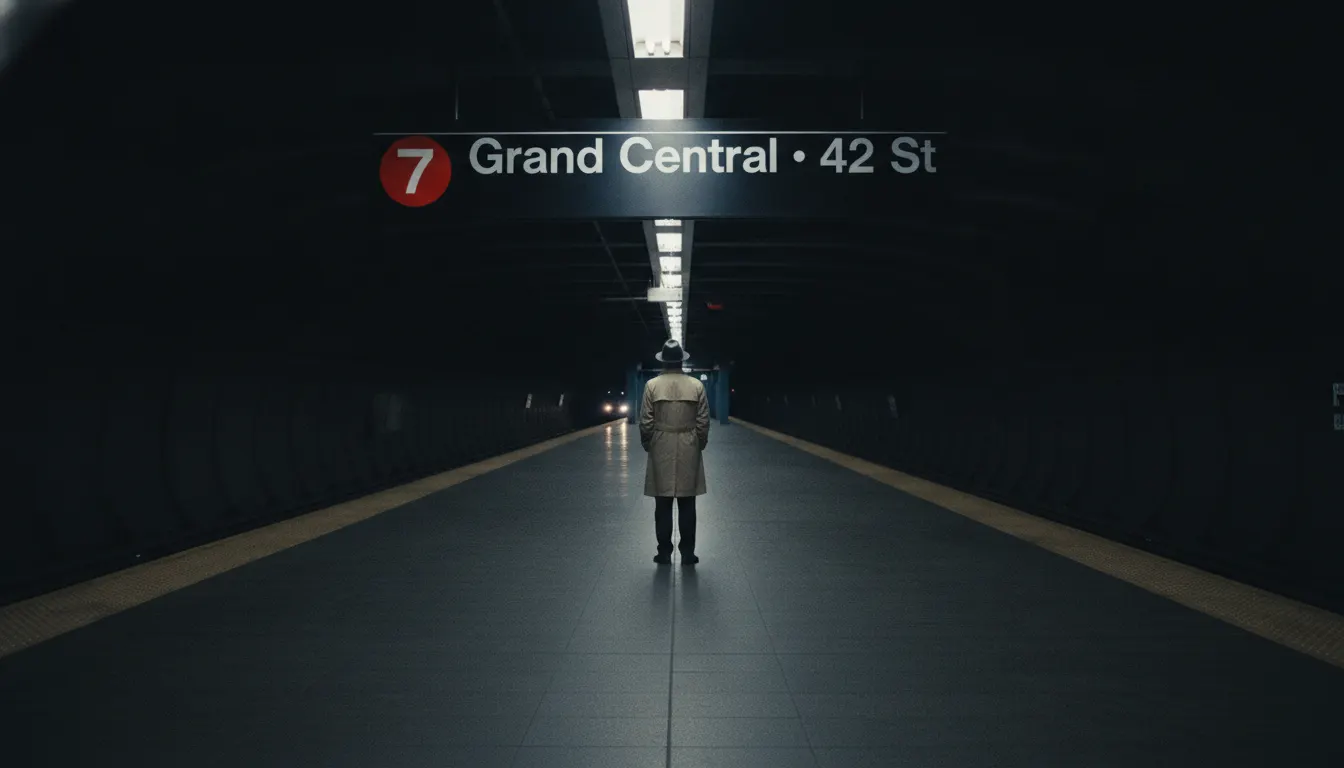
NYC Subway Helvetica signage system aesthetic. Massimo Vignelli MTA standards manual, black-background station name with white Helvetica, color-line route bullet.
The moves a human crew would use to get here. Cue applies them for you, and knowing their names is how you ask for a change.
neutral, authoritative, highly legible at all sizes
background combinations
coded line system: each train line assigned a distinct hue applied consistently to all materials
based sign panel layout with precise specifications for letter height and viewing distance
colored circles bearing the train number/letter as route markers
degree lines only: geographic abstraction in service of navigation clarity
only the essential wayfinding content, no decorative elements
The New York City subway signage system designed by Massimo Vignelli and Bob Noorda of Unimark International in 1970 is one of the most consequential applications of typographic design to a public institution. It introduced Helvetica to mass American audiences and demonstrated that systematic modernist typography could function at urban scale.
Massimo Vignelli (1931-2014) co-founded Unimark International in Chicago in 1965 with Ralph Eckerstrom. Unimark became the largest graphic design firm in the world within a few years, applying Swiss International Style principles to corporate identity and environmental graphics at industrial scale. In 1966, the New York City Transit Authority commissioned Unimark to redesign the subway's notoriously inconsistent signage. Vignelli and Bob Noorda delivered the New York City Transit Authority Graphics Standards Manual in 1970.
The 1970 manual specified Helvetica Medium as the sole typeface for all station signage. It mandated black type on white backgrounds (interior) and white type on black (exterior). It established precise grid relationships for sign panels, specified exact letter heights for different viewing distances, and prohibited the decorative letterforms that had accumulated over decades in the system. The manual also specified a color-coded line system using a palette of bold primary and secondary colors - the red 1/2/3 lines, orange B/D/F/M lines, blue A/C/E lines, green 4/5/6 lines - applied to all station and train materials.
Vignelli also designed the 1972 New York City subway map, applying Beck's London Underground schematic principle to Manhattan. The map used 45-degree and 90-degree lines, equalized station spacing, and reduced geography to an elegant geometric diagram. It was controversial immediately - New Yorkers complained that it distorted the geography of their city, making Manhattan appear as a narrow oval. The map was replaced in 1979 by John Tauranac and Michael Hertz's more geographically accurate version, though a contemporary Vignelli map variant continues in print.
For most American commuters, the NYC subway was their first sustained encounter with Helvetica. The typeface, designed by Max Miedinger and Eduard Hoffmann at the Haas type foundry in Switzerland in 1957, had been adopted extensively in Europe but was relatively unknown in America until Unimark's corporate identity work and the subway application spread it through the country's largest city.
By the late 1970s and 1980s, the system's signage had deteriorated significantly. A decade of deferred maintenance, vandalism, and piecemeal additions had created exactly the inconsistency the standards manual had been designed to prevent. The 2012-2016 wayfinding initiative and the 2023 reissue of the original 1970 Standards Manual (co-published by Pentagram) renewed interest in the original system.
NYCTA Graphics Standards Manual (Unimark, 1970)
1972
NYC Subway diagram map
Helvetica typeface (Haas foundry, Switzerland, 1957)
2023
reissue of the 1970 NYCTA Standards Manual
Helvetica (documentary film, 2007): documents Vignelli and the typeface
A Look is not a filter. It is a set of stored decisions the pipeline reads before it makes a single frame, so two videos in the same Look actually match.