Four Freedoms
1943
four paintings, Norman Rockwell Museum, Stockbridge, MA
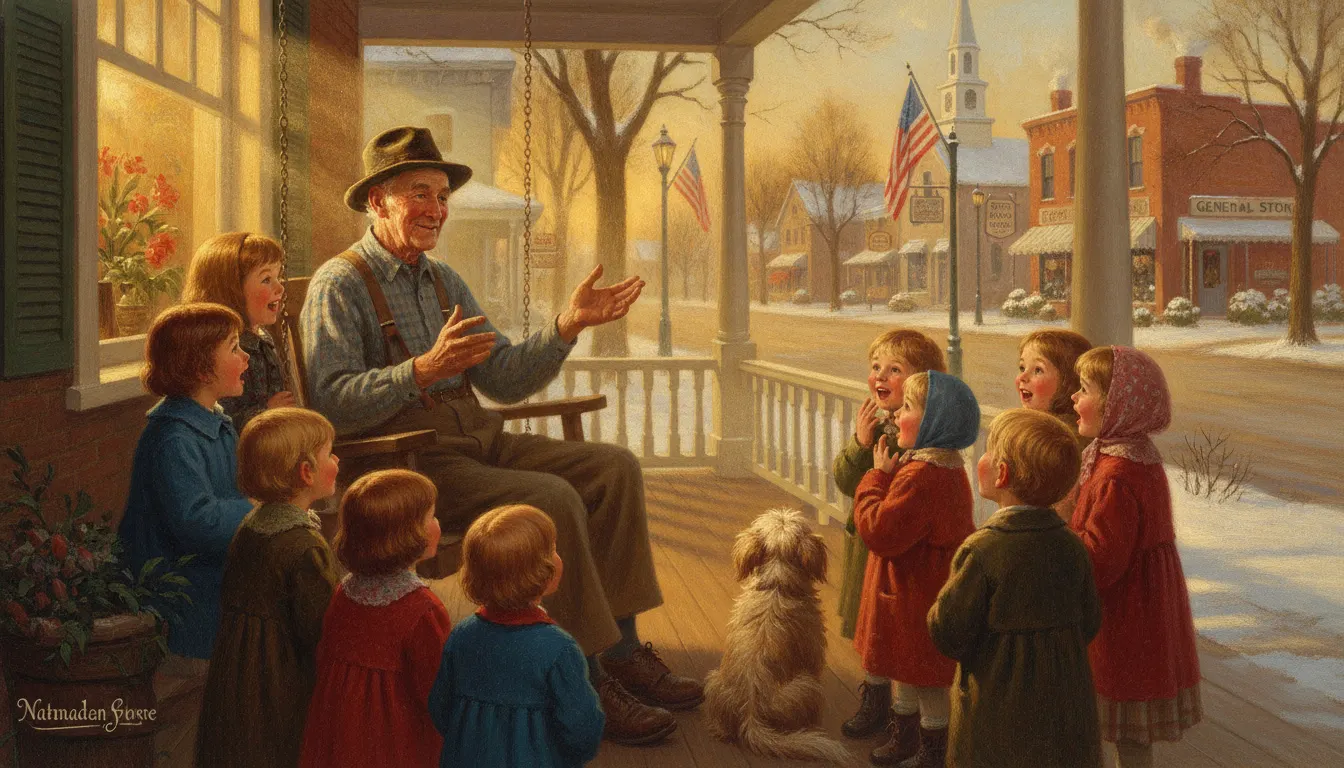
Norman Rockwell Saturday Evening Post Americana. Warmly painted small-town scene, narrative gentle humor, kid-and-grandpa storytelling.
The moves a human crew would use to get here. Cue applies them for you, and knowing their names is how you ask for a change.
within-a-moment: compositions that imply the full story through a single charged instant
amber light temperature evoking indoors, firelight, or late-afternoon sun
stock American figures (boy, grandmother, barber) made particular through costume and expression detail
details of clothing, tools, newspapers, and household objects that tell background stories
Rockwell's portraits achieve photographic fidelity in expression and likeness
visual punchlines - a dog's reaction, a child's expression - planted in secondary positions
objects in the foreground rendered with the same attention as faces, creating a world of material weight
Norman Rockwell (1894-1978) painted the covers of The Saturday Evening Post for 47 consecutive years, from 1916 to 1963 - 321 covers in total - making him the most widely reproduced American artist of the twentieth century and the primary shaper of popular images of American life for multiple generations.
The Post under editor George Horace Lorimer (until 1936) and his successors was the dominant mass-market magazine in America, with circulation reaching over three million in Rockwell's peak years. A Rockwell cover was seen by more Americans than virtually any other visual artwork. Working from his studio in Arlington, Vermont (from 1939) and later Stockbridge, Massachusetts (from 1953), Rockwell developed an elaborate process: extensive preliminary sketches, photographic reference shoots with local townspeople as models, detailed compositional studies, and final oils on canvas.
Rockwell's covers consistently told stories: a small boy with a black eye sitting outside the principal's office, his fishing pole between his knees (The Runaway, 1958); an elderly couple at a diner booth next to a young family on Thanksgiving (Freedom from Want, 1943). The characters are drawn from recognizable American social types - the freckled boy, the wise grandmother, the harassed father - but rendered with sufficient psychological specificity that they function as individuals rather than symbols.
Rockwell's most important single work came out of Franklin Roosevelt's 1941 State of the Union address, in which he articulated four essential human freedoms: freedom of speech, freedom of worship, freedom from want, and freedom from fear. Rockwell spent months working out the compositions for four paintings interpreting these concepts through specific, unglamorous American domestic scenes. Freedom of Speech shows a working-class man standing to speak at a New England town meeting. Freedom from Want depicts a family Thanksgiving. Freedom from Fear shows parents tucking sleeping children into bed while the father holds a folded newspaper with visible headlines about wartime bombing.
Published in The Saturday Evening Post across four issues in 1943, the paintings were also reproduced by the Treasury Department and the Office of War Information as posters, with prints sold to finance war bonds. They collectively raised $133 million.
Triple Self-Portrait (1960, Norman Rockwell Museum, Stockbridge) shows Rockwell painting his own reflection in a mirror - but the painted image on the canvas is idealized, more heroic than the reflection. The painting's frame is decorated with reproductions of earlier self-portraits by Dürer, Rembrandt, Picasso, and Van Gogh: Rockwell acknowledging his own art-historical context with characteristic self-deprecating wit.
1943
four paintings, Norman Rockwell Museum, Stockbridge, MA
1960
Norman Rockwell Museum, Stockbridge, MA
1958
Saturday Evening Post cover, September 20, 1958
1951
Saturday Evening Post cover, November 24, 1951
1964
Look magazine; Ruby Bridges integration painting
1950
Saturday Evening Post cover, April 29, 1950
1957
Saturday Evening Post cover, May 25, 1957
321 covers over 47 years
A Look is not a filter. It is a set of stored decisions the pipeline reads before it makes a single frame, so two videos in the same Look actually match.