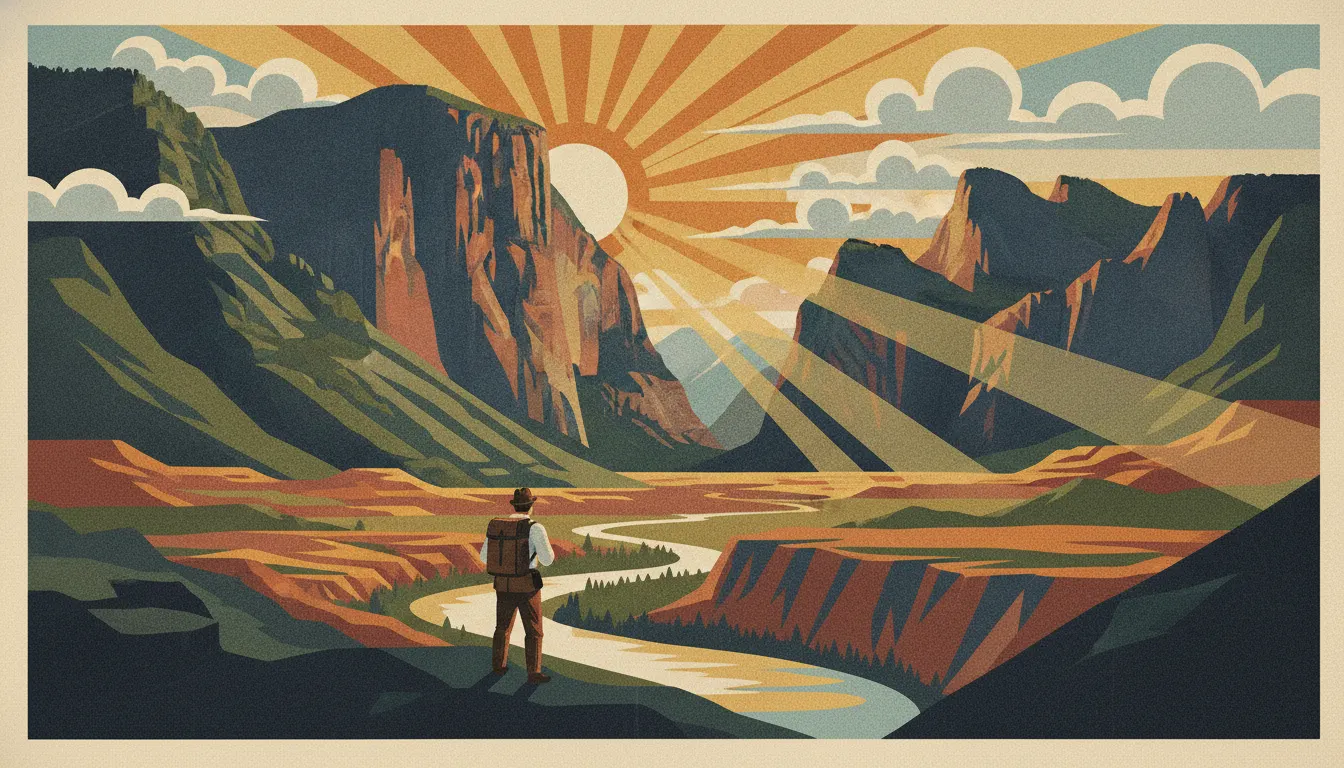
Yellowstone National Park WPA poster (c. 1938-1941)
geyser eruption composition
WPA Federal Art Project 1930s national-park poster. Silkscreen flat color, monumental mountain, Yosemite Grand Canyon Yellowstone civic optimism.
The moves a human crew would use to get here. Cue applies them for you, and knowing their names is how you ask for a change.
mountains, trees, and water as hard-edged color shapes with no gradient
typically 3-6 colors per poster, often including a warm foreground, cool sky, and one accent
and-Crafts display typography: park name as visual anchor in the lower or upper register
influenced landscape reduction: natural forms simplified to their essential geometric character
earth tones advancing against sky blues and greens receding
print registration quality: colors slightly offset at edges, suggesting handmade production character
The Works Progress Administration's (later Work Projects Administration) Federal Art Project, operating from 1935 to 1943, employed thousands of visual artists during the Great Depression to create public art, murals, and posters. Among the most enduring output of this program are the national park and public lands promotional posters - screen-printed works in a dramatically simplified graphic style that have become icons of both the New Deal era and American conservation culture.
The WPA poster aesthetic emerged from the particular constraints of Works Progress Administration's screen printing process. Screen printing (silkscreen) required that each color be applied separately as a flat, opaque layer - gradients and blends were technically impractical. The artists who worked in WPA poster studios - including the Chicago-based Illinois Art Project and the New York Poster Division - developed a visual language perfectly adapted to these constraints: bold silhouetted landscapes with hard-edged color separations, a limited palette of four to six colors, simplified organic forms for trees, mountains, and water, and display typography set in Art Deco or Arts-and-Crafts-inflected faces.
The national park posters in particular combined the influence of Japanese woodblock prints (in their reduction of landscapes to flat color planes and their radical simplification of natural form) with the bold promotional instincts of commercial poster design of the 1920s and 30s. The result was a visual world in which Yellowstone's geysers, Zion's canyon walls, and the Shenandoah's rolling hills were reduced to their essential graphic character.
The WPA national park style was largely forgotten until 1977 when Doug Leen (known in the parks community as Ranger Doug) began researching, documenting, and eventually reproducing the original posters. His company Ranger Doug's Enterprises has produced authorized reproductions and new-style WPA park posters since the 1980s, sustaining the visual tradition and sparking a wider revival that has made the style ubiquitous in American home and office decor and inspired dozens of commercial illustration studios working in the genre today.
The WPA park poster style has been widely adopted for state, city, and country promotional posters; outdoor recreation brand content; and nostalgic lifestyle branding.
geyser eruption composition
canyon wall silhouette
volcano with wildflower meadow
conservation and revival prints
2016
contemporary artists working in WPA style
2009
visual language parallel
A Look is not a filter. It is a set of stored decisions the pipeline reads before it makes a single frame, so two videos in the same Look actually match.