Pan Am Tokyo poster (c. 1960s)
Mount Fuji with aircraft, multiple artists
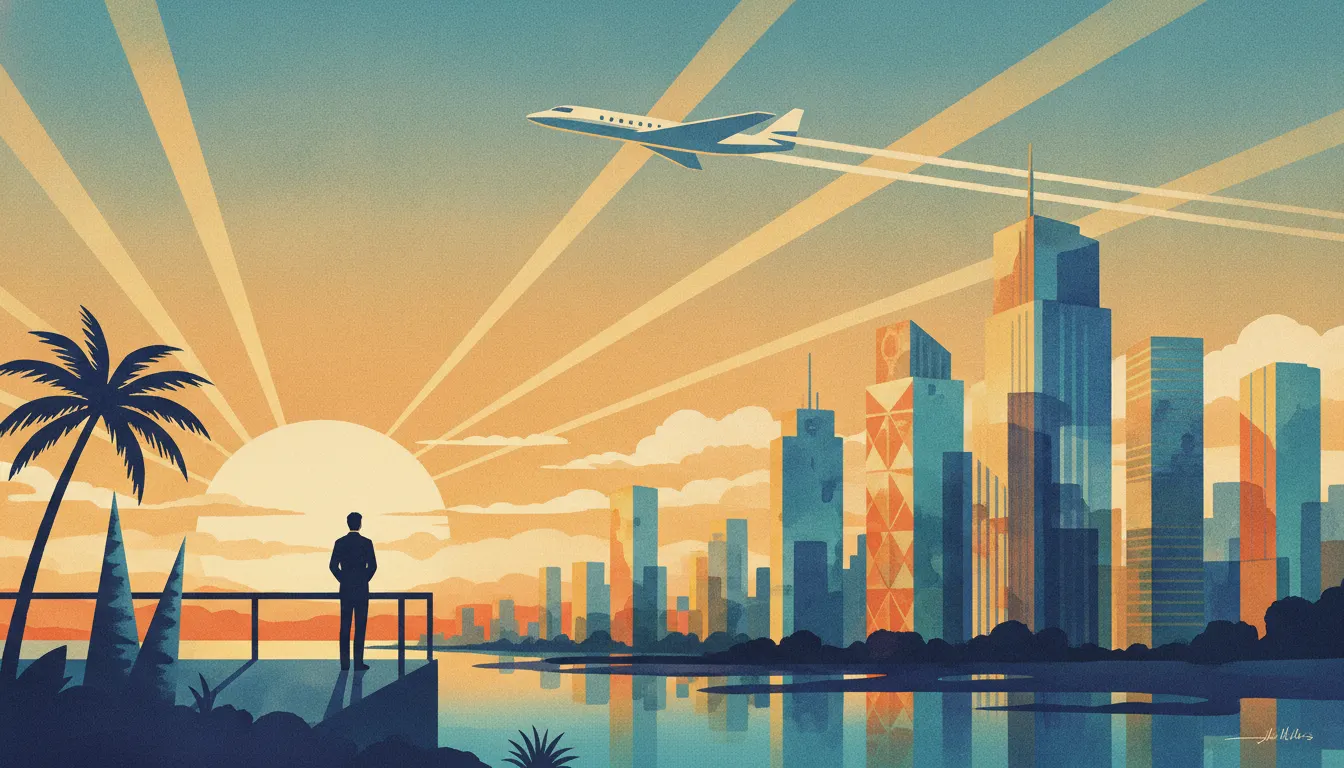
David Klein Pan Am 1960s travel poster. Watercolor city skyline, jet-age optimism, hand-lettered destination, vibrant flat color.
The moves a human crew would use to get here. Cue applies them for you, and knowing their names is how you ask for a change.
skies as solid blocks, water as flat teal, landscapes as color-field abstractions
iconic architectural or natural forms reduced to essential profile shapes
Ultramarine blue, cadmium red, golden yellow, and bright white - primary-adjacent but not primary
serif typography for destination names as visual anchor
sleek silver forms placed diagonally to suggest speed and arrival
to-dusk lighting conventions: illustrations often set at golden hour to maximize color drama
elegantly dressed travelers reduced to graphic shapes in foreground staging
From the late 1940s through the 1960s, Pan American World Airways (Pan Am) and the broader commercial aviation industry produced what is arguably the most visually coherent era of travel advertising in history. The combination of a new and genuinely glamorous product (intercontinental air travel), technical advances in color printing, and a generation of commercial artists steeped in European modernist design traditions produced a distinctive visual language that still reads as optimistic, cosmopolitan, and aspirational.
Pan Am's graphic identity drew on the same postwar modernist sensibility as the WPA posters (simplified form, bold flat color, dramatic typographic framing) but with a specifically commercial and international inflection. The posters rendered global destinations - Tokyo, Rio, Rome, Nairobi, Hong Kong - as flat color compositions where the iconic landmark of each city (the Eiffel Tower, Sugarloaf Mountain, Mount Fuji) was reduced to its essential silhouette against a bright sky. Jet aircraft in Pan Am's white-and-blue livery appeared as sleek, optimistic silver forms crossing the frame.
The style was indebted to Swiss poster design and to American commercial illustrators like Bob Peak and Stevan Dohanos, whose work for Saturday Evening Post covers demonstrated how bold color and confident rendering could communicate instantly at poster scale.
Pan Am posters used bold sans-serif or slab-serif display type - often in white or yellow against saturated color grounds - positioned at the bottom third of the composition beneath the illustration. Destination names were often treated as the visual headline: TOKYO, LONDON, BUENOS AIRES set in condensed caps that anchored the image. Airline logos and route information occupied the lower register in smaller type.
Beyond Pan Am, airlines including TWA (whose 1950s posters by David Klein are particularly celebrated), BOAC, Air France, and Qantas each developed national-inflected versions of the same visual grammar. Rail companies, cruise lines, and national tourist boards produced parallel work. The overall effect was a visual world that made every journey feel like an event of cultural and personal significance.
Mount Fuji with aircraft, multiple artists
TWA 'Fly to New York' poster series (1956-1960)
French travel posters (1950s)
multiple artists including Guy Georget
1962
Eero Saarinen building as architectural parallel to the poster aesthetic
A Look is not a filter. It is a set of stored decisions the pipeline reads before it makes a single frame, so two videos in the same Look actually match.