Oath of the Horatii
1784
Louvre Museum, Paris
Jacques-Louis David Neoclassical heroism. Stoic Roman togas, frieze-like staging, severe linear contour, civic virtue.
The moves a human crew would use to get here. Cue applies them for you, and knowing their names is how you ask for a change.
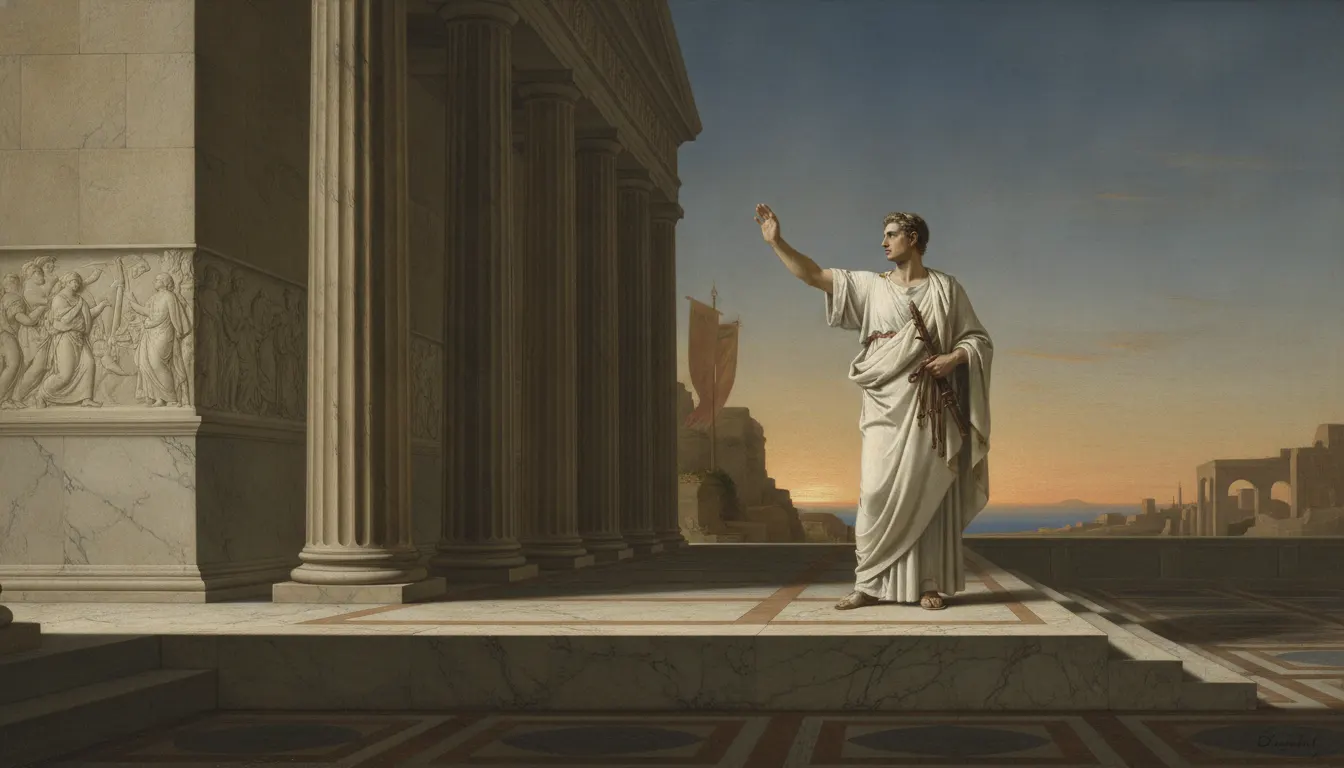
figures rendered with stone-like precision, musculature indicated by cool highlights and cool shadows rather than warm-cold contrast
Doric columns, plain walls, or minimal environmental detail focusing attention on figures
tricolor implication in red, white, and blue-gray compositions
figures arranged in a single picture plane parallel to the canvas surface
single-source illumination from above-left, creating sharp shadow on the opposite side
outstretched arms, raised swords, pointing fingers - poses borrowed from Roman rhetorical tradition
no visible paint surface - the image aspires to the condition of colored marble
Jacques-Louis David (1748-1825) is the dominant figure of French Neoclassicism and arguably the most politically consequential painter in Western history - a revolutionary activist whose canvases shaped the visual mythology of both the French Revolution and the Napoleonic era.
Commissioned by Louis XVI's director of public buildings but immediately read as a manifesto of civic virtue over royal authority, The Oath of the Horatii (Louvre, Paris) shows three Roman brothers pledging their swords to Rome before their weeping female relatives. The composition is stripped to essentials: a spare Doric arcade provides the backdrop, the male figures occupy a single picture plane with their outstretched arms converging on the sword bundle, and the palette is restricted to military grays, earth reds, and cool blues. There is no Baroque flourish, no atmospheric haze. The painting insists on clarity as a moral value.
When it was exhibited at the Paris Salon of 1785, the Oath was understood as an implicit critique of Rococo excess and aristocratic culture, and as a call for a more austere, virtuous society modeled on Roman republican ideals. It became the founding image of the Neoclassical movement.
Paul Marat, radical journalist and member of the National Convention, was assassinated in his medicinal bath by Charlotte Corday in July 1793. David, who had visited Marat the day before, produced this painting in three months for the Convention hall. The composition is Pietà-like: Marat's stabbed body slumping from the bathtub, one arm dangling with a quill pen, the murder letter still in his other hand, green baize and a wooden crate serving as the only context. David described his intention as making Marat look like a murdered hero of antiquity. The painting is deliberately anti-heroic in scale and setting - domestic, spare, journalistic - while simultaneously sacred in its compositional borrowing from Renaissance Deposition paintings.
After the Revolution, David became Napoleon's official court painter. Napoleon Crossing the Alps (1800-01, five versions) reimagines a notoriously unglamorous mule ride as a rearing-horse heroic portrait. The Coronation of Napoleon (1805-07, Louvre) documents the Notre-Dame ceremony with documentary exactness but compositional organization derived from High Renaissance altarpieces.
1784
Louvre Museum, Paris
1793
Royal Museums of Fine Arts, Brussels
Châteaux de Versailles et de Trianon (primary version)
Louvre Museum, Paris
1781
Palais des Beaux-Arts, Lille
1799
Louvre Museum, Paris
1800
Louvre Museum, Paris
1814
Louvre Museum, Paris
A Look is not a filter. It is a set of stored decisions the pipeline reads before it makes a single frame, so two videos in the same Look actually match.