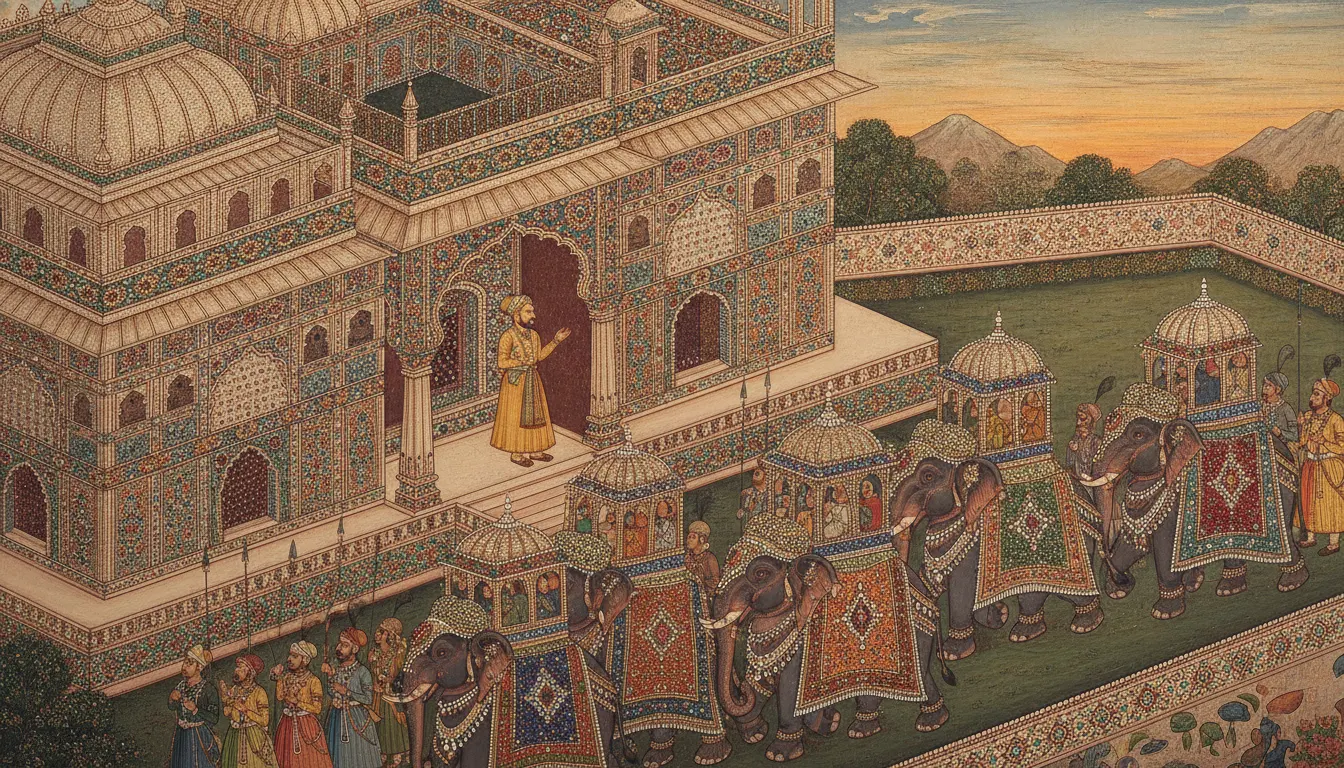
Hamzanama (1562-1577)
Akbar period; ~200 surviving folios in collections including V&A and MAK Vienna
Mughal Indian miniature painting. Akbar court hunting scene, intricate jewelled detail, isometric architecture, elephant procession.
The moves a human crew would use to get here. Cue applies them for you, and knowing their names is how you ask for a change.
architecture, sky, and water often in gold-over-lapis
the emperor or central figure larger than attendants, who are larger than landscape elements
palace interiors rendered as decorative geometric tiles and arabesque panels
adjacent spatial arrangement: no single-point perspective
faces, especially of important figures, executed by specialist portrait painters
Mughal miniature painting flourished in the Indian subcontinent under the patronage of the Mughal emperors from the reign of Humayun (who brought Persian court painters Mir Sayyid Ali and Abd al-Samad to India in the 1540s) through the reigns of Akbar, Jahangir, Shah Jahan, and Aurangzeb, spanning roughly from 1550 to 1750 AD. The tradition is one of the most technically accomplished small-scale painting practices in world art history.
The earliest and most monumental project of the Mughal atelier was the Hamzanama - an illustrated recounting of the exploits of Hamza, uncle of the Prophet - commissioned by Emperor Akbar and executed between 1562 and 1577. Originally comprising around 1,400 large folio paintings (roughly 68 x 52 cm) on cotton cloth, approximately 200 survive scattered across world collections. The Hamzanama synthesizes Persian compositional conventions with the bold, physical energy of Hindu visual traditions and the spatial awareness Akbar's court artists absorbed from European prints brought by Jesuit missionaries.
Emperor Jahangir (reigned 1605-1627) was an obsessive naturalist and patron, and the miniatures of his reign represent the apex of Mughal naturalistic observation. Painters including Mansur (nicknamed Nadir al-'Asr, Wonder of the Age) produced extraordinarily precise botanical and wildlife illustrations - the first zebra, turkeys, and dodo birds to be recorded in Indian art were painted for Jahangir's personal albums. Jahangir's memoir, the Tuzuk-i-Jahangiri, records him stopping a military campaign to have a dying crane sketched before it died.
Mughal miniatures were painted on paper prepared with multiple layers of burnished ground. Pigments included lapis lazuli imported from Afghanistan, vermilion, malachite, orpiment (arsenic trisulfide, yellow), carbon black, and lead white. Gold and silver were applied in powdered form mixed with gum and then burnished. Brushes were made from squirrel hair, the finest containing only a few hairs; the most minute details were applied with single-hair brushes. Collaborative production was standard: a master artist composed and drew the outline, specialists filled color or painted faces, while a senior artist completed final details and added gold.
Akbar period; ~200 surviving folios in collections including V&A and MAK Vienna
Abu'l-Fazl's history of Akbar's reign; Victoria and Albert Museum
Rare Turkey (c. 1612) - Jahangir period; natural history study
Jahangir Preferring a Sufi Shaikh to Kings (c. 1615-1618) - Freer Gallery, Washington
Metropolitan Museum of Art
Dervishes Fighting (c. 1625) - Chester Beatty Library, Dublin
The Mughals and Europeans (c. 1600) - various collections
Squirrels in a Plane Tree (c. 1610) - India Office Library, British Library
A Look is not a filter. It is a set of stored decisions the pipeline reads before it makes a single frame, so two videos in the same Look actually match.
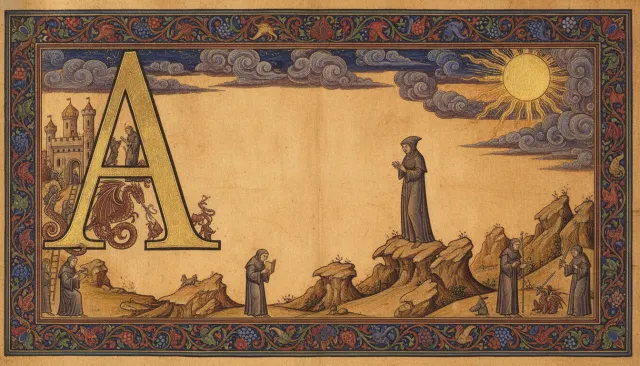 Medieval VictorianMedieval Illuminated Manuscript
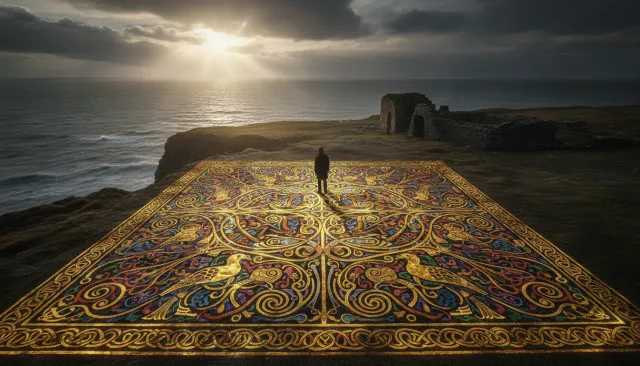 Historical Illuminated ExtendedLindisfarne Gospels Anglo Saxon Gold
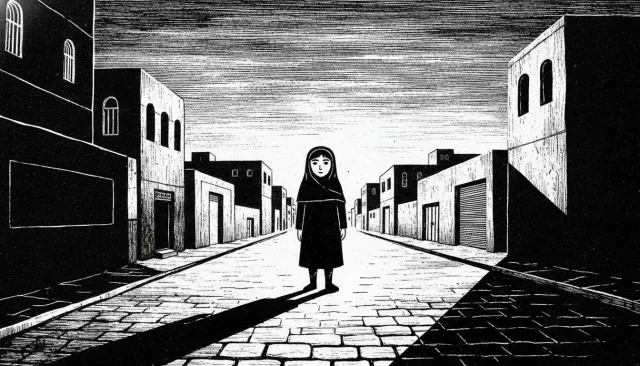 Illustrators ExtendedMarjane Satrapi Persepolis BW Thick Line
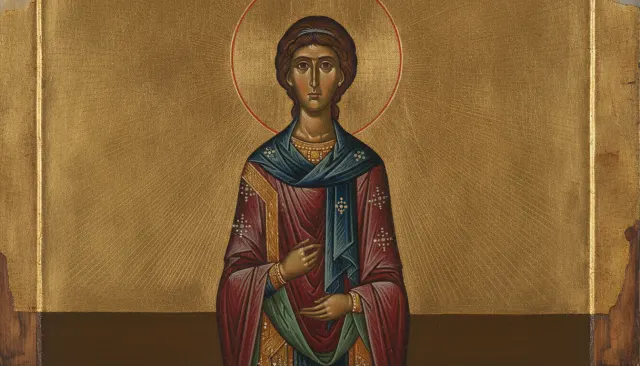 Eastern HistoricalByzantine Icon Gold Leaf
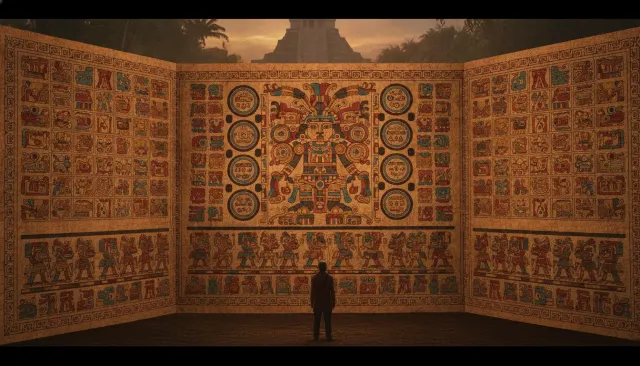 Historical Illuminated ExtendedAztec Mesoamerican Codex Symbol
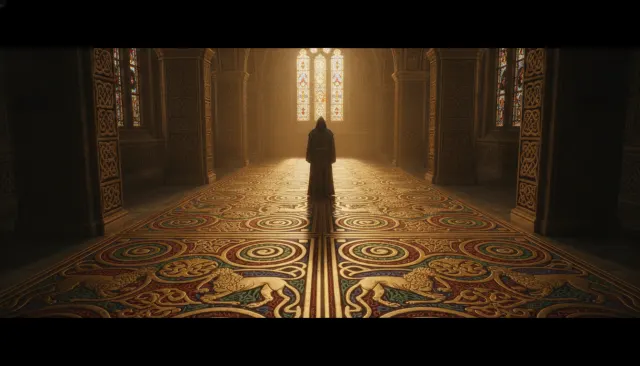 Historical Illuminated ExtendedBook of Kells Celtic Illuminated