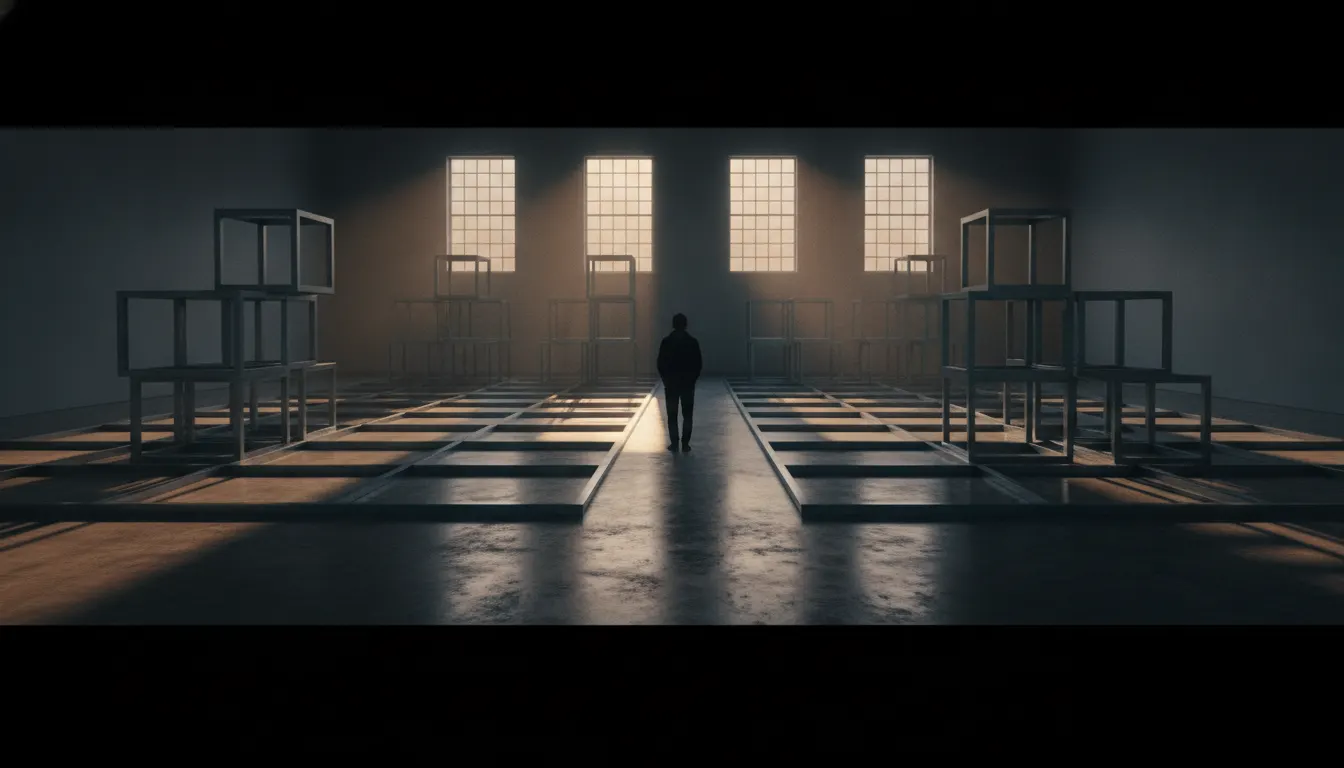
Donald Judd
Untitled (Stack), 1967 - MoMA, New York
Donald Judd Sol LeWitt 1960s Minimalism. Industrial materials, repeated geometric units, gallery floor placement, no expression.
The moves a human crew would use to get here. Cue applies them for you, and knowing their names is how you ask for a change.
forms made by manufacturers to precise specifications, with no visible hand-made quality
identical units arranged in series, with the logic of repetition made explicit
geometric forms that cannot be reduced further - cubes, rectangles, cylinders, planes
galvanized steel, Cor-Ten steel, anodized aluminum, Plexiglas, commercial fluorescent tubes
works that claim the real space of the gallery rather than existing on a pedestal
compositional layout: placement determined by mathematical rule or room dimensions, not aesthetic taste
single industrial color or the natural color of the material itself
Minimalism emerged as the dominant avant-garde tendency in American art in the early 1960s, constituting a wholesale rejection of the expressionistic subjectivity of Abstract Expressionism that had defined serious American art in the previous decade. Where Pollock and de Kooning put the visible mark of the artist's body at the center of the work, the Minimalists sought to eliminate gesture, composition, and all evidence of the artist's hand.
Donald Judd (1928-1994) published his foundational essay 'Specific Objects' in 1965, articulating the theoretical basis for the movement he disliked being called a movement. Judd argued that the most interesting new work was neither painting nor sculpture but something else - three-dimensional objects that occupied real space on the same terms as other real objects, fabricated from industrial materials by commercial manufacturers following the artist's precise specifications. His signature form: rectangular boxes in galvanized iron, anodized aluminum, or Plexiglas, arranged in repetitive vertical or horizontal progressions mounted to walls or floor. Works include the Stack series (1965-1991) - identical cantilevered boxes extending from floor to ceiling - and the Marfa, Texas installations at the Chinati Foundation (1986), where 100 milled aluminum boxes occupy two converted artillery sheds.
Dan Flavin (1933-1996) worked exclusively with commercial fluorescent tubes purchased from hardware stores. His Monuments to V. Tatlin series (1964-1990) - diagonal fluorescent tubes on walls - honored Constructivism while transforming the gallery into a space of colored, diffused light. Flavin is unique among Minimalists for making light itself the medium: his objects cannot be separated from the spatial experience they create.
Frank Stella's Black Paintings (1958-1960) - uniform black stripes with the width dictated entirely by the canvas stretcher - launched the movement. Carl Andre's floor sculptures (Equivalent VIII, 1966; 120 firebricks arranged flat on the floor) confronted viewers with the extreme of object equivalence. Robert Morris's large-scale gray geometric forms explored phenomenological space - how the body navigates around objects that cannot be taken in from a single viewpoint.
Untitled (Stack), 1967 - MoMA, New York
100 untitled works in mill aluminum (1982-1986) - Chinati Foundation, Marfa, Texas
1966
monument for V. Tatlin - multiple museum collections
1959
The Marriage of Reason and Squalor II - MoMA, New York
1966
Equivalent VIII - Tate Modern, London
Untitled (L-Beams) (1965-67) - Whitney Museum of American Art
1971
untitled (to Donna) 5a - Solomon R. Guggenheim Museum
1969
Untitled (6-unit progression) - multiple editions
A Look is not a filter. It is a set of stored decisions the pipeline reads before it makes a single frame, so two videos in the same Look actually match.