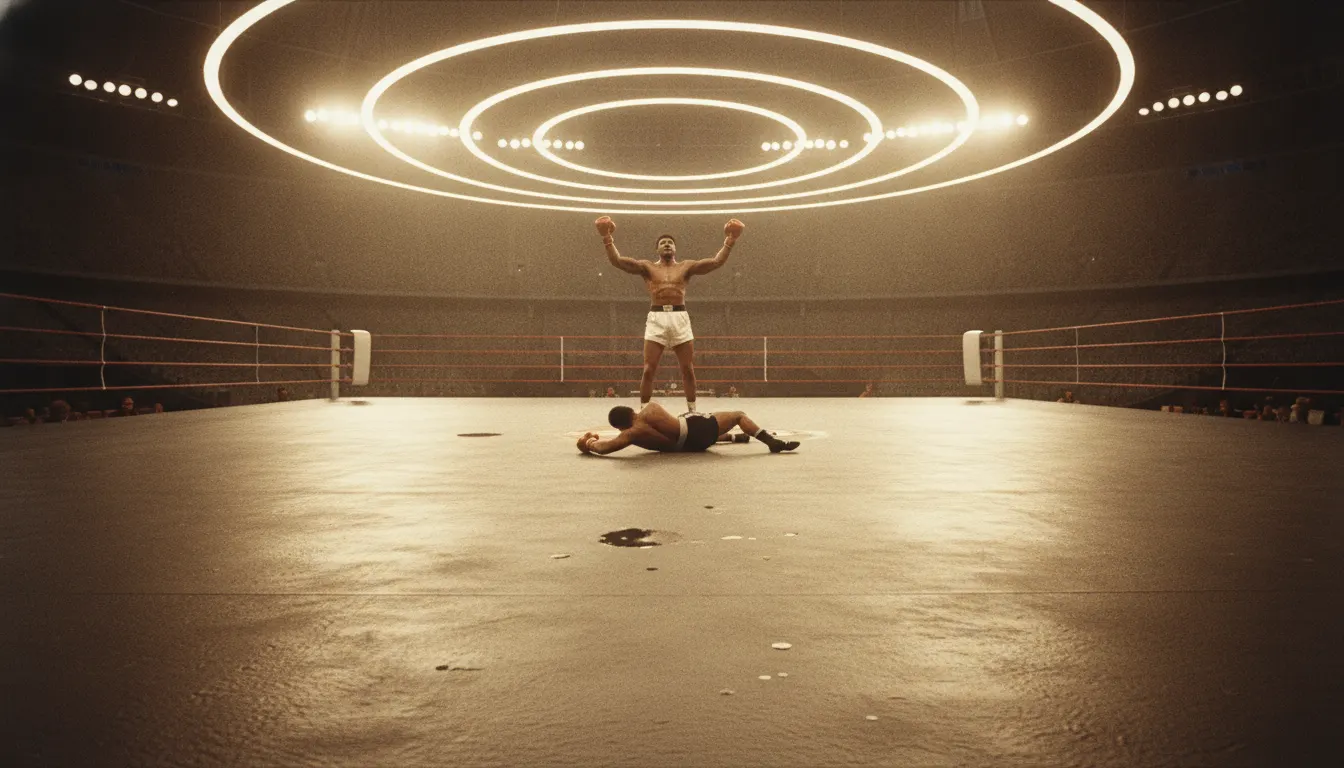
Muhammad Ali vs Sonny Liston, Lewiston Maine
Sports Illustrated cover, 25 May 1965
Neil Leifer iconic boxing. Ali standing over Liston 1965, overhead Astrodome lighting, ring-canvas reflective shimmer, decisive moment athletic.
The moves a human crew would use to get here. Cue applies them for you, and knowing their names is how you ask for a change.
level ringside position looking upward to create low-angle hero framing of standing fighter
white canvas as graphic ground plane
speed flash synchronization for frozen action at ring-level ambient light conditions
Neil Leifer (born New York City, 1942) shot over 200 Sports Illustrated covers over a career spanning six decades, but it is two boxing photographs that have secured his place in the pantheon of sports photography: the ground-level frame of Muhammad Ali standing over a felled Sonny Liston in Lewiston, Maine, on 25 May 1965, and the overhead ring-flash image of Ali defeating Cleveland Williams in Houston, Texas, on 14 November 1966.
The Lewiston frame - Ali, gloves raised, mouth open in primal exultation, looming over Liston prone on the canvas - was made from a ground-level position ringside, looking upward. The composition is pure instinct: Leifer was one of several photographers at ringside but was positioned at the precise angle that put the fallen champion below and the standing one above, with the referee and crowd as vertical frame elements. It ran as the Sports Illustrated cover and has since been reproduced on more magazine covers, posters, and prints than almost any sports photograph in history.
The Houston overhead is the technically extraordinary complement. Leifer negotiated permission to mount a camera in the lighting rig above the ring, triggered via remote at the moment of Williams's knockdown. The resulting frame shows the ring as a graphic diamond, Williams horizontal, Ali in dynamic stance, the arena crowd a circular halo. The image's compositional perfection derives from its aerial vantage making the boxing ring's geometry explicit - the white canvas as compositional field.
Leifer's boxing photography combined meticulous pre-fight preparation (camera positioning, remote trigger placement, strobe synchronization with existing ring lights) with an athlete's reflexes during action. He used Nikon equipment with fast prime lenses and high-speed flash synchronization at a time when most sports photography was technically crude. His color work for Sports Illustrated also introduced the use of multiple remote cameras positioned simultaneously to guarantee at least one decisive frame.
Leifer also documented the 1964 Tokyo Olympics, the 1968 Mexico City Olympics (including Tommie Smith's black-power salute), and Super Bowls I through XXII, building one of the most complete archives of American sporting life in the 20th century.
Sports Illustrated cover, 25 May 1965
Sports Illustrated cover, 14 November 1966
A Look is not a filter. It is a set of stored decisions the pipeline reads before it makes a single frame, so two videos in the same Look actually match.