Raymond Damadian
first full-body human MRI scan of Lawrence Minkoff's thorax (July 3, 1977)
MRI axial cross-section. Greyscale slice through anatomy, T1 or T2 weighted contrast, brain or torso, anonymized clinical DICOM look.
The moves a human crew would use to get here. Cue applies them for you, and knowing their names is how you ask for a change.
contrast S-curve: crush blacks below 15%, clip whites at 98% to simulate MRI signal range
apply a rounded-rectangle or oval mask to simulate the circular FOV of MRI receiver coil data
add 6-8pt white monospace text in upper-left/right corners with clinical parameter-style abbreviations
add Film Grain at 20-30 units with size 1.5-2.5 to simulate MRI reconstruction noise
place scan oval on absolute black (#000000) background, no vignette
color mapping: remap grayscale to FLIR-style heat (dark=blue, mid=green, bright=red/yellow) for 'enhanced' scan effect
add hairline crosshair at image center in pale gray at 15% opacity for clinical measurement reference
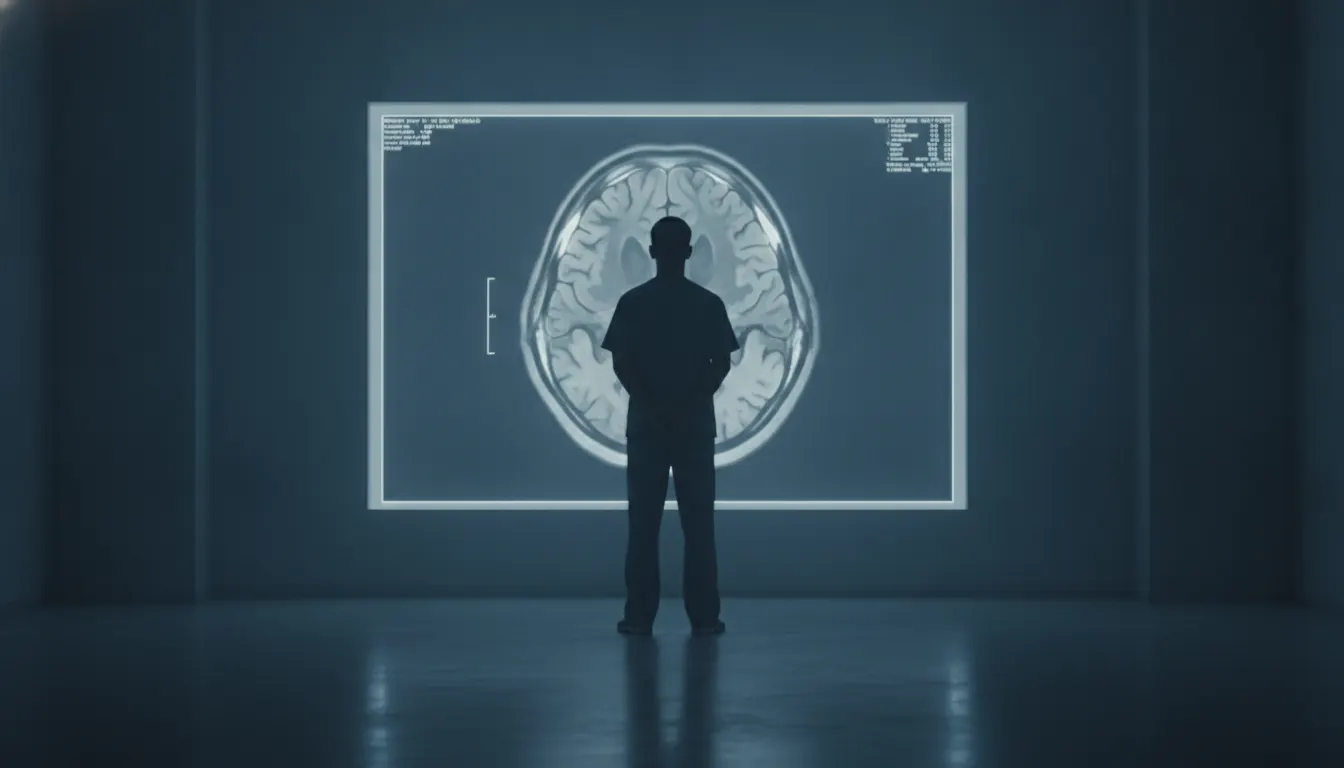
The MRI cross-section aesthetic presents subjects as if imaged by magnetic resonance imaging - rendered in grayscale (or false-color pseudocolor), sliced axially, coronally, or sagittally to reveal internal structure, annotated with clinical measurement markers, and displayed at the distinctive aspect ratios and graininess of medical scan formats. It is simultaneously the most clinical and the most uncanny of medical imaging aesthetics, because it shows the interior of living bodies with the same neutral authority as a weather map.
Magnetic resonance imaging derives from the nuclear magnetic resonance (NMR) physics described by Felix Bloch and Edward Purcell (who shared the 1952 Nobel Prize in Physics). The leap from laboratory spectroscopy to imaging was made by Raymond Vahan Damadian, an American physician-scientist who recognized that tumors had different NMR relaxation times from healthy tissue. Damadian filed the first MRI patent in 1972 and on July 3, 1977, he and his colleagues Minkoff and Goldsmith completed the first full-body MRI scan of a human being - a scan of Minkoff's thorax, produced by their scanner they named "Indomitable." The scan took nearly five hours.
Paul Lauterbur (University of Illinois) invented the gradient-field localization technique that made practical MRI imaging possible (1973), producing the first 2D MRI images. Peter Mansfield (University of Nottingham) developed the echo-planar imaging technique (1977) that enabled fast enough acquisition for clinical use. Lauterbur and Mansfield shared the 2003 Nobel Prize in Physiology or Medicine. Damadian, controversially excluded from the Nobel despite his foundational patent, had campaigned publicly for inclusion.
The first commercial MRI scanners entered hospitals around 1980-1982. By the mid-1980s, clinical MRI had become the gold standard for soft-tissue imaging, particularly of the brain and spine.
The distinctive look of MRI output includes: a square or near-square black frame with the image in center; high-contrast grayscale with very dark field around the anatomy; visible noise/grain from the signal averaging process; bright white in fat-rich tissue and fluid, darker gray in muscle; geometric slice lines and cross-reference markers; scan parameter text overlaid in small bright sans-serif type (TR, TE, slice thickness, FOV); and the circular or oval anatomy cross-section shape that reveals interior structures invisible to any surface imaging.
first full-body human MRI scan of Lawrence Minkoff's thorax (July 3, 1977)
1973
first 2D NMR zeugmatography image , Nobel Prize 2003
1977
echo-planar imaging technique enabling fast MRI acquisition , Nobel Prize 2003
2004
_The Architecture and Design of Man and Woman_ MRI-based anatomical visualization book
MRI scan series of athletes and dancers as fine art photography (2010s)
_Genetic_ MRI self-portrait series (1990s)
A Look is not a filter. It is a set of stored decisions the pipeline reads before it makes a single frame, so two videos in the same Look actually match.