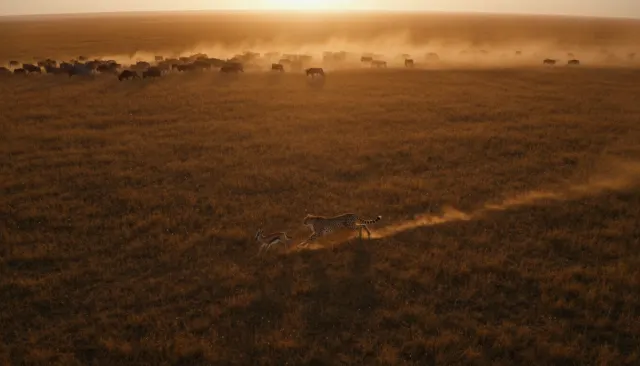
Kodak Aerochrome film first produced for USAAF aerial surveillance
1942
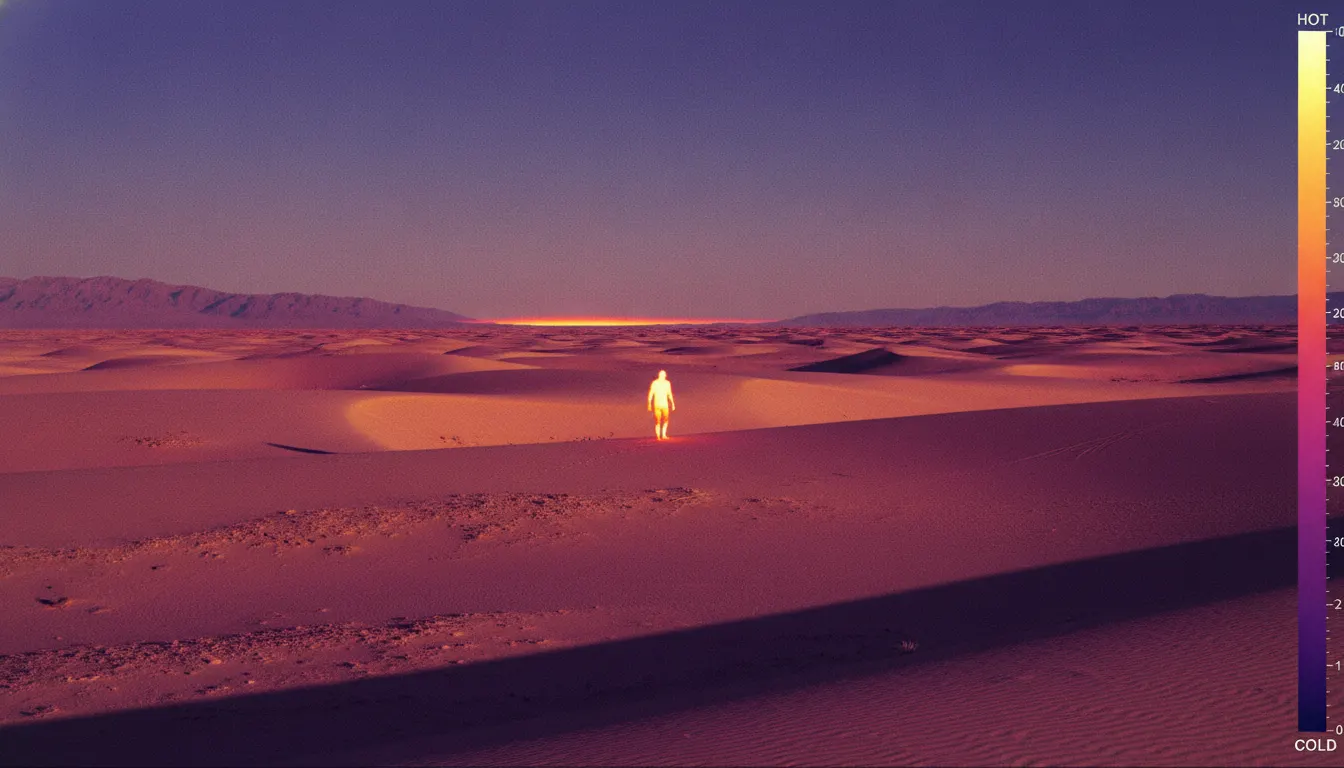
FLIR thermal-camera false-color rendering. Heat-mapped magenta-to-yellow gradient, temperature scale bar, alien biological-imaging look.
The moves a human crew would use to get here. Cue applies them for you, and knowing their names is how you ask for a change.
copy NIR-proxy (luminance of green foliage areas) into Red channel; shift original Red to Green
shift Greens and Yellow-Greens to Magenta/Red range (+120 to +180 degrees)
select sky by luminance mask, reduce exposure -1.5 to -2.5 stops
add slight Gaussian glow to luminance-clipped areas (bloom radius 8-15px)
to-black sky: push Hue Saturation on Blues toward desaturation and darken
coarse grain at 80-120 units, size 60+
to-cool split tone: shadow tinted deep blue/cobalt; highlights orange-yellow to simulate transparency film
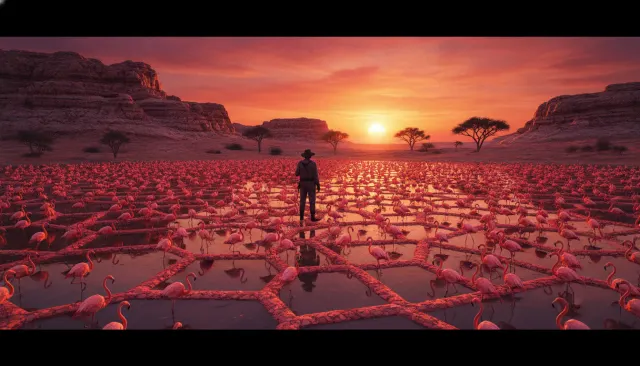
Infrared false-color photography records wavelengths of light beyond the visible spectrum and maps them onto visible color channels, producing surreal palettes where the familiar world is rendered in alien hues. The most iconic variant - foliage burning magenta or red, blue skies rendered black or deep cobalt, and clouds glowing white against the dark - comes from near-infrared (NIR) capture remapped to false color.
Kodak Aerochrome infrared film was developed in 1942 for US military aerial reconnaissance: its sensitivity to NIR wavelengths made it possible to distinguish camouflage netting (which reflected IR like painted cloth) from real vegetation (which reflects very high IR due to chlorophyll). The film's three layers were sensitized to green, red, and NIR rather than RGB, and when processed as a standard E-6 transparency the NIR channel appeared red, red appeared green, and green appeared blue - creating the characteristic false-color appearance. Wildlife biologists and foresters later adopted it for mapping vegetation health. Landscape photographers including Simon Norfolk and Richard Mosse recognized its expressive potential.
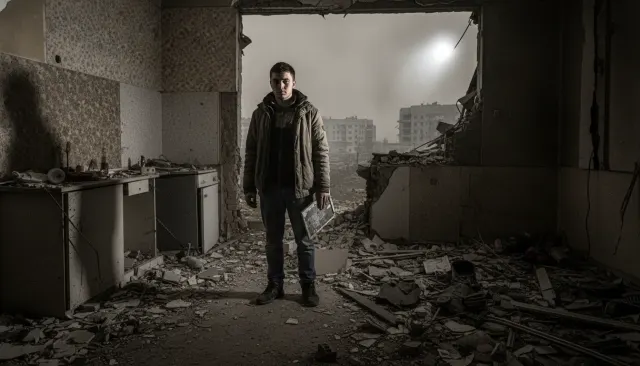
Richard Mosse used Aerochrome (and, after the film was discontinued, a custom 16mm infrared motion picture film) to document the ongoing conflict in the Democratic Republic of Congo in his _Infra_ photography series (2010-2012) and _The Enclave_ video installation (2013). By rendering the armed groups and devastated jungle in fluorescent pink and magenta, Mosse created images that were simultaneously beautiful and morally disorienting, using the aesthetic defamiliarization of false color to force attention onto an overlooked humanitarian crisis. _The Enclave_ won the Deutsche Borse Photography Foundation Prize in 2014.
True thermal infrared (7-14 micrometer wavelength, captured by uncooled microbolometer sensors) produces a different look: a heat map where warm bodies glow bright orange or white against cool dark backgrounds. Military night-vision and FLIR camera aesthetics fall here. In everyday use both "infrared" and "thermal" get conflated in the false-color category, so both palettes - the Aerochrome magenta foliage palette and the FLIR heat-gradient palette - circulate under the same umbrella term.
Digital cameras can capture near-IR by removing the built-in hot-mirror filter (a permanent modification) or using an IR-pass filter (720nm or 850nm) over the lens with long exposures. Software recreation uses channel swapping (replace Red with IR-proxy channel), selective hue rotation of greens to magentas, and luminance-based sky darkening.
1942
_Infra_ photography series, eastern Congo (2010-2012)
_The Enclave_ 16mm infrared film installation, Deutsche Borse Prize winner (2013-2014)
infrared landscape photography, Afghanistan and conflict zones (2000s)
infrared portrait work, Germany (1990s-2000s)
1910
first artistic infrared photography experiments
A Look is not a filter. It is a set of stored decisions the pipeline reads before it makes a single frame, so two videos in the same Look actually match.