The Mitchells vs. the Machines
2021
Sony Pictures Animation, Mike Rianda/Lord Miller
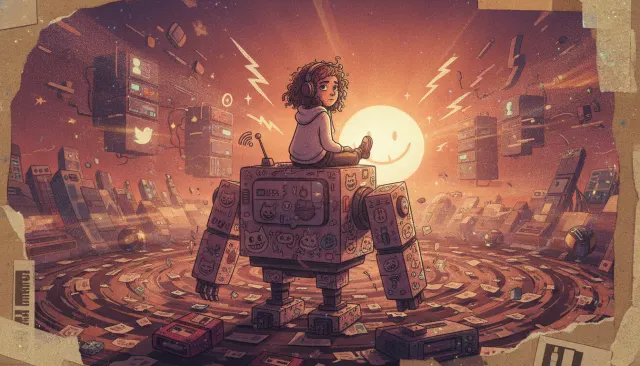
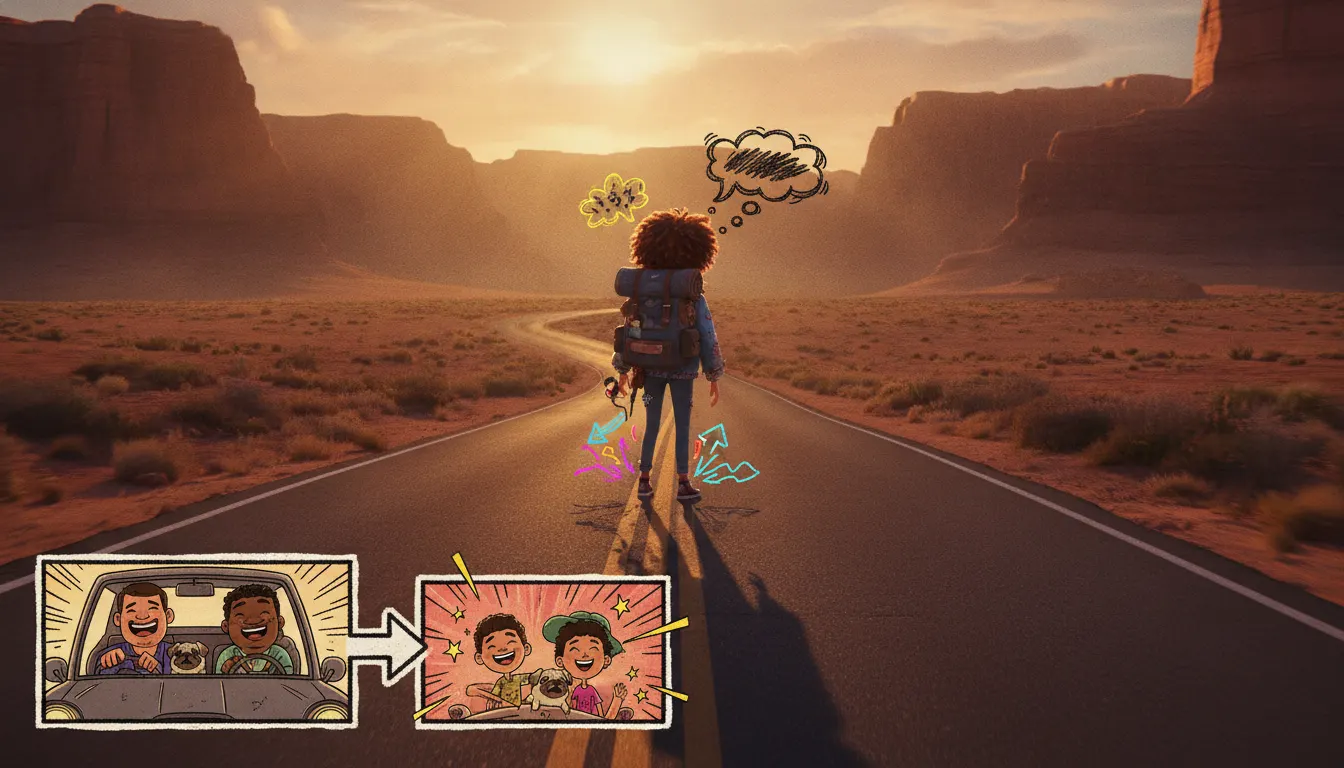
Mitchells vs the Machines Sony 3D-with-2D-overlays. Doodle-on-top frame, energetic comic captions, road-trip family chaos.
The moves a human crew would use to get here. Cue applies them for you, and knowing their names is how you ask for a change.
drawn 2D doodles, scribbles, and annotations composited over rendered 3D frames
style thought bubbles and speech balloons with irregular, hand-lettered type
style emoji and reaction graphics placed on characters and objects
thick outlines and intentionally imprecise shapes contrasting polished CGI
crayon shading and hatching layered over smooth surface rendering
within-frame 'movie' aesthetics when the protagonist is filming or imagining
The Mitchells vs. the Machines (2021), directed by Mike Rianda and produced by Sony Pictures Animation and Lord Miller Productions (Phil Lord and Chris Miller), introduced one of the most distinctive hybrid aesthetics in contemporary animation. The film overlays flat hand-drawn doodles, comic-book thought bubbles, emoji-style stickers, and expressive scribbles directly onto fully-rendered 3D scenes, creating the visual language of a teenager's personal sketchbook come to life.
The look was developed to capture protagonist Katie Mitchell's subjective experience: she sees the world through the lens of a self-taught filmmaker obsessed with making weird movies, and the film's visual language literalizes her interiority. When she finds something funny, the frame erupts with cartoon annotation. When the robot apocalypse begins, her handmade aesthetic filters the horror into something survivable.
Production designer Lindsey Olivares and the Sony Pictures Imageworks team developed a pipeline where 2D illustrators could paint directly onto rendered frames in post. The doodles are intentionally lo-fi - thick marker outlines, wobbly scribbles, badly drawn hearts and sparkles - which creates maximum contrast against the polished Imageworks rendering beneath.
The film's comedy and emotional resonance hinge on this contrast. In technically flawless 3D scenes, a character's inner monologue might be rendered as a crayon drawing captioned in Comic Sans-adjacent handwriting. The robot antagonists - rendered with full industrial precision - get defaced with googly eye stickers. The effect democratizes the frame: amateur annotation and studio-grade rendering coexist as equals.
The comic-overlay language is tied specifically to protagonist Katie Mitchell's identity as an aspiring filmmaker. Her homemade short films appear within the feature as deliberately crude 2D animated sequences, establishing her creative voice through intentional imperfection. When the robot apocalypse begins, Katie's instinct is to film it - and the visual language shifts to incorporate her filmmaker's framing alongside the normal narrative. This creates a film-within-a-film dimension that makes the overlay layer feel narratively motivated rather than decorative.
This approach influenced subsequent animated and live-action productions. The 2023 Spider-Man: Across the Spider-Verse (Sony Pictures Animation) pursued a related meta-visual strategy, though through ink-and-halftone comic-panel physics rather than overlay doodles. Both films are credited to the Lord Miller creative orbit and reflect a shared philosophy: the visible seam between craft levels is itself expressive.
The Mitchells vs. the Machines was originally developed for theatrical release at Sony Pictures, but the COVID-19 pandemic shifted it to a Netflix streaming debut in April 2021. The streaming release meant the film reached its audience without the competitive pressure of box office metrics, and critical reception was exceptional: 97% on Rotten Tomatoes at launch. The film's visual distinctiveness was widely cited as a model for how animation could accommodate a creator's personal visual language within a studio production context, and it sparked renewed industry discussion about whether animation's reliance on consistent, predictable visual standards was a creative constraint worth questioning.
2021
Sony Pictures Animation, Mike Rianda/Lord Miller
2018
Sony Pictures Animation; related meta-animation philosophy
2023
Sony Pictures Animation; ink/halftone comic physics
Disney, Alex Hirsch; journal doodle overlays
Frederator Studios; soft overlay mixed media
Netflix; doodle-adjacent character graphic annotation
A Look is not a filter. It is a set of stored decisions the pipeline reads before it makes a single frame, so two videos in the same Look actually match.