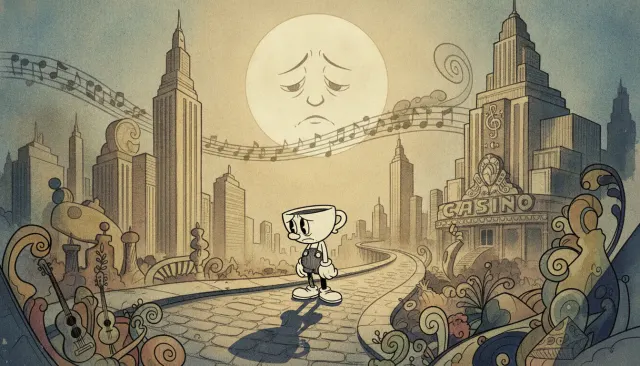
The Mouse of Tomorrow
Paul Terry / Terrytoons · 1942
First appearance as Super Mouse; superhero mouse template established
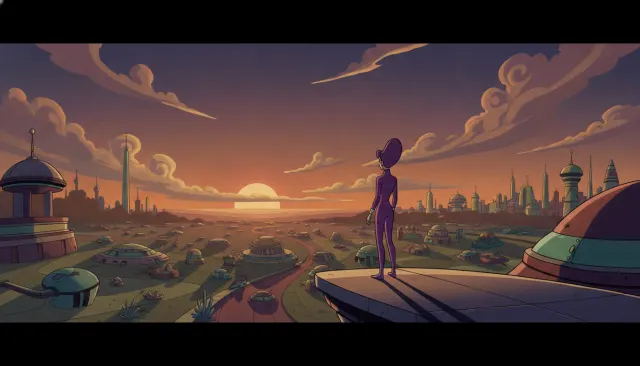
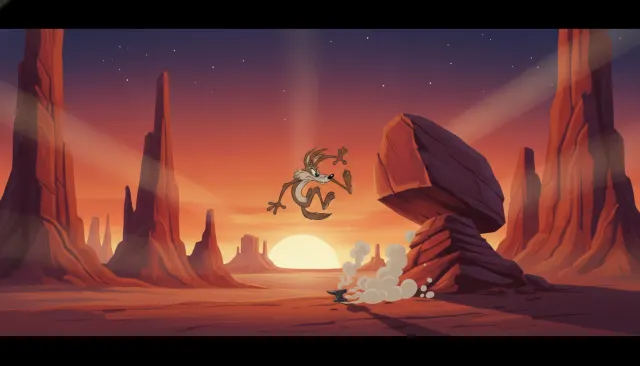
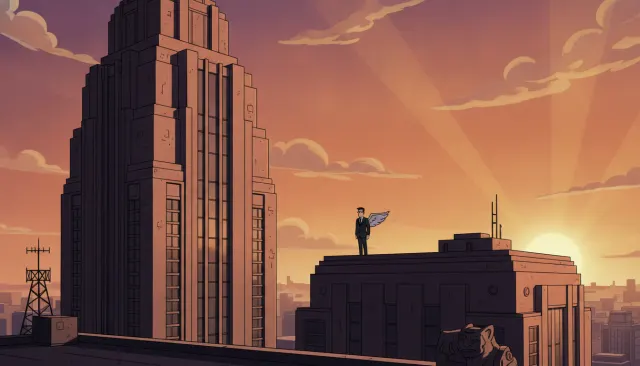
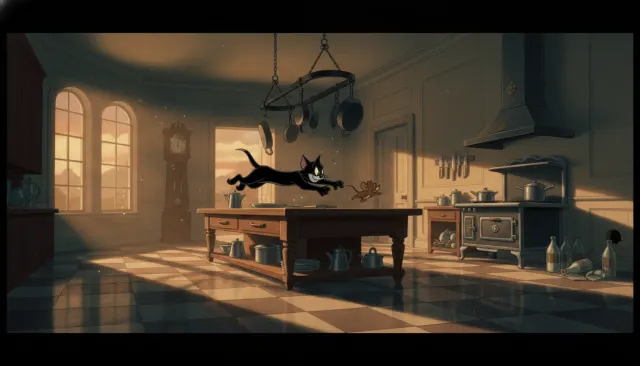
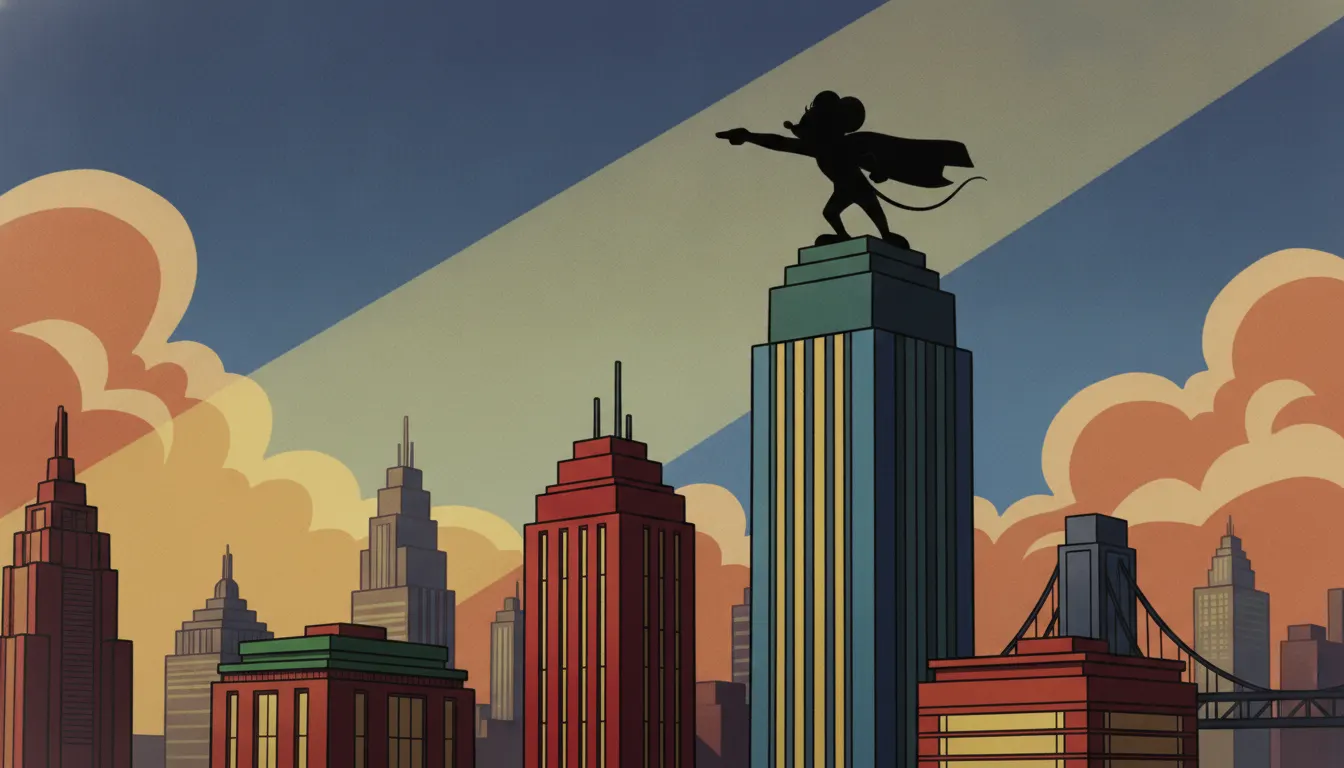
Mighty Mouse and Terrytoons-era 1960s-70s Saturday morning cartoon palette. Bright primary heroics, urban skyline cityscapes, kid-targeted action.
The moves a human crew would use to get here. Cue applies them for you, and knowing their names is how you ask for a change.
Bold red and yellow costume on simple oval mouse form - superhero iconography reduced to absolute visual minimum for maximum recognition.
Simplified environment backgrounds with minimal atmospheric perspective - strong color fields and graphic forms functioning as visual shorthand.
Character action narrated through opera cues rather than dialogue - a production economy that became a defining stylistic quirk.
Hero and villain designs built for immediate silhouette contrast: small round hero vs. tall thin/wide villain forms.
Production economy of repeating animation sequences becomes an aesthetic feature - the same 'Mighty Mouse flies to the rescue' sequence appearing across episodes.
Characters built from basic oval and circle forms with minimal anatomical complexity - designed for reproducibility under tight TV production schedules.
Clear three-act hero-villain structure with rescue climax - the narrative template that became the basis for American children's TV adventure animation.
Mighty Mouse is an animated superhero mouse character created by Paul Terry at the Terrytoons studio. Originally introduced as 'Super Mouse' in the theatrical short The Mouse of Tomorrow (1942), the character was renamed Mighty Mouse in 1944 and became one of the most popular characters in American theatrical animation of the 1940s-50s. The character later transitioned to television with The Mighty Mouse Playhouse (1955-1967), one of the first Saturday morning cartoon programs, and was revived in the critically celebrated Mighty Mouse: The New Adventures (1987-1988) created by Ralph Bakshi.
Paul Terry's Terrytoons studio operated at the lower end of theatrical animation quality from 1929 to 1971, producing content at a fraction of Disney and Warner Bros. budgets. This economic reality shaped the studio's visual aesthetic: simpler character forms, more limited animation, flat graphic backgrounds, and a reliance on stock footage and reused sequences. These characteristics, once understood as limitations, later became the defining features of the Saturday morning television animation style when Terrytoons transitioned to TV production.
The Mighty Mouse Playhouse became a Saturday morning template: straightforward hero-villain narratives, operatic soundtracking (Mighty Mouse's adventures were narrated through opera cues rather than dialogue), bright primary colors, and simple animation that could be produced at television budgets. The show ran for 12 years on CBS.
Mighty Mouse's classic design is a direct superhero parody: the mouse body (simple oval form, rounded ears, long tail) in an unmistakable Superman-referencing red and yellow costume. The character design is deliberately simple - legibility was the primary requirement. Villains, particularly Oil Can Harry the cat, use similarly reductive designs with strong silhouette contrast.
Background design in the Terrytoons era is flat and graphic: simple painted environments with minimal atmospheric perspective, strong color fields, and the deliberately stylized quality of a visual shorthand. This became the template for television animation's simplified background painting, directly influencing Hanna-Barbera's budget-driven approach.
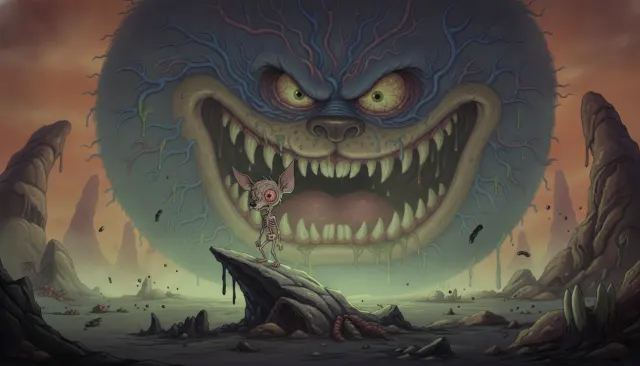
Mighty Mouse: The New Adventures was a CBS Saturday morning series created by Ralph Bakshi and John Kricfalusi (who was a key staff member). The revival used the classic Mighty Mouse character as a vehicle for Bakshi's experimental animation sensibility and Kricfalusi's grotesque-expressionist character animation. The show's visual style was radically different from the original - more anarchic, deliberately imperfect, and willing to push against Saturday morning conventions. CBS famously objected to several episodes and canceled the series after two seasons.
Mighty Mouse represents the transition point between theatrical and television animation - a character whose design was refined for budget television production and whose Saturday morning template became the foundational grammar for 1960s-80s American children's TV animation. The Bakshi revival had direct influence on John Kricfalusi's subsequent development of Ren & Stimpy (1991).
Paul Terry / Terrytoons · 1942
First appearance as Super Mouse; superhero mouse template established
Paul Terry / Terrytoons / CBS · 1955
First Saturday morning TV cartoon; ran 12 years and established the format
Ralph Bakshi & John Kricfalusi · 1987
CBS revival; anarchic Bakshi/Kricfalusi reinterpretation preceding Ren & Stimpy
Hanna-Barbera · 1958
Direct successor in Saturday morning template - Hanna-Barbera systemized the Terrytoons low-budget approach
Hanna-Barbera · 1973
Saturday morning superhero animation carrying the Mighty Mouse template into 1970s DC context
A Look is not a filter. It is a set of stored decisions the pipeline reads before it makes a single frame, so two videos in the same Look actually match.