A Wild Hare
Tex Avery · 1940
First definitive Bugs Bunny; 'What's up, Doc?' introduced
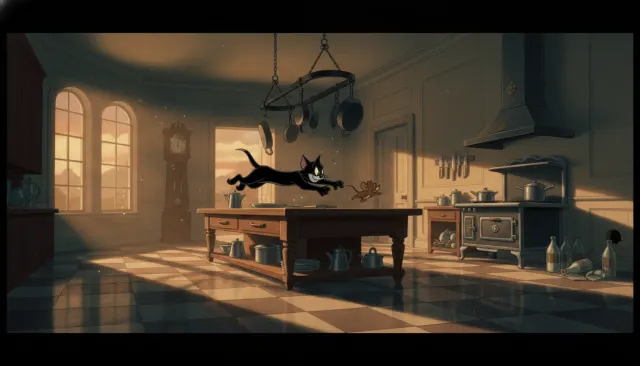
Warner Bros Looney Tunes squash-and-stretch. Tex Avery, Chuck Jones, Bob Clampett exaggerated takes, painted desert backgrounds.
The moves a human crew would use to get here. Cue applies them for you, and knowing their names is how you ask for a change.
Deformation of character bodies taken to cartoonish extremes - jaws to the floor, eyes telescoping, bodies flattening to paper thinness on impact.
Double-take and triple-take reactions where the character's emotional response to a shock is delayed, staged in multiple escalating beats, and physically total.
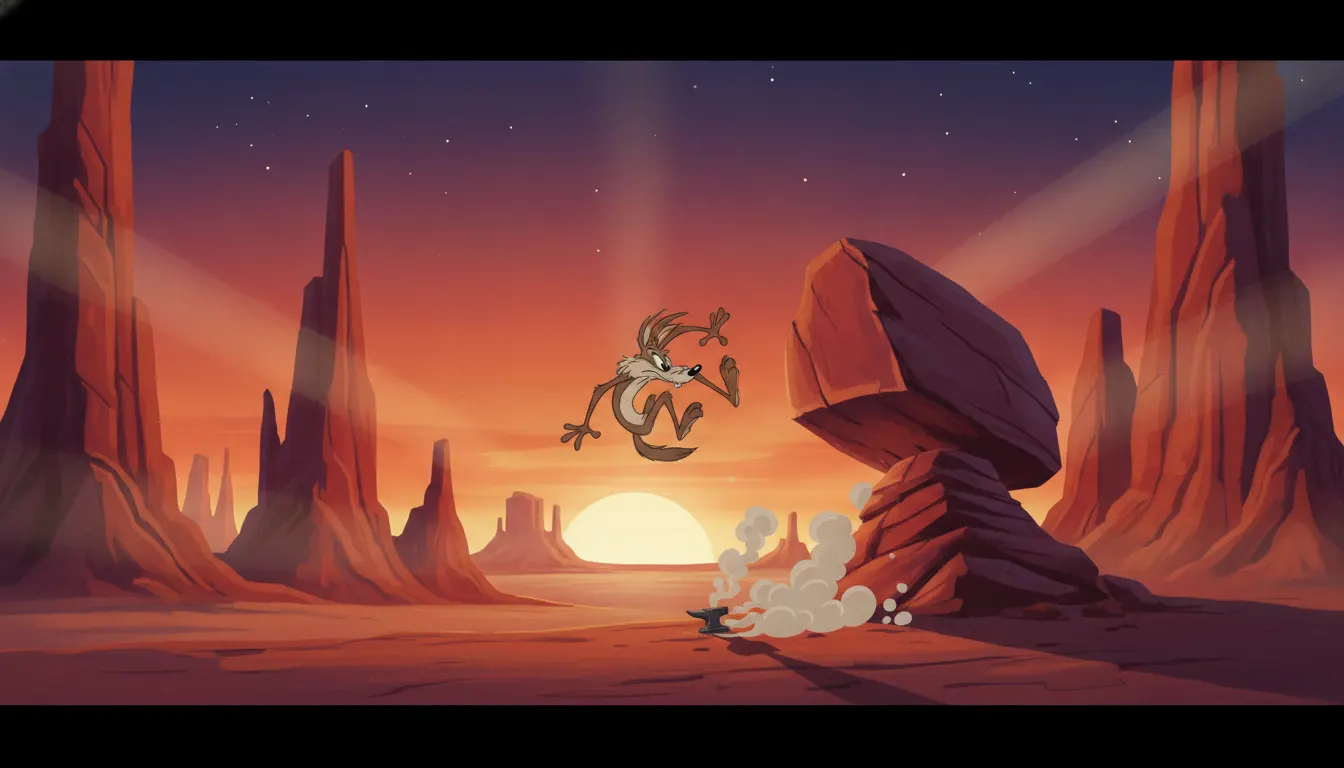
Chuck Jones's Wile E. Coyote series established the visual grammar of elaborate product failure - complex Rube Goldberg devices and industrial-spec failures as pure comedy.
Characters address the camera, acknowledge the screen, argue with the iris closing in - Tex Avery's primary comedic register; Bugs Bunny's primary power.
The traditional iris-out used to end theatrical shorts subverted as a comedic tool - characters get caught in closing irises, argue through them.
Character actions and comedy beats timed to specific musical cues - particularly in Friz Freleng's cartoons where the score is the choreographic script.
Chuck Jones's specific contribution: the held pause where characters realize their physical predicament before physics takes over, exchanging a look with the audience.
Looney Tunes is the theatrical short animation series produced by Warner Bros. Cartoons from 1930 to 1969. Alongside its sister series Merrie Melodies (1931-1969), it produced over 1,000 theatrical short films featuring characters including Bugs Bunny, Daffy Duck, Porky Pig, Elmer Fudd, Tweety Bird, Sylvester the Cat, Wile E. Coyote, and the Road Runner. The series represents the apex of the anarchic, physically inventive strand of American theatrical animation, and its visual language - defined by directors Tex Avery, Chuck Jones, Bob Clampett, and Friz Freleng - remains among the most widely recognized in the history of the art form.
Warner Bros. Cartoons was established in 1933 under Leon Schlesinger's production company. The studio developed in conscious contrast to Disney's naturalistic, emotionally earnest approach: where Disney pursued prestige and visual beauty, Warner Bros. pursued speed, subversion, and pure comedic anarchy. The creative culture was shaped by directors competing to outdo each other in visual invention and joke density.
Tex Avery joined the studio in 1936 and immediately began pushing the medium's physical and fourth-wall-breaking possibilities. His introductions of Bugs Bunny (A Wild Hare, 1940) and his MGM work (Red Hot Riding Hood, 1943; Screwball Squirrel, 1944) established the lunatic-energy aesthetic that defines the style. After Avery left for MGM, Chuck Jones and Bob Clampett continued developing the form in different directions.
Looney Tunes animation is defined by its physical exaggeration: squash-and-stretch deformation taken to extremes, limbs that detach, bodies that flatten against walls, characters whose jaws drop to the floor and whose eyes telescope out of their skulls. These techniques were used in Disney animation for naturalistic weight and bounce; in Looney Tunes they became the primary comedic language, deployed at maximum intensity.
Chuck Jones developed precise timing theories around these physical gags, particularly in his Road Runner/Coyote series (beginning Fast and Furry-ous, 1949). The Coyote's anticipation pause before falling off a cliff - the moment when he looks at the camera before gravity remembers him - became one of the most analyzed timing sequences in animation history.
Tex Avery: maximum velocity, maximum exaggeration, fourth-wall obliteration, iris-in/iris-out jokes, meta-textual awareness. Chuck Jones: more precise, character-driven timing; architectural staging; Coyote series' physics-as-tragedy. Bob Clampett: grotesque, anarchic, occasionally disturbing physical comedy. Friz Freleng: musical timing (many cartoons were synchronized to specific musical pieces), Tweety/Sylvester character development.
Mel Blanc voiced the majority of the Looney Tunes cast from 1937 until his death in 1989, creating vocal personalities so distinct they shaped the visual character designs retroactively. Bugs Bunny's New York/Brooklyn accent, Daffy's spray-spit lisp, Porky's stutter - these audio signatures are inseparable from the visual style.
Looney Tunes' visual vocabulary - squash-and-stretch, take reactions, ACME product destruction sequences - is the foundational grammar of American comedic animation. Its influence is visible in every subsequent generation of animation, from the Animaniacs (1993) to modern online animation. The Road Runner cartoons directly influenced the formal properties of video game design.
Tex Avery · 1940
First definitive Bugs Bunny; 'What's up, Doc?' introduced
Chuck Jones · 1949
First Road Runner vs. Wile E. Coyote cartoon; ACME and gravity comedy template
Chuck Jones · 1957
Critically regarded as the greatest Looney Tunes cartoon; Wagner opera pastiche
Tex Avery (MGM) · 1943
Avery post-WB MGM work pushing maximum exaggeration in adult-audience direction
Chuck Jones · 1953
Daffy Duck as victim of an unseen animator; canonical meta-animation statement
Chuck Jones · 1955
Michigan J. Frog; wordless narrative tragedy using pure animation language
Chuck Jones · 1942
Pioneered 'smear' animation technique influencing subsequent fast-action animation
A Look is not a filter. It is a set of stored decisions the pipeline reads before it makes a single frame, so two videos in the same Look actually match.