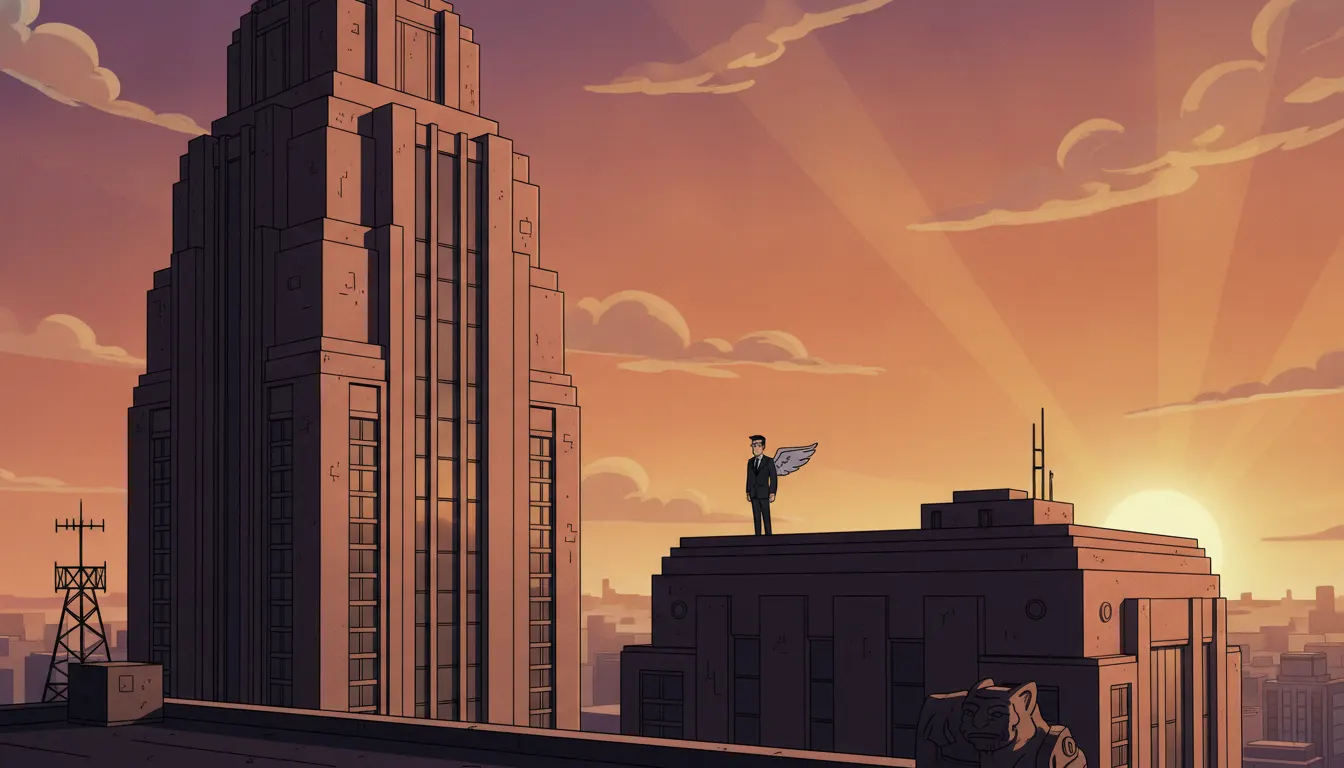
Harvey Birdman, Attorney at Law
Michael Ouweleen & Erik Richter · 2001
Adult Swim series; recycled Hanna-Barbera footage in absurdist legal comedy context
Michael Ouweleen and Erik Richter Hanna-Barbera-recycled-asset legal comedy. Sebben and Sebben law firm flat-cel, cartoon-cameo courtroom palette.
The moves a human crew would use to get here. Cue applies them for you, and knowing their names is how you ask for a change.
Original 1960s Hanna-Barbera animation composited alongside newly drawn material, with no attempt to hide the difference - the mismatch is the aesthetic.
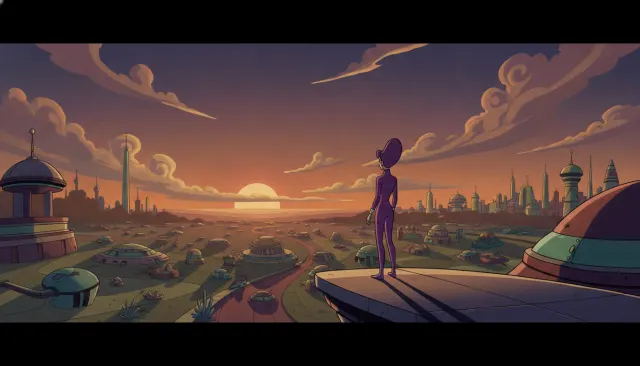
Theatrical frontal compositions with symmetrical framing - courtrooms treated as flat stage sets rather than three-dimensional architectural spaces.
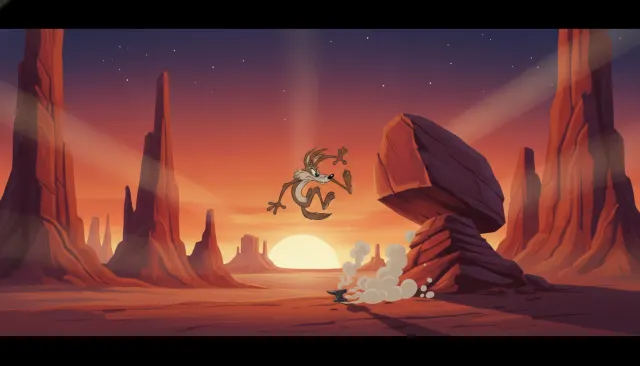
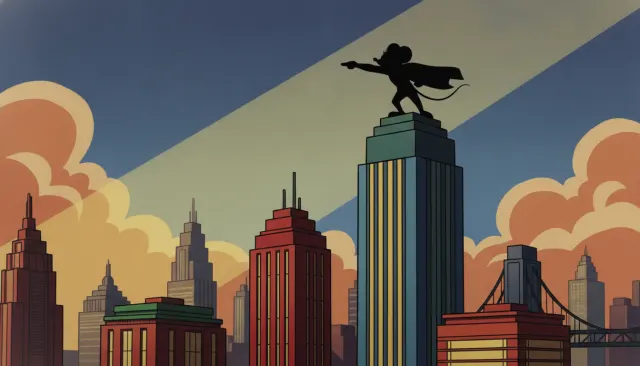
Palette governed by the warm, slightly faded quality of 1960s Hanna-Barbera cel production - mustards, brick reds, and powder blues.
Comedic beats delivered through extended still holds, slight line vibration, and minimal character movement - timing over action.
Unrelated animation clips, title cards, and abstract imagery inserted mid-scene as comedic punctuation without explanation.
Characters from completely different Hanna-Barbera shows occupy the same space using the shared flat compositional logic of 1960s TV animation.
Specific juridical language, procedural forms, and courtroom conventions applied to superhero and cartoon physics problems for tonal incongruity.
Harvey Birdman, Attorney at Law is an adult animated comedy series that aired on Cartoon Network's Adult Swim block from 2001 to 2007, with a brief revival in 2018. Created by Michael Ouweleen and Erik Richter, the show takes Birdman - a superhero character from the 1967 Hanna-Barbera series Birdman and the Galaxy Trio - and repurposes him as an overmatched attorney defending other classic Hanna-Barbera characters in increasingly absurd legal proceedings.
The show's visual identity is built on deliberate anachronism: original 1960s Hanna-Barbera animation cells are composited alongside newly drawn material in a way that makes no attempt to hide the difference. The original footage runs at the low frame rate and flat graphic quality of 1960s TV animation; new material is drawn to match that aesthetic as closely as possible while maintaining a subtle modern cleanliness. The result is a collage aesthetic where forty years of animation history coexist on screen simultaneously.
The courtroom scenes, which anchor most episodes, use a theatrical staging derived from both actual courtroom illustration tradition and the specific spatial logic of 1960s TV animation: frontal compositions, symmetrical staging, and deliberate flatness of perspective. The courtroom is a stage set rather than an architectural space, allowing characters from completely different Hanna-Barbera shows to occupy the same flat plane without visual incongruity.
This staging choice reflects the show's conceptual premise: that all Hanna-Barbera cartoons exist in a shared legal universe with the same spatial rules - or rather, with the same spatial indifference.
The color palette is governed by the source material: the warm, slightly faded colors of 1960s Hanna-Barbera production - mustard yellows, brick reds, mid-century office greens, and powder blues. Harvey Birdman's own character design is the original 1967 design with minimal modification: the blue-gray superhero suit, yellow wings, and sun visor that reads as simultaneously heroic and ridiculous against a law office background.
The show was among the foundational texts of Adult Swim's late-night animation aesthetic: the assumption that vintage visual material is inherently funny when recontextualized, that non-sequitur and deadpan delivery are primary comedic tools, and that narrative resolution is optional. This aesthetic lineage extends to Space Ghost: Coast to Coast (1994) - the direct predecessor - and influenced the entire wave of Adult Swim recycled-animation programs.
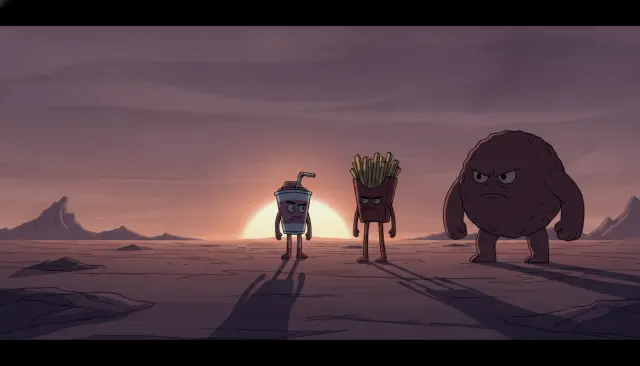
Harvey Birdman established a template for Adult Swim's archival-comedy approach that directly influenced Aqua Teen Hunger Force (2001), Sealab 2021 (2001), The Venture Bros. (2003), and dozens of subsequent productions. The show proved that 1960s animation's limitations could be leveraged as comedic assets rather than overcome.
Michael Ouweleen & Erik Richter · 2001
Adult Swim series; recycled Hanna-Barbera footage in absurdist legal comedy context
Mike Lazzo · 1994
Adult Swim predecessor; original recycled-animation talk show format
Harry Goz & Adam Reed · 2001
Adult Swim contemporary; recycled 1972 Hanna-Barbera footage in nihilistic comedy
Hanna-Barbera · 1967
Original source material providing character and archival footage
Jackson Publick & Doc Hammer · 2003
Adult Swim series citing Harvey Birdman's retro-animation recontextualization
A Look is not a filter. It is a set of stored decisions the pipeline reads before it makes a single frame, so two videos in the same Look actually match.