Pacific Rim
Legendary Pictures / Guillermo del Toro · 2013
Originating live-action mecha film establishing the scale language and rain-environment aesthetic this look references
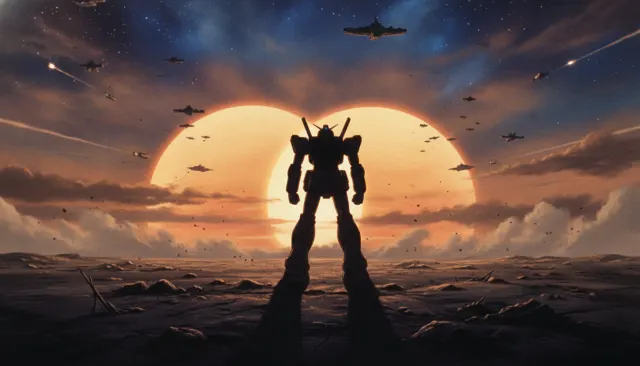
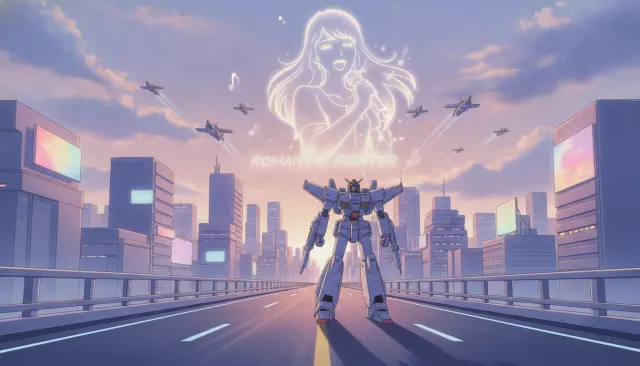
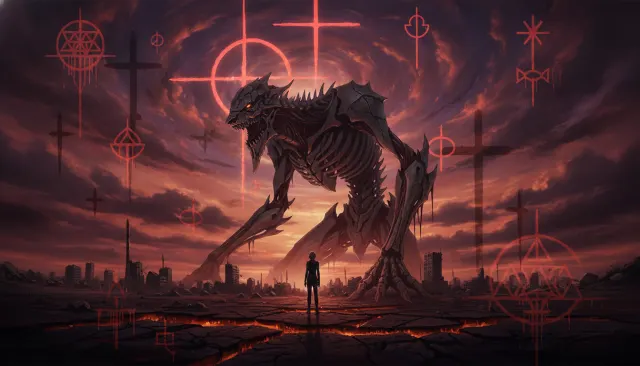
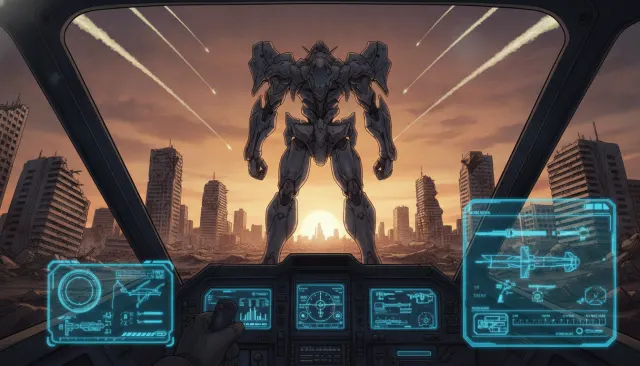
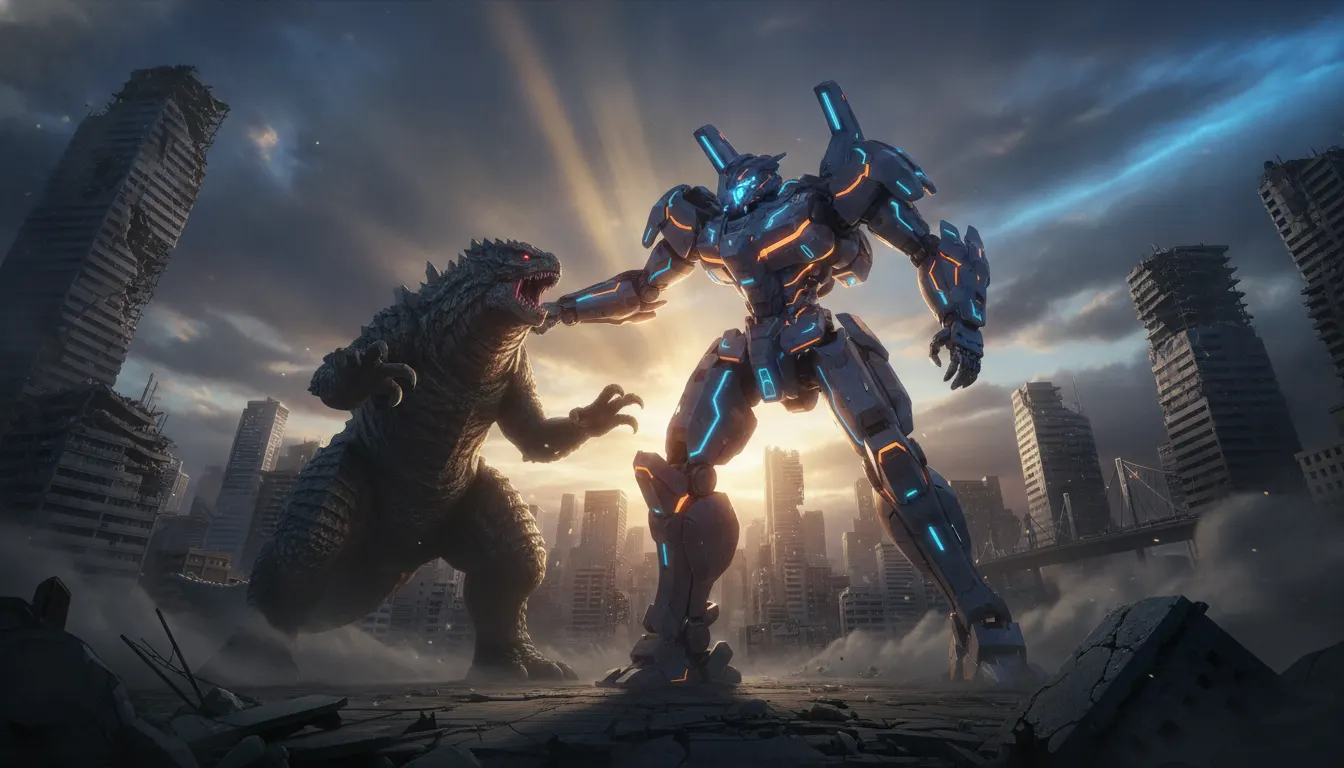
Modern mecha anime register (Pacific Rim Uprising, SSSS.Gridman, Darling in the Franxx). Bright digital mech polish, 3D-camera fight choreography, kaiju-scale staging.
The moves a human crew would use to get here. Cue applies them for you, and knowing their names is how you ask for a change.
Human observers in extreme foreground against enormous mecha/kaiju in background -- the Pacific Rim technique for communicating impossible scale without losing comprehensibility
Wet urban environments with rain, dust, and debris propagating from impact events, creating physical context for mechanical weight and movement
Cool blue-steel Jaegers / mecha against warm orange-gold Kaiju / energy -- a high-contrast split palette that reads in dark, rain-soaked, or particle-heavy environments
Impact events creating visible environmental shockwaves -- ground cracks, water displacement, building glass shattering -- that communicate kinetic force beyond the immediate contact point
Combat energy rendered as bright neon geometric shapes -- spirals, polygons, flame-forms -- that prioritize emotional force over physical plausibility
Mecha with biological curves, asymmetric panel arrangements, or pilot-body-mirroring proportions that suggest living tools rather than pure machines
The modern anime-inflected mecha aesthetic synthesizes Western blockbuster mecha (Guillermo del Toro's Pacific Rim, 2013; Steven S. DeKnight's Pacific Rim: Uprising, 2018) with the contemporary anime mecha visual grammar developed through Darling in the FranXX (2018, TRIGGER / A-1 Pictures), Promare (2019, TRIGGER), Gurren Lagann (2007, GAINAX/TRIGGER precursor), and the Netflix SSSS.Gridman (2018, TRIGGER) / Dynazenon (2021) franchise. The result is a hybrid aesthetic combining Hollywood-scale kinetic action with anime's expressionist freedom.
Del Toro's Pacific Rim established a specific scale vocabulary: Jaegers (mecha) and Kaiju (monsters) filmed at ground level, with human observers in the extreme foreground establishing scale. Rain, ocean, and urban debris create physical context for enormous weight. The color palette -- blue-steel Jaegers against yellow-orange Kaiju bioluminescence -- is designed for maximum contrast in dark, rain-soaked environments. Uprising (2018) moved battles to daylight, shifting the aesthetic toward brighter colors and faster cutting.
TRIGGER studio (founded 2011 by former GAINAX staff including Hiroyuki Imaishi) developed the modern anime mecha counterpart: Gurren Lagann's drill-themed spiral energy, Promare's neon-polygon fire effects, and SSSS.Gridman's tokusatsu (live-action suit) reference that translated rubber-suit mecha fighting into animation. TRIGGER's mecha fight in bright, high-contrast environments with less naturalistic physics and more emotional energy as a combat force.
The modern mecha anime aesthetic sits between these poles: Pacific Rim's scale realism and TRIGGER's expressionist energy. Darling in the FranXX uses organic-mecha hybrid designs (mechs piloted in suggestive positions) with bright color-coding per unit. Netflix's Neon Genesis Evangelion revival audience encountered mecha alongside Amazon Prime's Pacific Rim: The Black (2021-2022 anime series), creating a streaming-era mecha aesthetic that blends the franchises freely.
Modern mecha anime uses a more physically grounded approach than 1970s-80s super robot anime but less naturalistic than Pacific Rim's CGI weight simulation. Impact creates shockwaves that propagate through environments; movement uses momentum that needs to be arrested rather than stopped instantly; weapon energy effects have buildup and discharge cycles rather than instant activation.
Legendary Pictures / Guillermo del Toro · 2013
Originating live-action mecha film establishing the scale language and rain-environment aesthetic this look references
Legendary Pictures / Steven S. DeKnight · 2018
Sequel with more anime-adjacent bright-daylight combat aesthetics, closer to the modern anime mecha synthesis
TRIGGER / Hiroyuki Imaishi · 2019
TRIGGER's feature film with the purest expression of the studio's neon-polygon energy and mechanical-expressionist combat
TRIGGER / A-1 Pictures · 2018
Organic-mecha hybrid design with bright unit color-coding and a Pacific Rim-influenced large-scale battle aesthetic
TRIGGER / Akira Amemiya · 2018
Tokusatsu-inspired mecha anime that translates rubber-suit fighting choreography into animation with a distinctive retro-modern aesthetic
Legendary / Polygon Pictures · 2021
Netflix anime set in the Pacific Rim universe, merging the franchise's visual grammar with anime production conventions directly
A Look is not a filter. It is a set of stored decisions the pipeline reads before it makes a single frame, so two videos in the same Look actually match.