Brassai
1933
_Paris de Nuit_ / _Paris by Night_ photobook
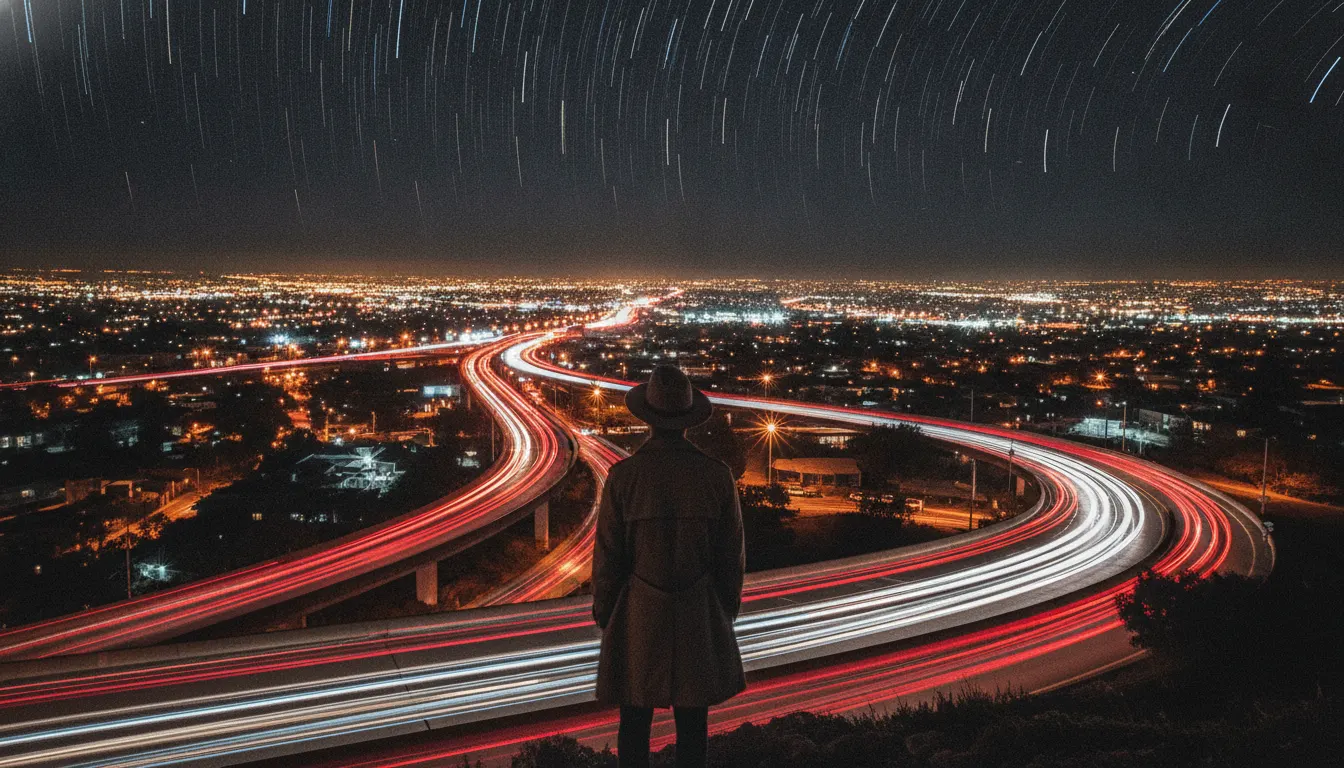
30-second long exposure of city traffic. Red tail-light trails, white headlight streaks, frozen buildings, motion painted across the frame.
The moves a human crew would use to get here. Cue applies them for you, and knowing their names is how you ask for a change.
ISO 100-400, f/8-f/16, shutter 15-120 seconds; cable release or remote to prevent shake
shoot 30-60 second clips with 0-2 second gaps, blend as Lighten mode stack in PS or StarStaX
shoot after light rain for doubled trail intensity via reflective surface
stack foreground trails (traffic) with a shorter exposure sharp background (city skyline) in post
daylight-balanced sensor renders sodium streetlights warm amber, LED lights cool blue - preserve and enhance this split
90-180 minute total accumulated exposure in polar-facing direction for full arc star paths
for video simulation, create horizontal streak layers on black, animate their length growing from 0 to full over 1-2 seconds
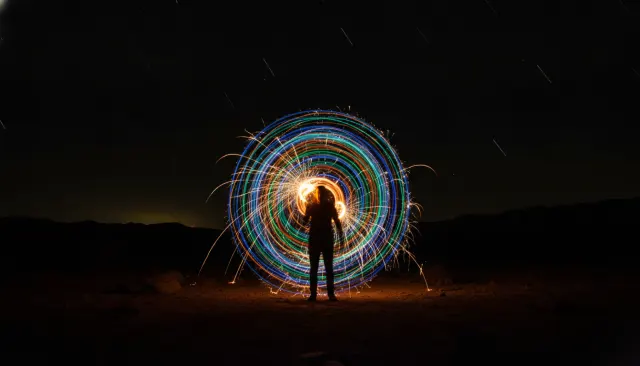
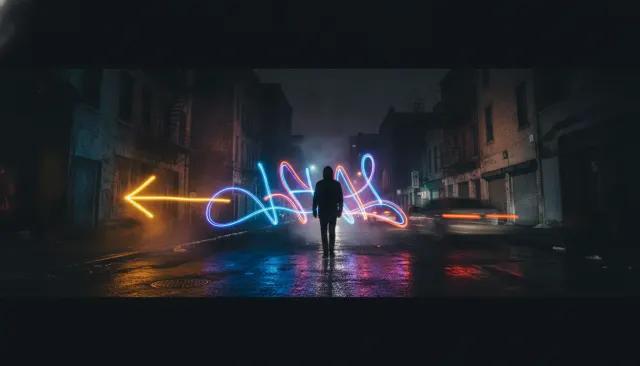
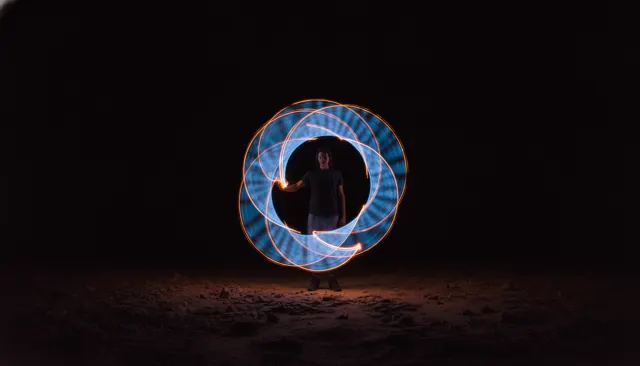
Long exposure night light trail photography accumulates the ambient light of moving sources - headlights, tail lights, neon signs, street lamps - over an extended shutter duration, transforming individual transient moments of light into continuous luminous ribbons that map motion across an entire scene. Unlike light painting (which uses deliberate, controlled light sources), the night trail look captures naturally occurring urban or natural light as its raw material.
Brassai (Gyula Halasz, Hungarian-French, 1899-1984) was the preeminent chronicler of night Paris. His 1933 publication _Paris de Nuit_ (Paris by Night), shot over two years beginning in 1930, presented the French capital in long-exposure photographs that captured wet cobblestones reflecting gas and electric light, café illumination spilling onto dark pavements, and the first automotive traffic streaks visible in cityscapes. Though the specific traffic-trail aesthetic as we know it requires longer exposures than Brassai typically used, his photographs established the visual grammar of urban nocturnal photography - the city as its own luminous subject, light as urban architecture.
Andreas Feininger brought traffic light trails to prominence in his New York City long-exposure work of the late 1940s and 1950s. His photograph of Broadway traffic at night - red and white streaks flowing between dark buildings - became a canonical image of the genre and was widely reproduced in photography magazines and books. The technique was technically simple: a tripod, a cable release, and an exposure of 10-60 seconds on slow film at a small aperture.
The same technique applied to night skies renders stars as arcing trails - circles (or partial arcs) around Polaris in the northern hemisphere, reflecting Earth's rotation. Exposure times from 30 minutes to several hours create increasingly long arcs. Ansel Adams made early star trail studies in Yosemite, and the genre has expanded with digital capture and stacking software (StarStaX, Sequator) that can blend hundreds of short exposures into seamless arcs without dew accumulation or noise buildup.
Long-exposure night trails became enormously popular on Instagram and 500px from 2012-2018, driven by the accessibility of mirrorless cameras with built-in intervalometers. Specific compositions - suspension bridges, highway interchanges, Times Square, neon-lit alleyways in Tokyo's Shinjuku or Hong Kong's Mong Kok - became pilgrimage sites for photographers seeking iconic trail images.
1933
_Paris de Nuit_ / _Paris by Night_ photobook
Broadway traffic light trail photographs, New York (late 1940s-1950s)
early night and star photography studies, Yosemite (1940s)
_New York_ color long-exposure city photographs (1952-1953, published in _Life_)
contemporary long-exposure cityscape and timelapses, Los Angeles (2010s-present)
A Look is not a filter. It is a set of stored decisions the pipeline reads before it makes a single frame, so two videos in the same Look actually match.