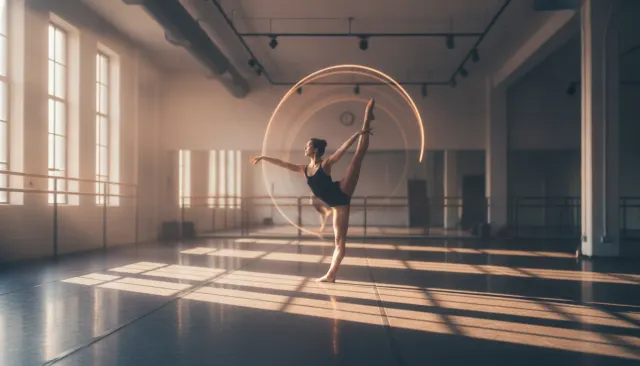
Gjon Mili / Pablo Picasso
1949
light drawings for _Life Magazine_ , proto-light-graffiti
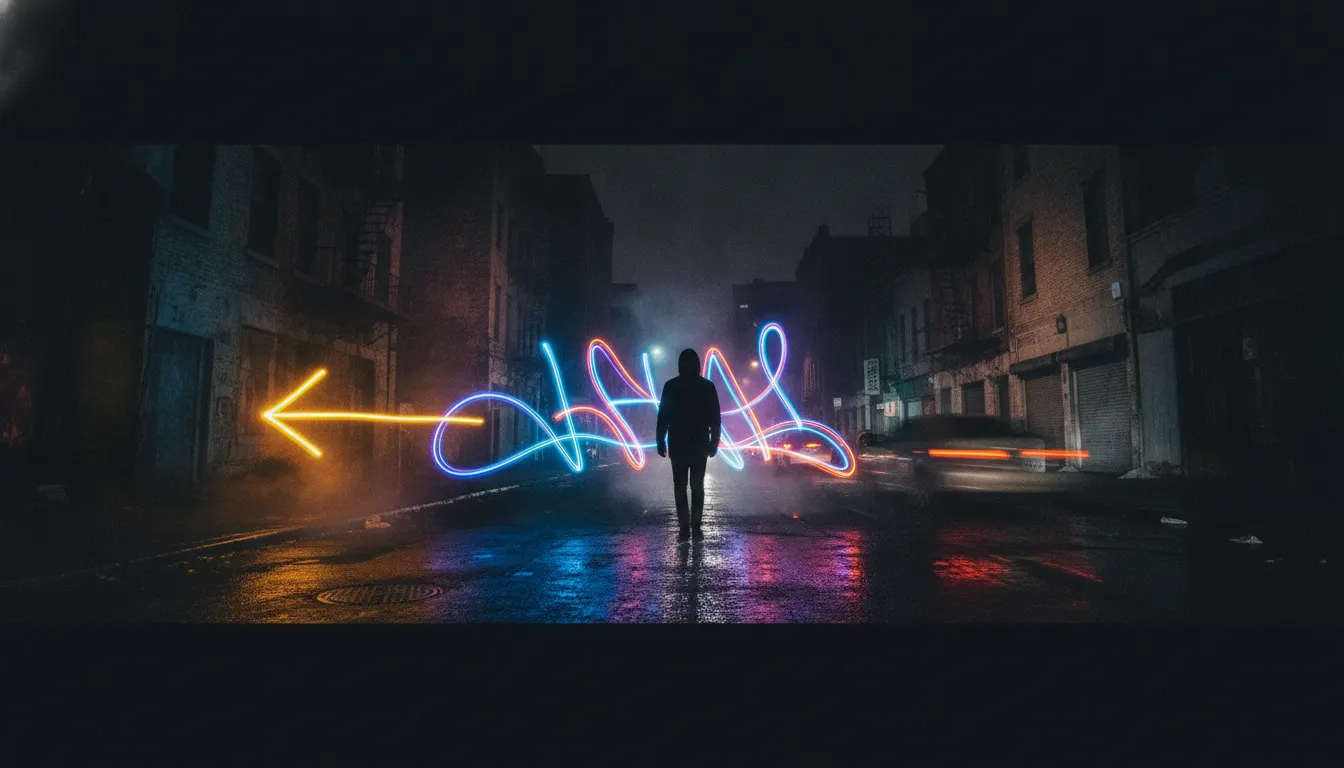
Urban light-graffiti aesthetic. Street scene at night with painted neon light trails spelling out words, glowing arrows, and tag silhouettes, long-exposure capture.
The moves a human crew would use to get here. Cue applies them for you, and knowing their names is how you ask for a change.
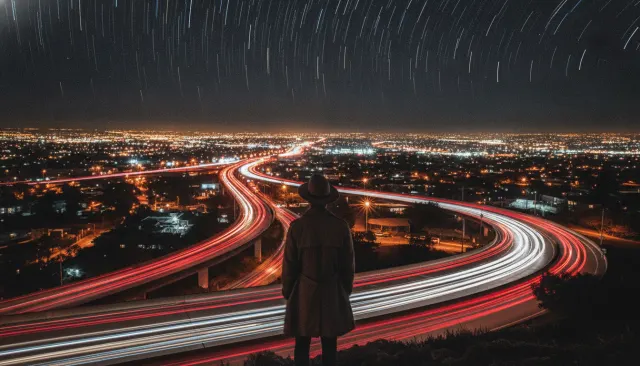
exposure blending: stack 30-60 second exposures at ISO 100-400, f/8-f/11, blend as Lighten in post
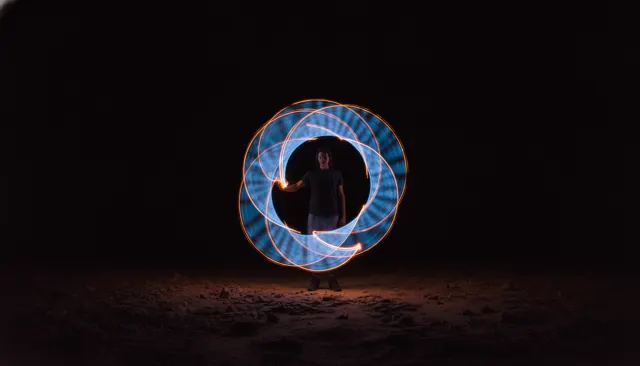
performer moves light source in deliberate shapes during exposure
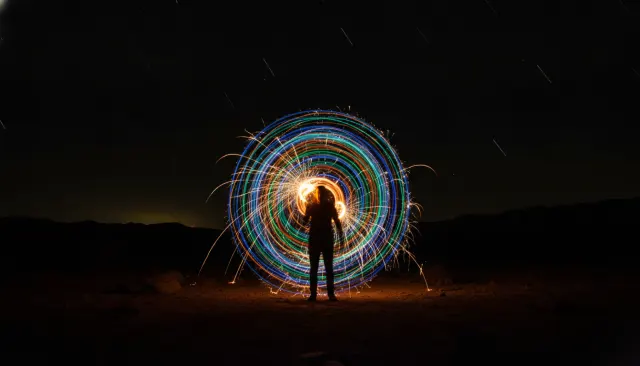
ignited fine-grade steel wool spun in a whisk produces golden spark trails (fire safety required)
wave a strip of addressable LEDs in a programmed color pattern to write in multiple hues
mode composite: place trail layers in Screen blend mode over a dark background for multiple-pass illusion
in video, apply directional motion blur (50-100px in motion direction) to bright elements on dark frame
mix warm (tungsten) and cool (LED blue) sources within the same exposure for natural vibrancy
Light graffiti - also called light writing or light tagging - is a subset of light painting in which a photographer or performer deliberately draws, writes, or creates shapes using handheld light sources during a long camera exposure. The darkened background records nothing; the moving light traces a luminous path that exists only in the photograph or video, an image created entirely in time rather than space.
The foundational technique belongs to the broader light painting tradition (see the related _light-painting-long-exposure_ look), but light graffiti as a distinct term - and as an art form with urban, performative, and text-based characteristics - crystallized in the mid-2000s. Pablo Picasso famously drew light roosters and centaurs for photographer Gjon Mili for a _Life Magazine_ shoot in 1949, but Picasso's work was intimate and painterly. Light graffiti shifts the emphasis toward public-space interventions, illegibility-of-medium, and the visual language of spray-can graffiti tags reimagined in photons.
The Lapp Brothers - Denmark-based photographers Jan Leonardo Woellert and Jens Warnecke - emerged in the mid-2000s as defining figures. Their _LightArt_ portfolio (active from approximately 2007-2015) used flashlights, LEDs, and fire to create precise, large-scale images in outdoor landscapes, photographed in single exposures lasting 30 seconds to several minutes. Their work brought the technique into the fine-art and commercial photography conversation.
LAPP (Light Art Performance Photography) as a community genre - distinct from casual long-exposure experimentation - developed in parallel with the rise of Flickr groups, where practitioners worldwide shared techniques, equipment rigs (LED poi, steel wool spinners, RGB light tubes), and collaborated on light graffiti installations.
The visual grammar of moving light trails overlaps heavily with rave-era glow-stick performance (1990s UK rave scene) and contemporary LED flow-arts disciplines including poi, staff, and hoops. Long-exposure photography of flow arts performers creates continuous light trail shapes - corkscrews, figure-eights, and starburst patterns - that are structurally identical to light graffiti even when no deliberate drawing is intended. The result is always a trace of human motion made visible.
For motion content, the aesthetic is achieved by combining low-ISO long-exposure frames blended as averages, or by using a black background with Screen-mode compositing of bright trails, simulating the accumulation of multiple exposures.
1949
light drawings for _Life Magazine_ , proto-light-graffiti
_LightArt_ portfolio (2007-2015)
long-exposure light painting photography, Poland (2010s)
light painting body art photography, international touring (2010s-present)
light writing documentary and urban light graffiti (2000s-2010s)
light painting photography, published internationally (2000s-2020s)
A Look is not a filter. It is a set of stored decisions the pipeline reads before it makes a single frame, so two videos in the same Look actually match.