Etienne-Jules Marey
chronophotographic motion studies, walking and bird flight (Paris, 1882-1895)
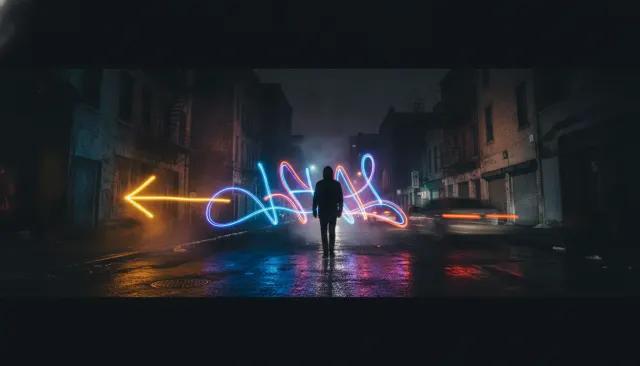
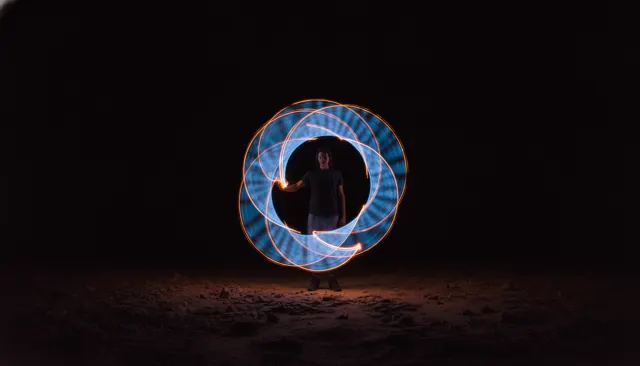
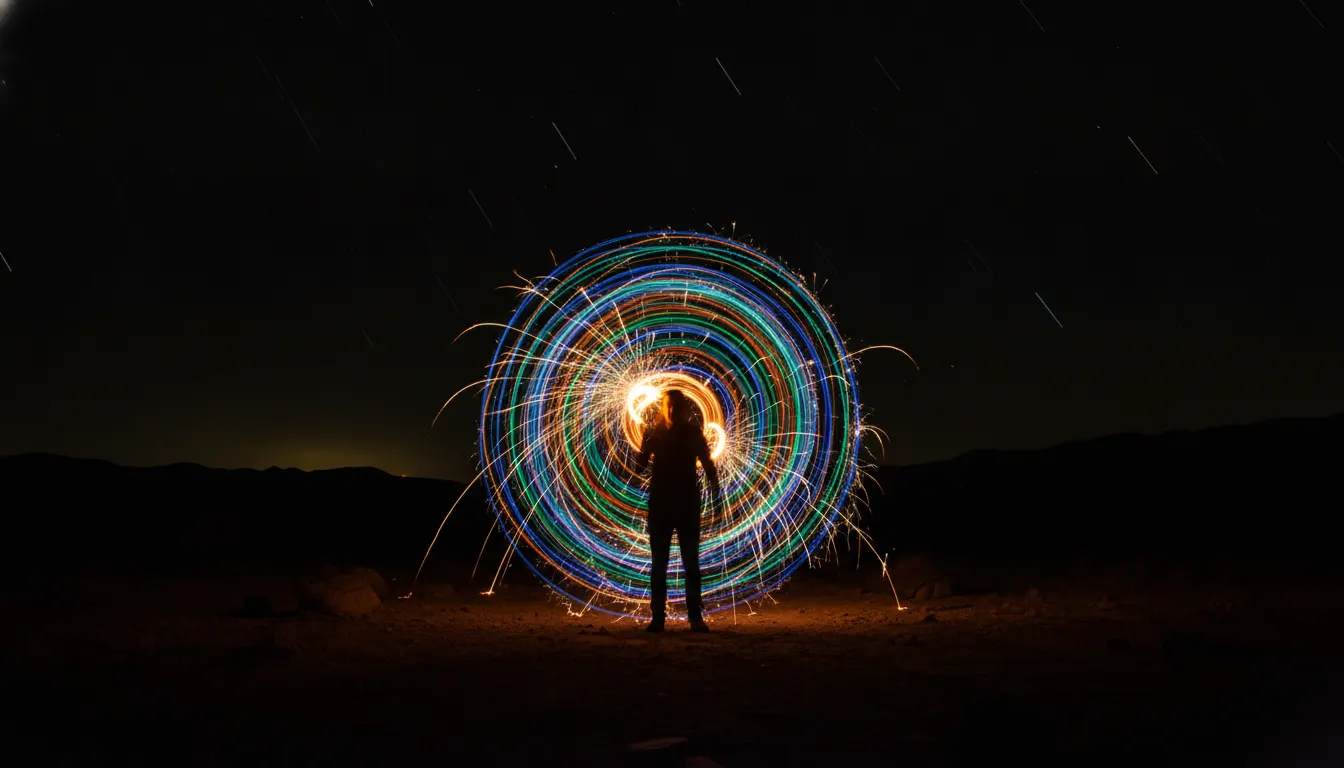
Long-exposure light-painting photograph. Camera shutter open while artist draws in the dark with handheld LEDs and sparklers, glowing line traces against deep black scene.
The moves a human crew would use to get here. Cue applies them for you, and knowing their names is how you ask for a change.
flash strobe sequence: fire strobe 3-10 times during exposure to create overlapping ghost figures across a single frame
hold LED point source and trace 3D paths through space, camera sees them as overlapping planes
rack lens focal length from telephoto to wide during exposure for starburst radiating effect
curtain sync flash: fire strobe at end of long exposure so sharp subject sits at terminus of motion trail
use a small tungsten flashlight to selectively illuminate parts of a static scene during a dark exposure
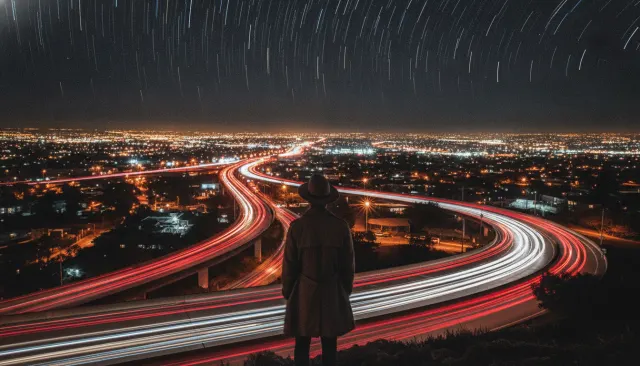
ultra-long exposure (15-120 minutes) at night to trace star paths as circular arcs around Polaris
attach lights to pendula, spirographs, or motors for Lissajous pattern generation
Light painting long exposure is the umbrella category for any photographic practice using extended shutter duration to accumulate light movement as a permanent visual record. The technique encompasses light graffiti, light trail landscapes, strobe-lit motion studies, steel-wool spinning, LED orb work, and fiber-optic brush painting - any practice where time is the axis and light is the medium.
The earliest systematic light-path photography was Etienne-Jules Marey's chronophotography (Paris, 1880s): by placing white markers on a black-suited subject and making multiple timed exposures on a single glass plate, Marey traced the exact arcs of joint movement in walking, running, and jumping. These were scientific documents before they were aesthetic objects, but their visual result - glowing white arcs and dots against a black field - established the light-on-dark vocabulary that defines the genre.
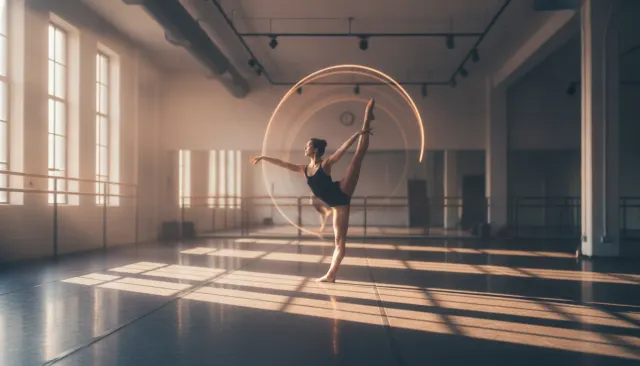
Harold Edgerton at MIT pioneered stroboscopic photography from the 1930s through the 1960s: his million-frames-per-second flash images of bullets through apples, playing cards, and milk drops, and his multi-flash exposure sequences that painted a dancer's arc as a dozen overlapping figures, were simultaneously rigorous physics and surrealist visual poetry. Edgerton's 1939 multi-flash photograph of a golfer's swing - the club rendered as a luminous blur, the golfer as a repeated ghost - is a direct ancestor of all modern motion-trace aesthetics.
Gjon Mili (Albanian-American, 1904-1984) was Edgerton's chief popularizer, taking the stroboscopic and long-exposure technique into editorial and art photography from his base at _Life Magazine_. Mili's 1949 sessions with Picasso (see the _light-painting-darkness-trail_ look) brought the technique to global cultural prominence.
Successful light painting long exposure requires control of three variables: ambient light level (must be very low), shutter duration (proportional to subject complexity), and light source characteristics (brightness, color temperature, beam angle). A single well-executed shot can require dozens of test exposures. The fundamental camera equation: exposure value = log2(N^2 / t), where N is f-number and t is time. Longer exposures at lower ISO require proportionally slower light movement to maintain even exposure across the trail.
The field divides into: (1) handheld light drawing in dark spaces; (2) environmental light trail photography (traffic, stars, fire); (3) strobe-based motion capture; and (4) projection mapping combined with long exposure for complex multi-source images.
chronophotographic motion studies, walking and bird flight (Paris, 1882-1895)
golfer's swing multi-flash photograph (MIT, 1939)
milk-drop crown stroboscopic image (MIT, 1957)
_Life Magazine_ light drawing session (Vallauris, January 1949, published 1950)
1940
_Martha Graham: Spring Primitive_ motion trace
New York long-exposure traffic light trails (1940s-1950s)
contemporary light painting masters (2010s-2020s)
A Look is not a filter. It is a set of stored decisions the pipeline reads before it makes a single frame, so two videos in the same Look actually match.