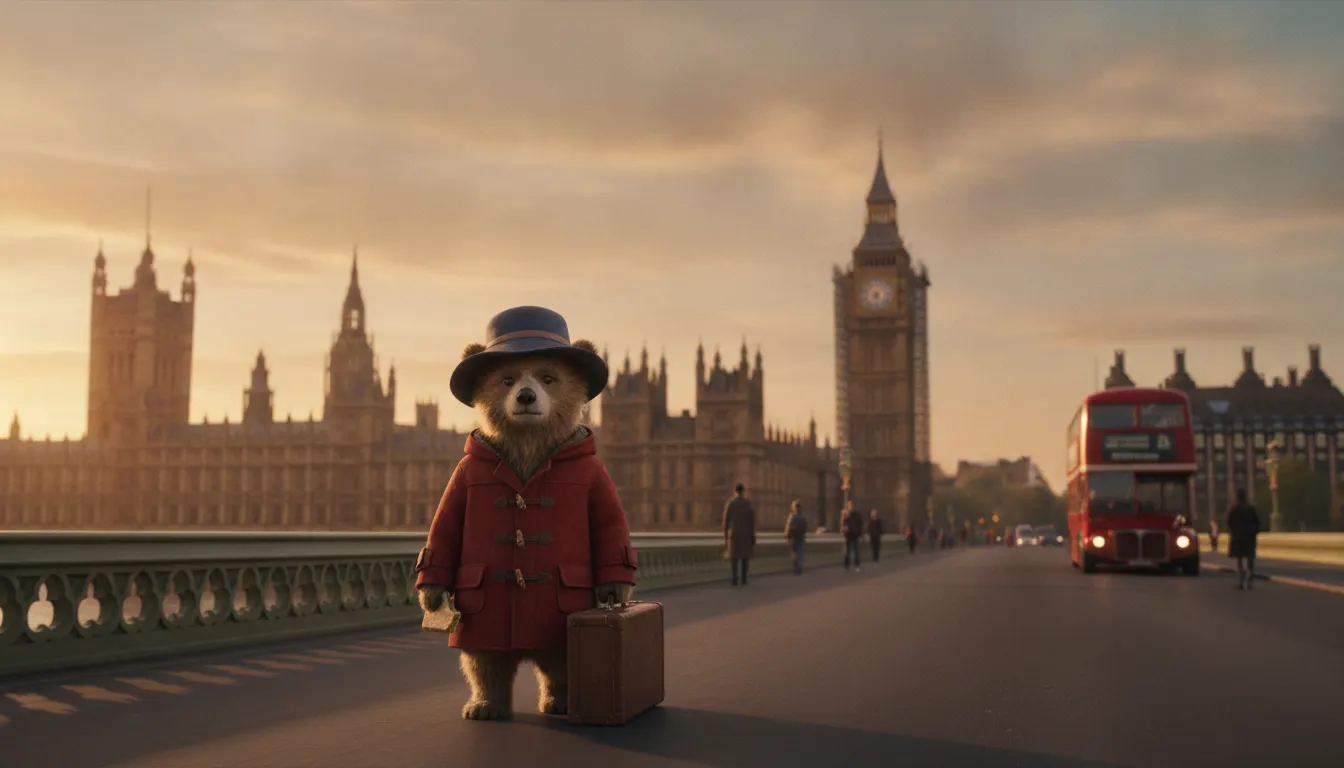
Paddington
StudioCanal / Paul King / Framestore / Christian Kaestner · 2014
Primary reference establishing the HDRI-matched CGI bear integration that set a new industry standard
Paddington CG character integration. Photoreal London with CG bear, fur simulation, marmalade-warm palette, gentle whimsy.
The moves a human crew would use to get here. Cue applies them for you, and knowing their names is how you ask for a change.
360-degree HDRI lighting capture for every exterior location, with per-frame updates for passing car reflections and sub-second ambient changes
Photogrammetry rig providing precise depth data for each set and location, enabling exact occlusion, parallax, and contact shadow relationships for the 4-foot bear
Fur displacement driven by voice performance texture: neck-raise for nervousness, compression for embarrassment, animated as a full-body emotional response system
Framestore proprietary system showing animators full-body fur displacement effects of each expression change simultaneously during blocking
Bear fur shading includes warm amber component that reads as internally warmer than ambient English winter light, making Paddington the thermally dominant element in each frame
Human cast performances to an on-set bear puppet approximation, with CGI replacement calibrated to honor every gaze, touch, and physical response in the plate photography
Locksmith Animation's Paddington film series (StudioCanal / Paul King, Paddington 2014 and Paddington 2 2017, VFX by Framestore) produced what many critics consider the finest integration of a CGI character into a live-action environment in cinema history. Paddington Bear himself -- a small bear in a duffle coat and red hat -- exists in the same frame as real London locations, real human actors, and practical set dressing with a visual coherence that routinely deceives even technically experienced viewers.
Framestore VFX supervisor Christian Kaestner's fundamental principle for Paddington was that the bear must respond to every environmental variable that a physical actor would respond to: light reflections from passing cars, sub-second lens flares from nearby windows, the specific quality of ambient fill bouncing off a cream-colored wall in a Victorian terraced house. The team built a massive environmental lighting capture system for every Paddington exterior shot -- 360-degree HDRI captures plus a 12-camera photogrammetry rig -- and matched the bear's shading model to this data frame by frame.
Paddington's fur is the primary vehicle for his emotional expression. Ben Whishaw's voice performance required the animation team to translate vocal texture into fur behavior: fur slightly raised on the neck for nervousness, fur flattened in embarrassment, the specific way bear fur compresses when sitting in a small suitcase. Framestore developed a real-time fur feedback system where animators could see how expression changes affected fur displacement across the character's entire body simultaneously.
One of Paddington's persistent visual challenges is scale: the bear is approximately 4 feet tall and must appear physically present in environments built for 6-foot adult humans. Framestore used photogrammetry depth data from each set and location to calculate exact occlusion, parallax, and contact shadow relationships, ensuring Paddington's feet cast the right shadow on the right surface texture regardless of location.
Director Paul King's brief to Framestore was explicit: Paddington must be the warmest thing in every frame. This drove color temperature decisions -- the bear's fur has a warm honey-amber component in its shading that reads as internally lit compared to the cooler ambient light of English winters.
Paddington's duffle coat and red hat are not merely costume elements but graphic anchors that solve a fundamental CG-in-live-action problem: the bear needs visual consistency across wildly varying London exterior locations. The red hat creates a color target that the eye locks onto regardless of background complexity -- a red focal point that the Framestore team could use as a compositing guide to ensure Paddington's presence read clearly against brick walls, shop windows, and tube station entrances alike. Michael Bond's original visual choices for the character, made in the 1950s, turn out to have been perfectly designed for future CGI integration requirements.
Paul King's direction of Paddington's physical comedy references the British slapstick tradition of Buster Keaton, Jacques Tati, and the Ealing comedies. Paddington's gags are built on the contrast between his sincere, careful behavior and the chaos that results -- and this comedy logic required Framestore to make Paddington's physicality extremely precise: the exact angle of his head tilt when confused, the specific rigidity of his walk when carrying a precious object, the quality of his stillness when observing. Comedy timing in CGI character work depends on being able to hit exact poses at exact frame counts, and Framestore's rig was designed with comedy precision as a primary requirement.
StudioCanal / Paul King / Framestore / Christian Kaestner · 2014
Primary reference establishing the HDRI-matched CGI bear integration that set a new industry standard
StudioCanal / Paul King / Framestore · 2017
Sequel maintaining and refining the integration approach; described by many critics as the better film and stronger visual achievement
StudioCanal / Dougal Wilson / Framestore · 2024
Third film maintaining the visual system under a new director, with South American location environments providing new integration challenges
Universal / Seth MacFarlane / Tippett Studio · 2012
Adult-comedy CGI-in-live-action bear integration providing direct comparison: similar technical challenge, radically different tone and emotional brief
New Line Cinema / Jon Favreau · 2003
Earlier family CGI-in-live-action integration demonstrating the warmth-as-design-brief approach Paddington would later refine
Jon Favreau / MPC · 2016
Contemporaneous CGI-in-live-action production demonstrating how the HDRI-matched integration approach scales from single characters to full environments
A Look is not a filter. It is a set of stored decisions the pipeline reads before it makes a single frame, so two videos in the same Look actually match.