Life of Pi
Ang Lee / Rhythm & Hues / Claudio Miranda / Bill Westenhofer · 2012
Primary reference: Academy Award Best VFX; Richard Parker widely considered the finest CGI animal performance before Jungle Book 2016
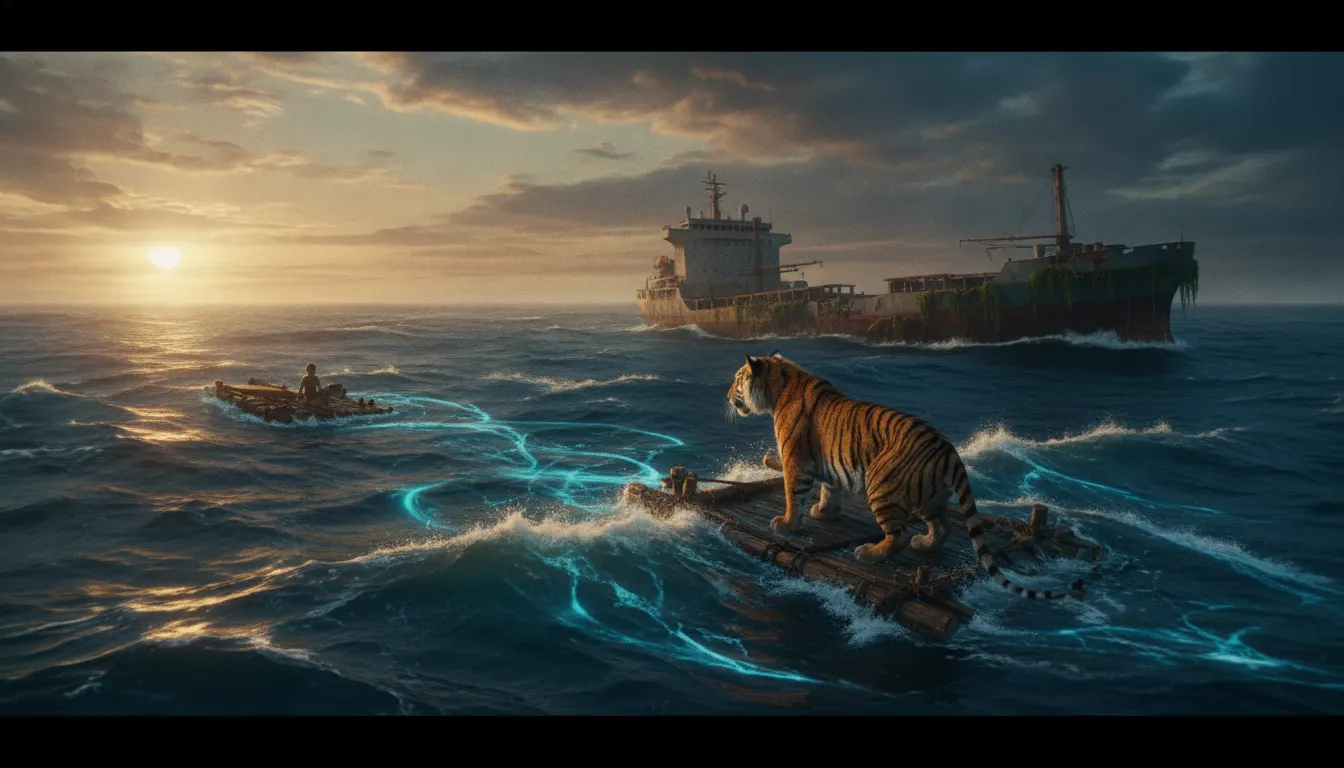
Life of Pi photoreal CG tiger. Ang Lee shipwreck-on-Pacific, Richard Parker tiger fur-simulation showcase, magical-realist ocean.
The moves a human crew would use to get here. Cue applies them for you, and knowing their names is how you ask for a change.
Individual guard hair and undercoat simulation at Rhythm & Hues scale, producing accurate Bengal tiger fur weight, drape, and pattern wrap around muscular anatomy
Physically accurate fur behavior changes between dry, damp, and soaked states for ocean sequence tiger shots, requiring separate simulation parameters per wetness level
Big cat cognitive behavior study informing blink timing, gaze duration, ear rotation sequences, and balance shifts -- biological plausibility at the micro-behavioral level
Practical actor performance against physical water, with CGI tiger composited as a response to actual human gaze and body language, maintaining performance authenticity
Claudio Miranda's CGI ocean lighting designed for cinematographic coherence across practical and digital frames, achieving Best Cinematography for sequences with no real ocean footage
Tiger stripe pattern design accounting for how markings change apparent width as they wrap around the cylindrical geometry of musculature in different contraction states
Ang Lee's Life of Pi (2012, VFX supervisor Bill Westenhofer at Rhythm & Hues, DP Claudio Miranda) won four Academy Awards including Best Cinematography and Best Visual Effects. The film's central challenge was creating a Bengal tiger (Richard Parker) that could share a lifeboat with a human actor for the majority of a two-hour film and be completely convincing as a real animal. Only two brief shots used a real tiger; the rest of Richard Parker's screen time was Rhythm & Hues CG.
Bengal tiger fur is among the most visually complex organic surfaces in nature: thousands of individual guard hairs over an undercoat layer, with pattern markings that change in width as they wrap around curved musculature. Rhythm & Hues built a custom fur simulation system for Richard Parker that handled 60 million individual hair strands per frame. The team worked with wildlife photographers' reference libraries and direct consultation with big cat specialists to calibrate the specific weight and drape of wet versus dry tiger fur across the film's ocean sequences.
The ocean sequences presented a secondary VFX challenge equal in complexity to the tiger itself: open-ocean water under varying light conditions, combined with realistic wetness on the tiger's fur when it was submerged or soaked. The production used Rhythm & Hues' proprietary fluid simulation software alongside Houdini fluid solvers to create the Pacific Ocean environment. DP Claudio Miranda's lighting designs for the ocean sequences won the Best Cinematography Oscar for shots where no practical photography of open ocean existed.
Ang Lee's direction strategy was to shoot Suraj Sharma (Pi) against physical water in practical tanks, then composite Richard Parker as a response to Sharma's real performance. The tiger had to breathe, blink, and react to Sharma's gaze in a way that was biologically plausible. Rhythm & Hues studied tiger cognitive behavior specifically: how long a Bengal looks before looking away, the specific muscle sequence of an ear rotation, the exact weight distribution when a large cat shifts balance in a rocking boat.
Richard Parker is widely considered the finest CGI animal performance before The Jungle Book (2016). Tragically, Rhythm & Hues filed for bankruptcy during the film's Oscar campaign week. Their closure marked the end of one of VFX's most innovative independent studios.
Ang Lee / Rhythm & Hues / Claudio Miranda / Bill Westenhofer · 2012
Primary reference: Academy Award Best VFX; Richard Parker widely considered the finest CGI animal performance before Jungle Book 2016
Jon Favreau / MPC / Rob Legato · 2016
Direct successor in photoreal animal CGI; MPC's Shere Khan tiger explicitly built on the Rhythm & Hues Life of Pi benchmark
Jon Favreau / MPC · 2019
Full photoreal animal cast extending the big-cat simulation approach from single character to ensemble African wildlife
BBC Natural History Unit · 2016
Documentary wildlife cinematography providing the visual standard that photoreal CGI animal work is measured against
National Geographic · 2020
Documentary reference for wild Bengal tiger behavior and environment, the type of source material used for Life of Pi's behavioral reference
Carroll Ballard / Warner Bros. · 2005
Live-action film featuring real big cat performance under similar story conditions -- single human, single large cat over extended narrative -- used as behavioral reference
A Look is not a filter. It is a set of stored decisions the pipeline reads before it makes a single frame, so two videos in the same Look actually match.